
Painting Stories Back Into the Landscape: The making of the Dowra Folklore Mural at St Hugh's National School
When the children came back
When the children of St Hugh's National School in Dowra returned to their Junior Yard after the summer holidays, something had changed. Their little covered shelter had become a world of mountains and water, moonlight and stars, ancient figures, strange creatures and stories that belong to the landscape surrounding their school.
I had spent around six quiet summer days inside that shelter, painting across roughly 13 metres of wall and then carrying the image up onto the ceiling. By the time the children came back in September, the ordinary green-and-white space they knew had disappeared beneath a night landscape of deep teal, blues, purples and soft greens.
The mural became Painting Stories Back Into the Landscape, an artist-led commission from the Board of Management of St Hugh's. It grew from a collection of local stories and folklore shared with me by the school principal, Pádraig Kenny and from the very particular geography of Dowra itself.
A village at the beginning of the Shannon
Dowra is the first village on the River Shannon, straddling the Cavan-Leitrim border where the river runs through the village. Around 12 kilometres upstream, the river rises at the Shannon Pot in County Cavan before making its way down through the valley, through Dowra and then on towards Lough Allen, the first lake on the Shannon.
St Hugh's National School sits on the Leitrim side of the village, with Lough Allen, Sliabh an Iarainn and the Arigna mountains all part of the wider landscape around it. I live here too, so these are not distant scenic references to me. These hills and water are part of my world.
From the beginning, I wanted the landscape painted inside the shelter to connect to the landscape outside. The lake, mountain ranges and river were positioned directionally in relation to the geography of the real places themselves, almost like a loose story-map wrapping around the children as they stood inside it.
The more I researched the stories that Pádraig had given me, the more I realised they were not simply stories from this area. They belonged to particular waters, islands, mountains and pieces of ground. The Shannon Pot is traditionally regarded as the source of the River Shannon, and it is also the place around which Sionann's story gathers. Lough Allen, Inishmagrath, Sliabh an Iarainn and the Black Pig's Dyke were not backdrops to the stories, they were part of them.
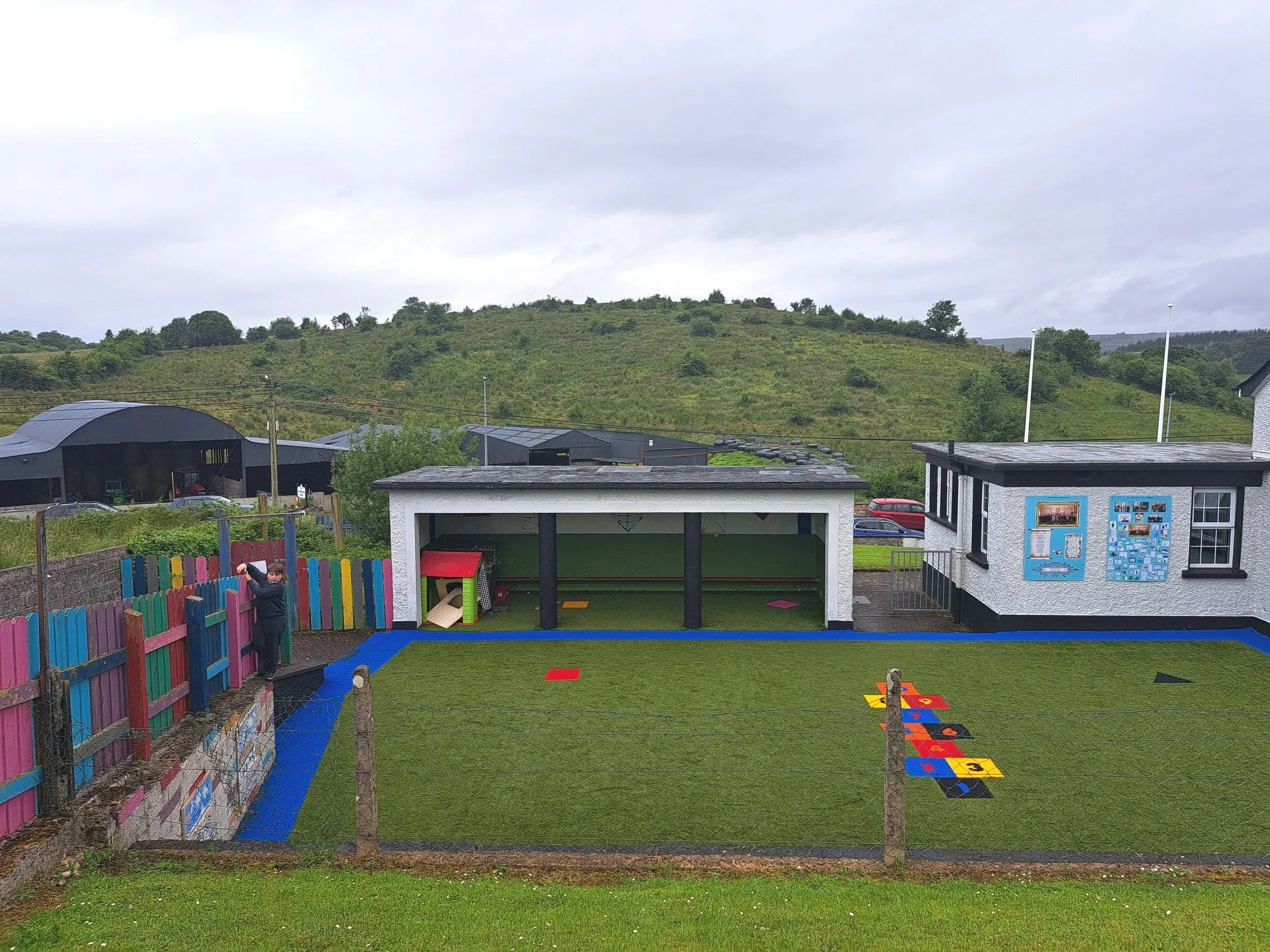
The view from St Hugh's Junior Yard, with the hill traditionally identified as part of the Black Pig's Dyke rising directly behind the shelter. The Black Pig's Dyke is the name given to a mysterious group of ancient earthworks and associated landscape features extending across nine Irish counties. At Dowra, a section traditionally identified with the Dyke runs from the village towards Lough Allen.
Where the stories meet the landscape
The early design had to do several things at once. I wanted the mural to feel magical and full of narrative, but I also wanted the stories to sit within one continuous landscape rather than becoming a row of separate illustrations.
I worked from reference photographs of the surrounding hills, including Arigna and Sliabh an Iarainn, and began building a long composition in which the river and lake could move through the different scenes. Sionann and the birth of the Shannon sit to one side, the Black Pig drives through the centre, Saint Hugh appears over Inishmagrath, Gobán Saor works at his forge and overhead, the Tuatha Dé Danann arrive through a mist above Sliabh an Iarainn.
The first design sketch needed to give me a clear direction without becoming too prescriptive. I wanted something I could anchor the composition to, while still leaving enough space for the way I naturally work and for the play and unexpected decisions that happen once I begin painting. I needed to understand how all of those parts would meet at the corners of the shelter, how the figures would sit against the architecture and how the ceiling could become part of the same world.
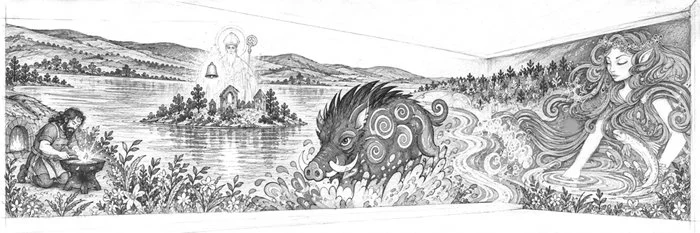
Early design sketch exploring how the landscape, characters and folklore might come together within the mural.
Before the magic came the scraping
The romantic part came later. The first full day was almost entirely preparation.
The Junior Yard is covered in AstroTurf, which immediately made protecting the floor more awkward than I had expected. The sticky-backed floor protection I brought did not really want to stick to it and even the two large dust sheets I had with me did not cover the whole shelter. Because I was working alone, I spent a lot of the day moving them around after myself as I worked from one area to the next.
The walls were in rough condition too. There was loose paint to scrape away and a series of strange AstroTurf-coloured shapes fixed directly to the wall with thick grey adhesive. I think they had originally been intended as some kind of sensory feature, but by then they were covered in cobwebs and grime and definitely needed to go. Some took around twenty minutes each to remove. After a while I was going slightly spare.
I had thought a power washer might make the job easier, but there was a hosepipe ban at the time and there was no power washer there anyway. At a certain point I stopped trying to solve the entire shelter in my head and just told myself: keep going.
Eventually the walls, ceiling and built-in bench were clean and stable enough to prime. The shelter took around 10 litres of primer overall before I could start sketching up the design.
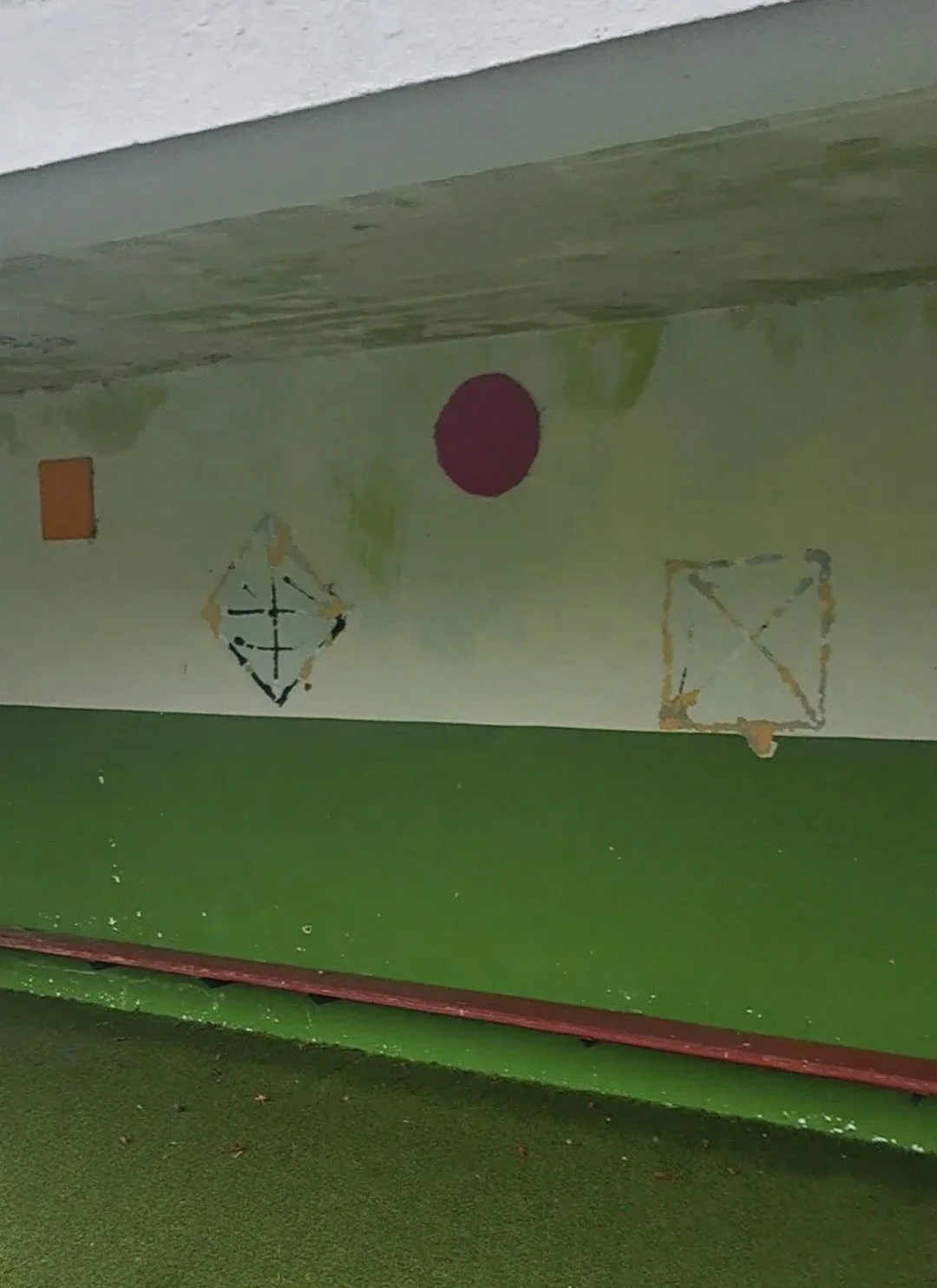
Inside the Junior Yard shelter before preparation began, showing the condition of the walls and some of the old sensory shapes that had to be removed.
Painting the night
I knew before I started that I wanted this mural to take place at night. The stories had too much magic in them for a bright daytime landscape. I wanted the shelter to feel atmospheric and slightly otherworldly, somewhere familiar had shifted into another version of itself.
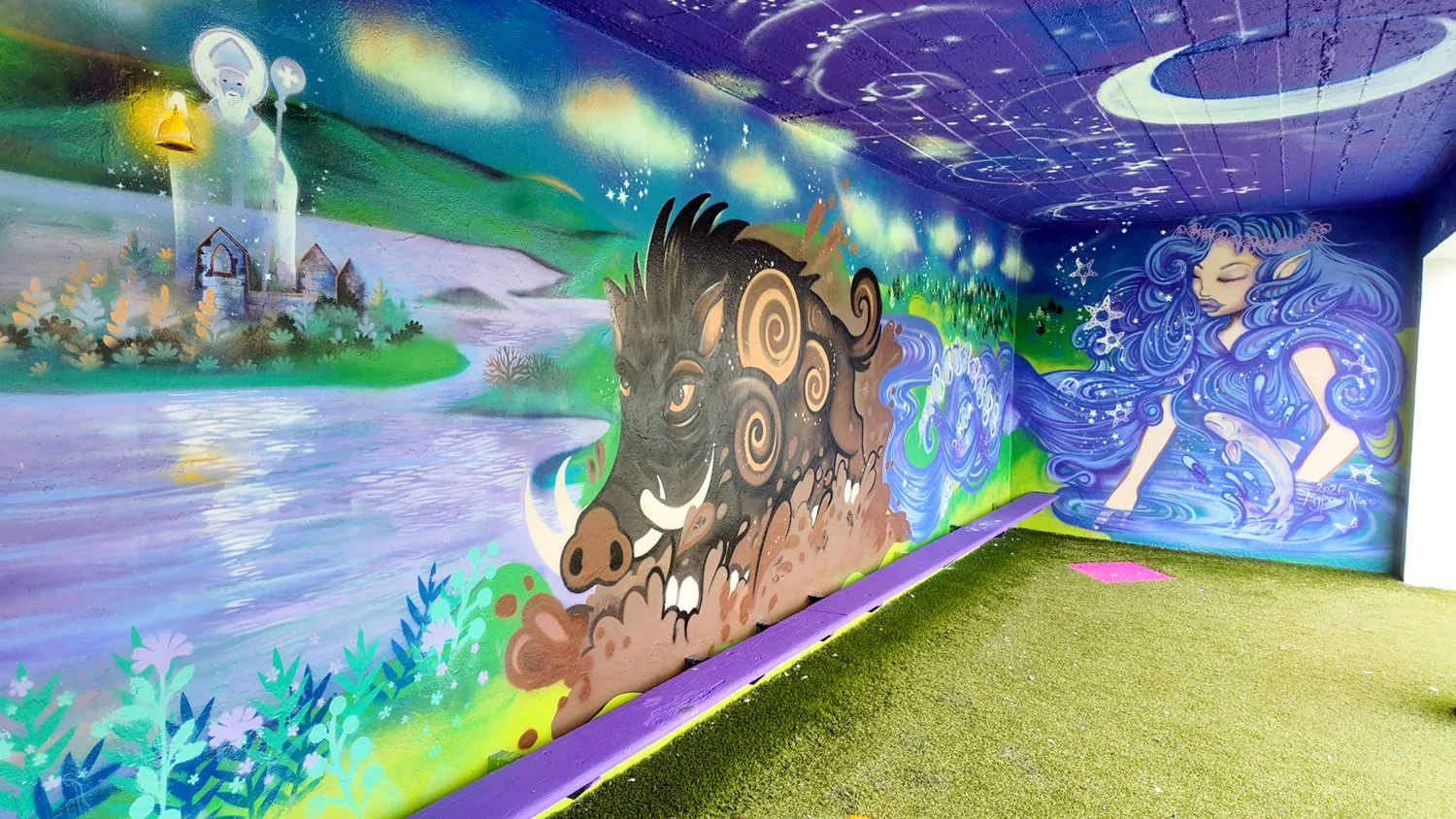
I used exterior masonry paint in a mix of deep teal and purple across the shelter, then built the landscape over it with spray paint and hand-painted detail in acrylic. The ceiling became a night sky of stars, a crescent moon and swirling celestial marks. The clouds are a mint, almost white-green, with darker shadows moving through them.
Lough Allen became one of my favourite parts to paint. I made a special ripple stencil and, rather than holding it in one fixed position, dragged it along the wall as I sprayed. That created long shimmery wave patterns which move across the lake instead of repeating as obvious separate stencil marks.
The water still became an important way of connecting the different parts of the mural. The young Shannon moves out from Sionann, while Lough Allen opens across the other side of the shelter, helping the different stories sit within one continuous landscape.
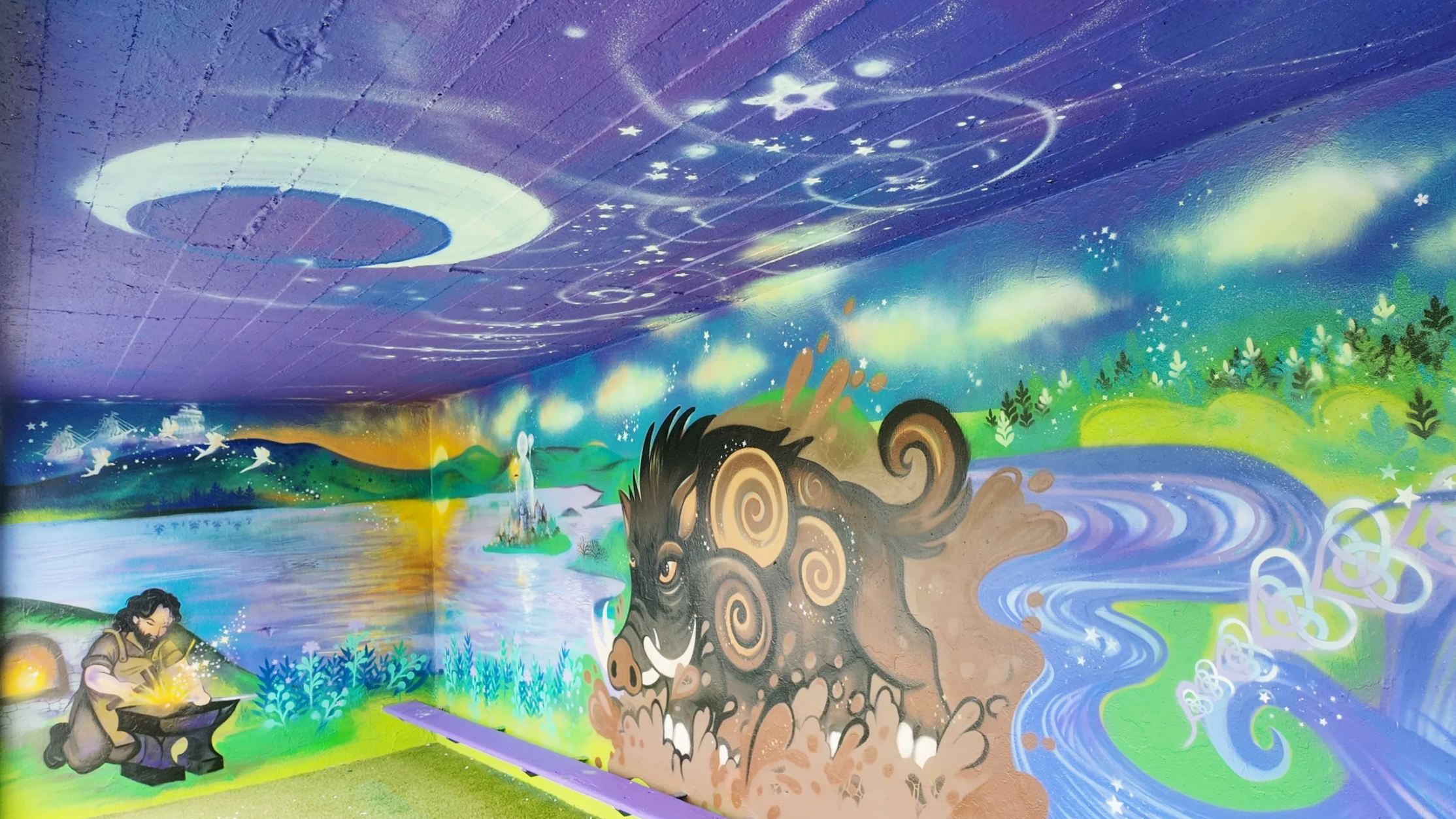
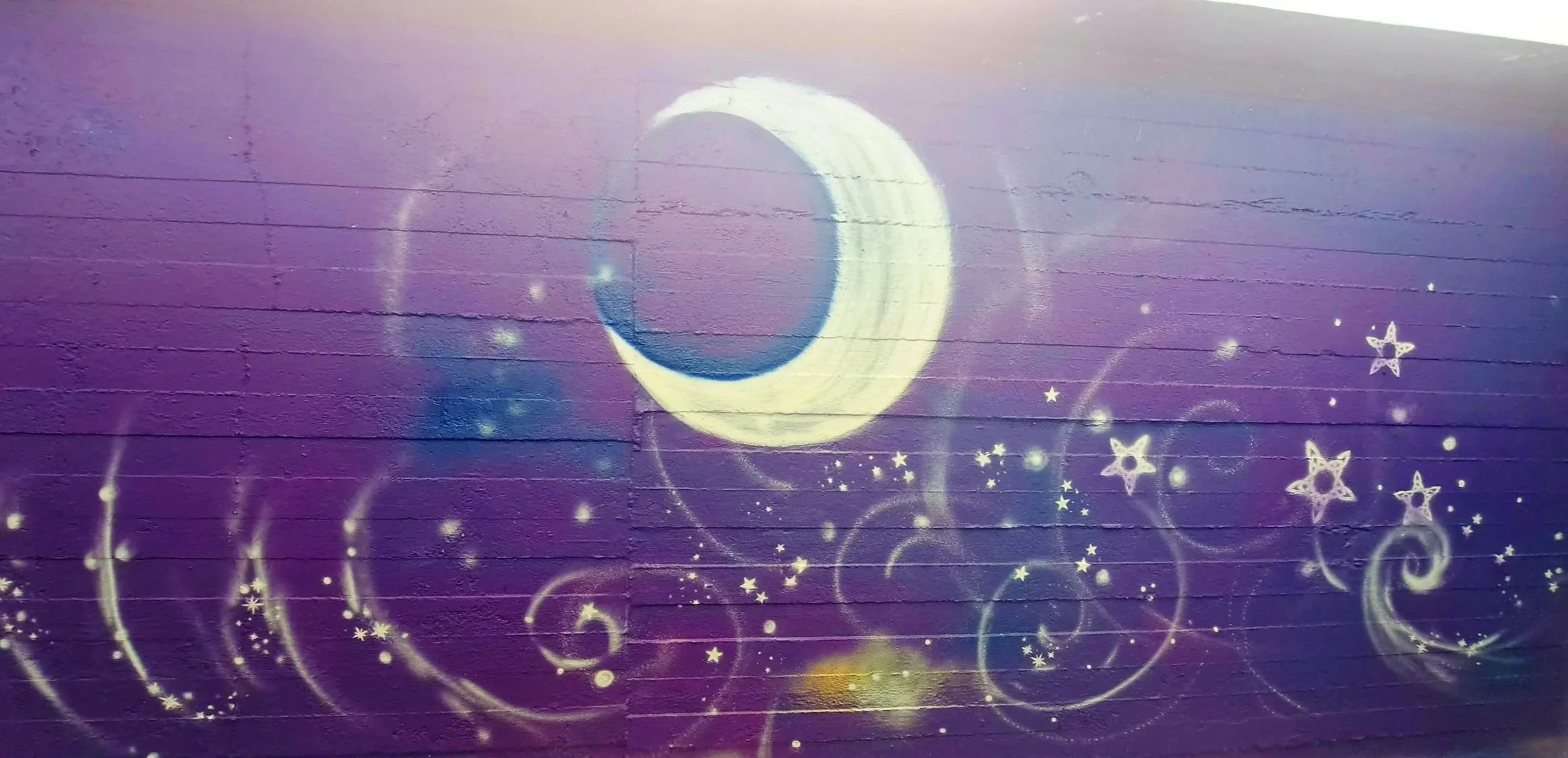
Left: Lough Allen flowing through the mural, with shimmery ripples created using a moving stencil. Right: the night sky continuing overhead, with a huge crescent moon, stars and swirling celestial details.
Sionann and the birth of the Shannon
Because Dowra is the first village on the Shannon, Sionann felt like an essential part of the mural.
There are different tellings of her story. In one local version preserved in the Dúchas - National Folklore Collection, Sionann seeks knowledge at a sacred well, catches and tastes the salmon associated with that wisdom and is then overtaken by the water as it bursts from the well and becomes the great river that carries her name. Other versions shift the details around the well, hazelnuts, bubbles and the Salmon of Knowledge.
I did not want to make the mural about choosing one supposedly definitive version. What interested me was the recurring image of a woman seeking knowledge and becoming inseparable from the river that begins here.
The full story is also a bleak one and this mural was being made for a primary school yard. I intentionally left Sionann's death out of the painted scene. Instead, I tried to suggest transformation. Her hair is blue and begins to turn into the river itself, flowing out from her body and into the water around her.
I tend to draw women in a stylized way, so I used repeating Celtic knotwork and decorative details through her hair, jewellery and the water around her to pull my own character style further into a Celtic fae world. The knotwork is decoration rather than a coded symbol, but it helps her feel as though she belongs to this particular story and place.
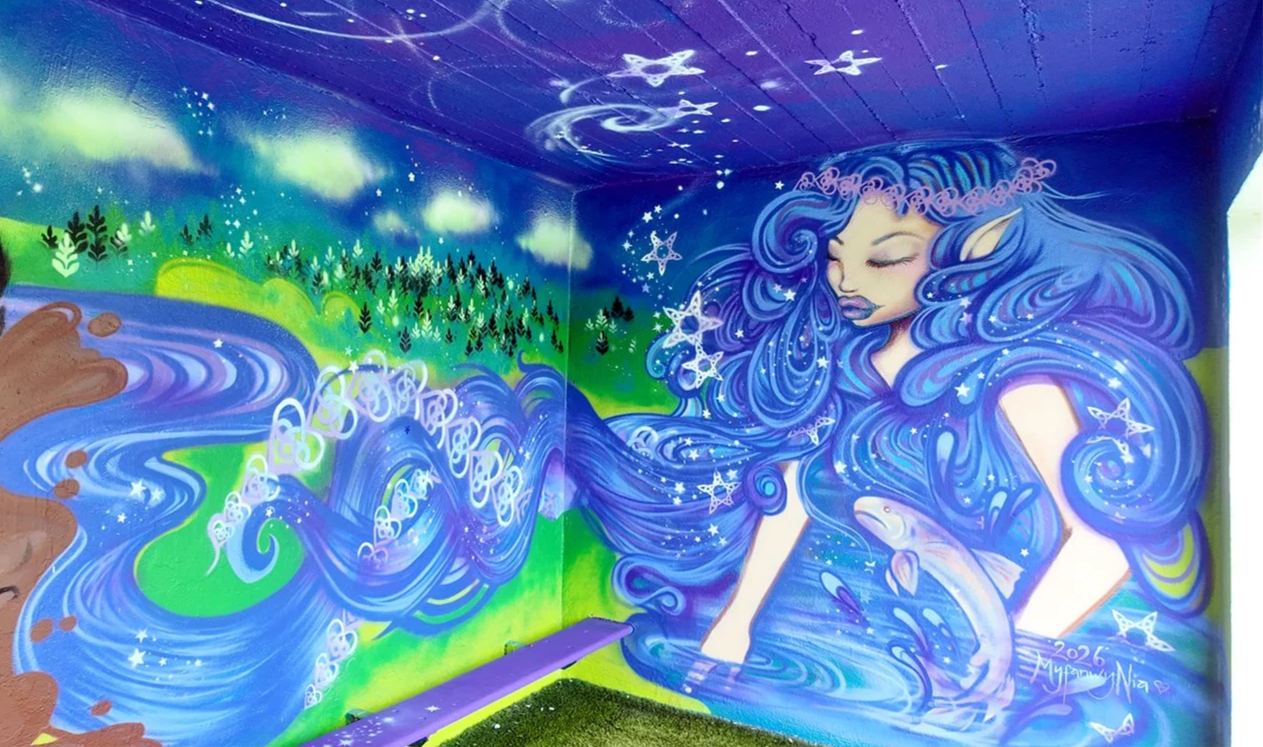
Sionann, her blue hair becoming the River Shannon. Heart motifs are intertwined through the Celtic-inspired knotwork, connecting ideas of femininity, love, birth and creation within the story.
The Black Pig's Dyke
The Black Pig's Dyke is one of those places where archaeology and folklore sit side by side, but don't always tell the same story.
The name is given to a series of banks, ditches and other landscape features found across the north midlands and south Ulster, rather than one continuous earthwork. Some of the surviving sections have been dated to the Iron Age, but archaeologists are still uncertain about how the different sites relate to one another or what they were originally built for. The feature traditionally identified with the Dyke at Dowra is particularly interesting, as archaeological research suggests that it may actually be a natural formation rather than a man-made earthwork. Black Pig's Dyke
Local folklore, however, gives the landscape a much more dramatic origin: a gigantic black boar tearing through the land, its tusks carving the great dyke behind it.
For the mural I followed the story rather than trying to make the animal naturalistic. The boar charges through the centre of the shelter, oversized and almost creature-like, with large Celtic spirals across his body. I wanted him to feel like something from a folk tale rather than simply a wild pig that had stampeded into the scene.
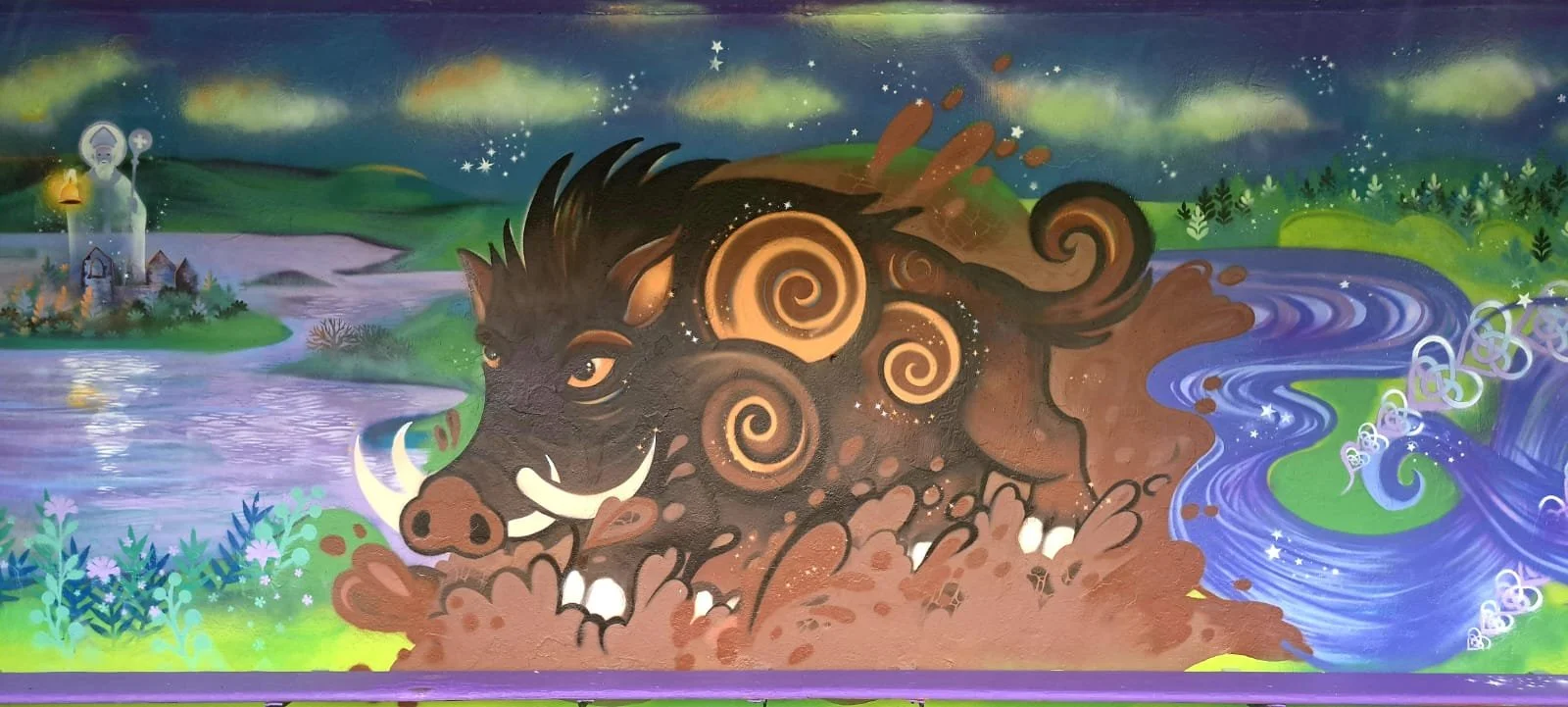
The Black Pig's Dyke, imagined through local folklore as a gigantic black boar tearing through the landscape, its tusks carving the dyke behind it.
Saint Hugh and Inishmagrath
Further across the mural, the water opens out towards Lough Allen and Inishmagrath.
Local tradition connects Saint Hugh, or Beo-Aodh, with an early church on Inishmagrath Island. One of the stories Pádraig shared with me also spoke of Saint Hugh's bell and its healing powers.
I painted the island low in the water, with the church ruins tucked into the landscape, while Saint Hugh appears above them almost like a memory. He is deliberately pale and translucent against the night landscape, with the bell glowing beside him.
I liked that this part of the mural could feel quieter. After the movement of the boar and the river, his pale apparition appears over the lake.
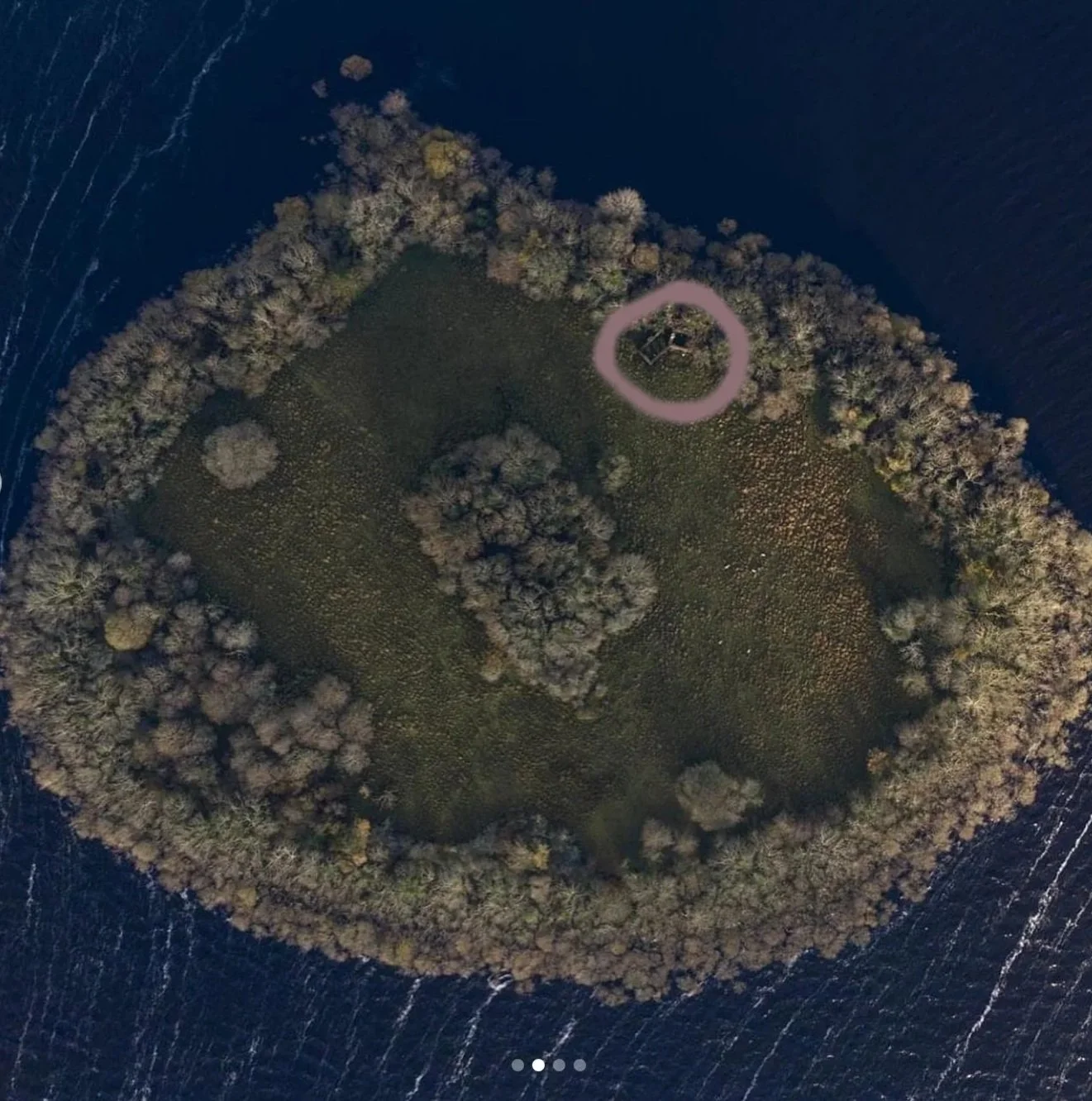
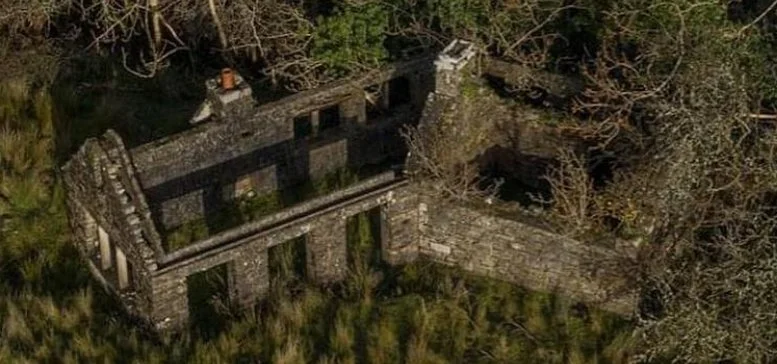
Inishmagrath Island on Lough Allen, with the church ruins visible among the trees.
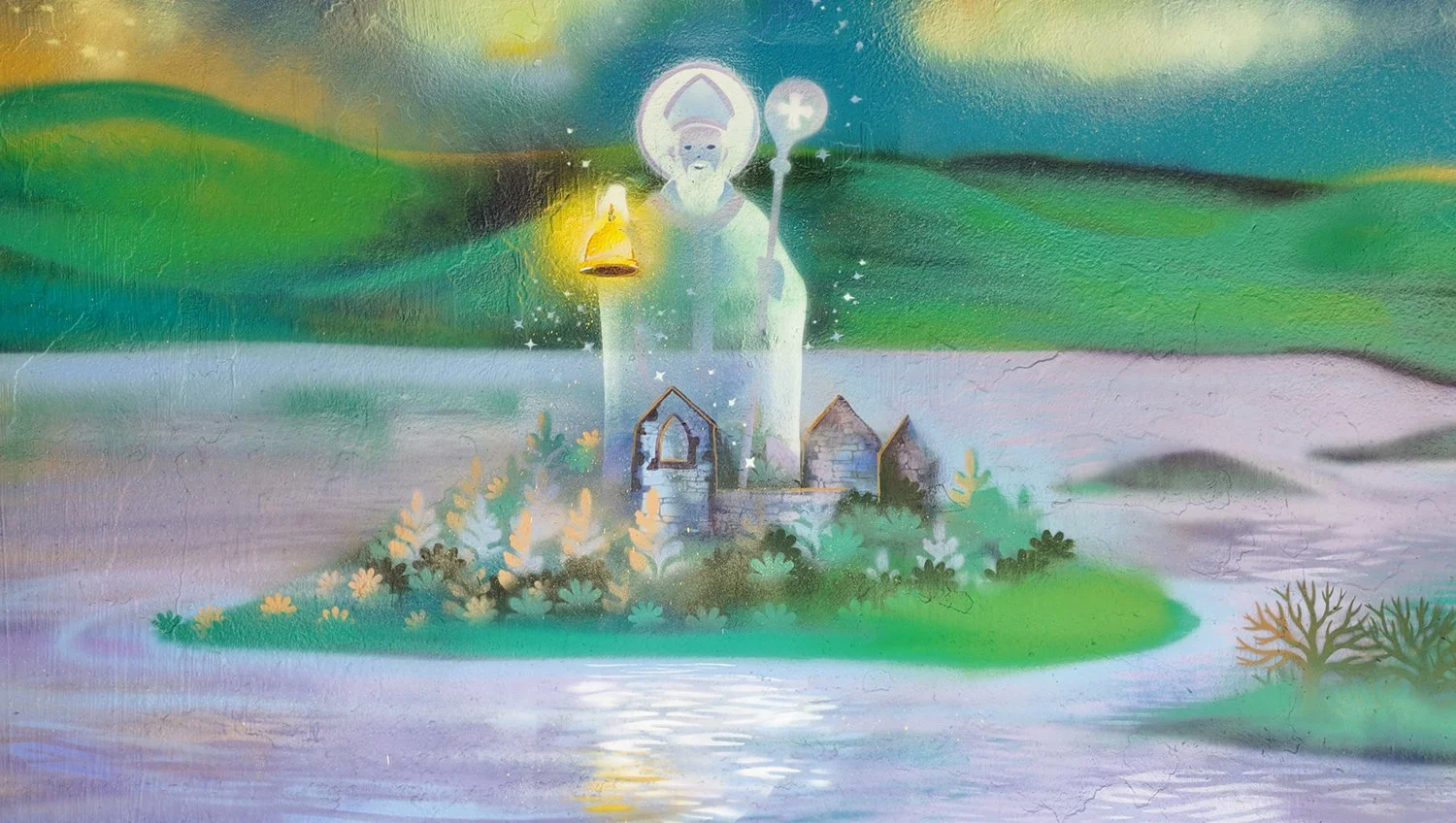
My interpretation of Inishmagrath, with Saint Hugh appearing above the island like a memory, his healing bell glowing beside him.
Gobán Saor and the Iron Mountain
Sliabh an Iarainn literally carries iron in its name and the mountain has long been associated locally with iron working and with stories of Gobán Saor, the legendary master craftsman and builder.
In the Dúchas Schools' Collection there is local Leitrim folklore describing Gobán Saor coming to Sliabh an Iarainn and making use of the iron he found there. That was enough to give me the image I wanted.
I placed his forge into the mountainside itself. Rather than treating him as a historical portrait, I painted him as a maker inside the mountain, bent over his work as bright sparks fly from the forge. The sparks push the scene back towards magic again, somewhere between a forge, a workshop and a little pocket of the mountain coming alive.
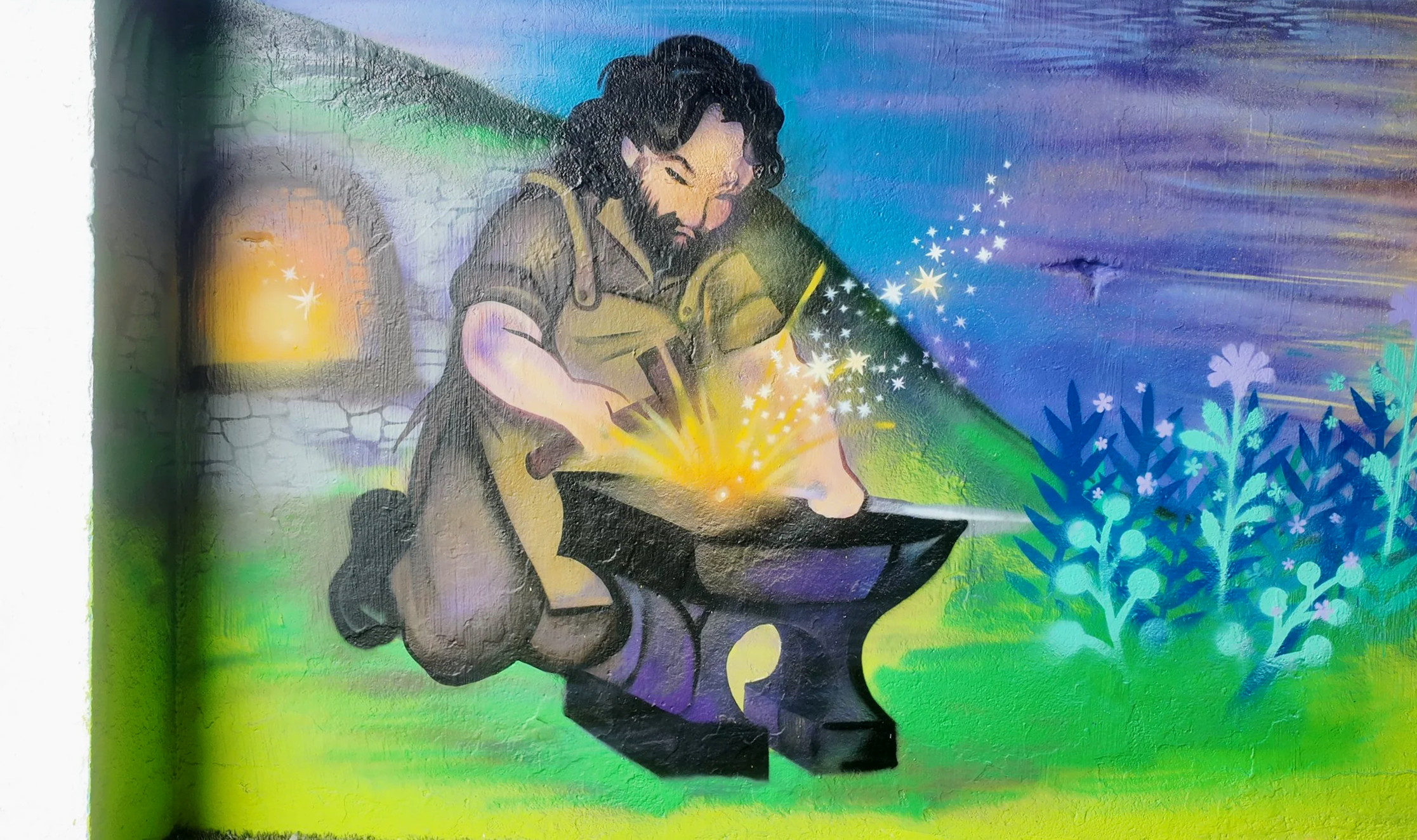
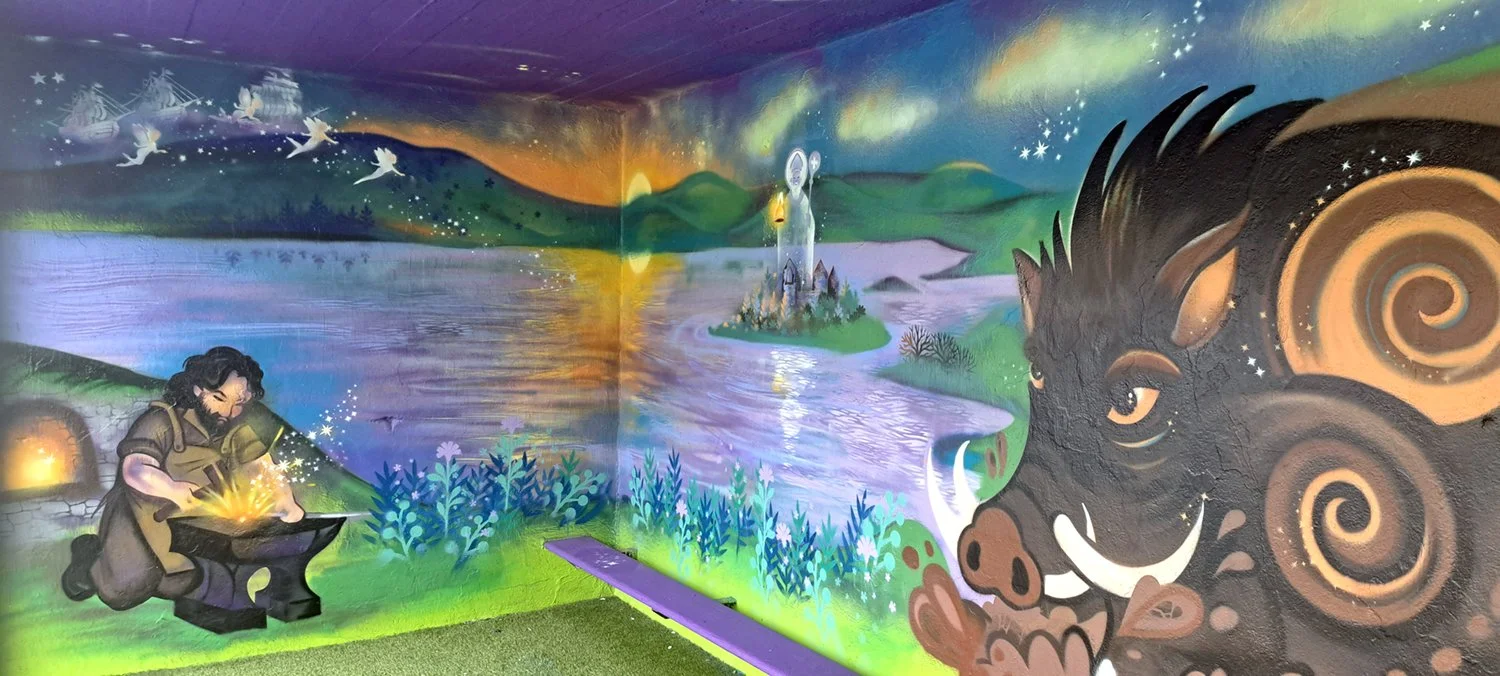
Gobán Saor working at his forge within Sliabh an Iarainn, with sparks of iron and magic flying from his work.
Ships in the mist: the Tuatha Dé Danann
The Tuatha Dé Danann gave me one of the most enjoyable parts of the mural to interpret.
Older written accounts describe them concealing themselves in druidic mist before reaching Sliabh an Iarainn. Some modern retellings describe flying ships in dark clouds and from there people have produced all sorts of alien theories.
That was not the image I wanted at all. I imagined them much more romantically: tall ships glowing with magical energy as they sailed through the night above the mountain, almost as though they were appearing out of the mist itself. They are small within the scale of the mural, almost something the children might notice after they had already looked at it several times.
I painted little fairies moving alongside them like guides, pulling the arrival into my own visual world. The ships, fairy figures flow with stars that continue onto the ceiling so the story is not confined to the wall in front of you. You have to look up.
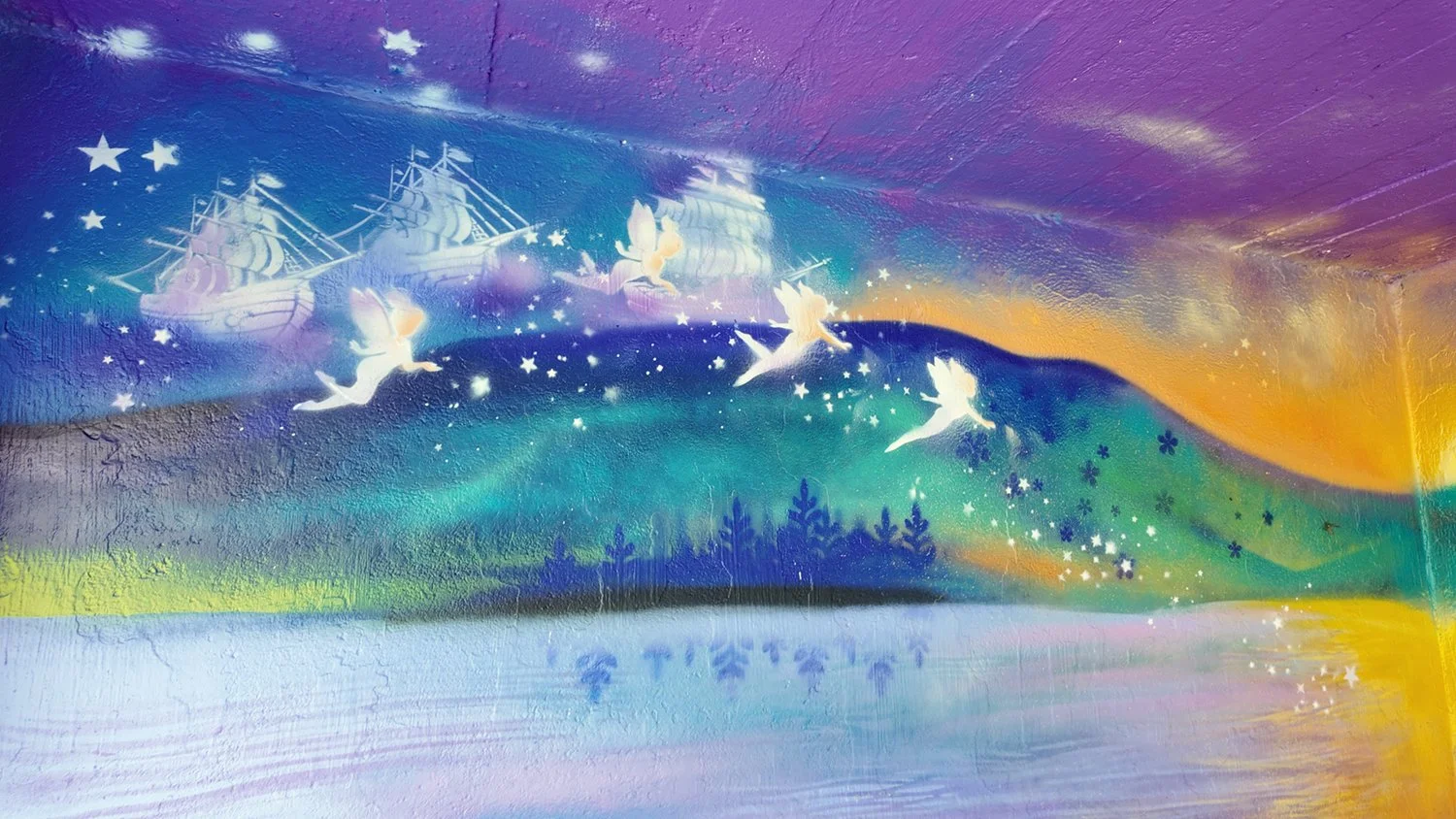
The Tuatha Dé Danann arriving above Sliabh an Iarainn, imagined as glowing tall ships emerging through the mist, surrounded by magical energy and guided by fairies.
A mural you have to stand inside
One of the reasons I enjoyed this commission so much was the shape of the space itself.
The shelter is not a flat wall that can be understood from one photograph. The image wraps around three sides, moves through the corners and continues over the ceiling. You have to stand inside it and turn around to find all the parts.
Painting the mural at night made even more sense because of the shelter itself. You can step in from a bright daytime playground and suddenly find yourself in a darker, cosier space, with a night sky overhead. I loved imagining the games children might play in there, and how easily that little shift from day outside to night inside could bend reality within their imaginary play.
That is also why the river became so useful compositionally. It could travel. It carries the eye from Sionann through the water towards the Black Pig, past the island and the forge, while the night sky and the Tuatha Dé Danann pull the painting upwards.
By the end, the little shelter felt less like somewhere a mural had been added and more like the inside of a storybook.
A closer look at the finished mural, moving through the landscape, characters and stories painted across the shelter walls.
Painting close to home
This commission was particularly special to me because St Hugh's is our local school and both my sons have attended it.
I loved those quiet summer days working there when the yard was empty. Even when the preparation was fighting me, there was something lovely about knowing exactly what the space would become again in September: noisy, busy and full of children.
When I finally finished, I was looking at the same local landscape I had been painting all week. The real hills were outside the shelter. The young Shannon was moving through the village. Lough Allen was just beyond it. The stories were never somewhere far away.
They were already here.
And when the children came back after the summer, all of those old stories were there waiting for them.
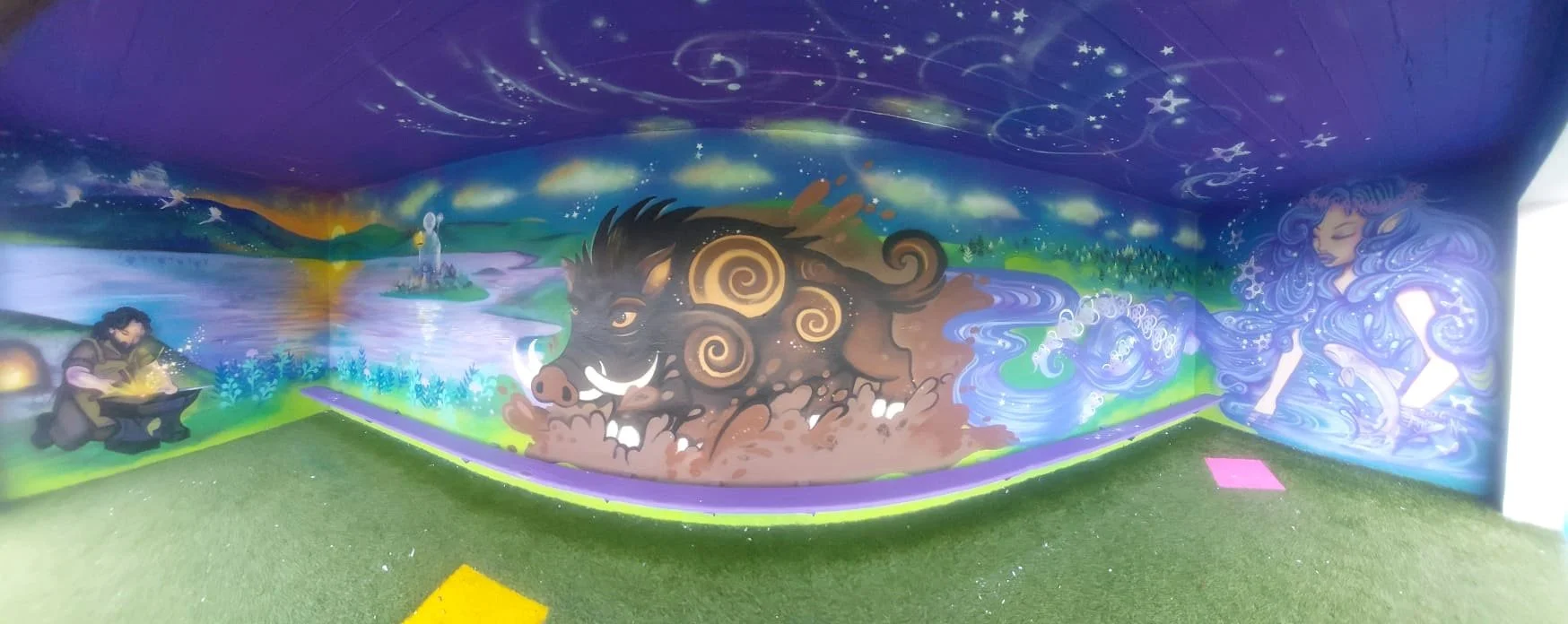
A 360° view inside the finished Junior Yard mural. Photo: Jess Johnson.
A huge thank you to Pádraig Kenny and the Board of Management of St Hugh's National School for trusting me with the commission and for giving me the space to spend a summer painting these stories back into the landscape.
fin
Project details
Project: Painting Stories Back Into the Landscape - Dowra Folklore Mural
Location: St Hugh's National School, Dowra, Co. Leitrim
Date: August 2026
Commission: Board of Management, St Hugh's National School
Artist: Harriet Myfanwy Nia Tahany / MyfanwyNia
Scale: Approximately 13 metres of wall, continuing across the ceiling of the Junior Yard shelter
Themes: Dowra, River Shannon, Shannon Pot, Lough Allen, Sliabh an Iarainn, local folklore and Irish mythology