
Street to Studio: Minaw at Flux Gallery Dublin 2025
Opening night
It had been a while since I had made paintings on canvas at this scale.
I love painting, but over the last few years my small sketchbook illustrations have naturally lent themselves particularly well to the product side of my practice, while murals have given me another way to work large. Painting on canvas occupies a slightly different space for me. It asks me to slow down, stay with an image for longer and reconnect with the Fine Art side of my practice.
So when we began planning Street to Studio, Minaw Collective’s new exhibition at Flux Gallery in Dublin, I knew I wanted to use it as an opportunity to make two substantial new paintings.
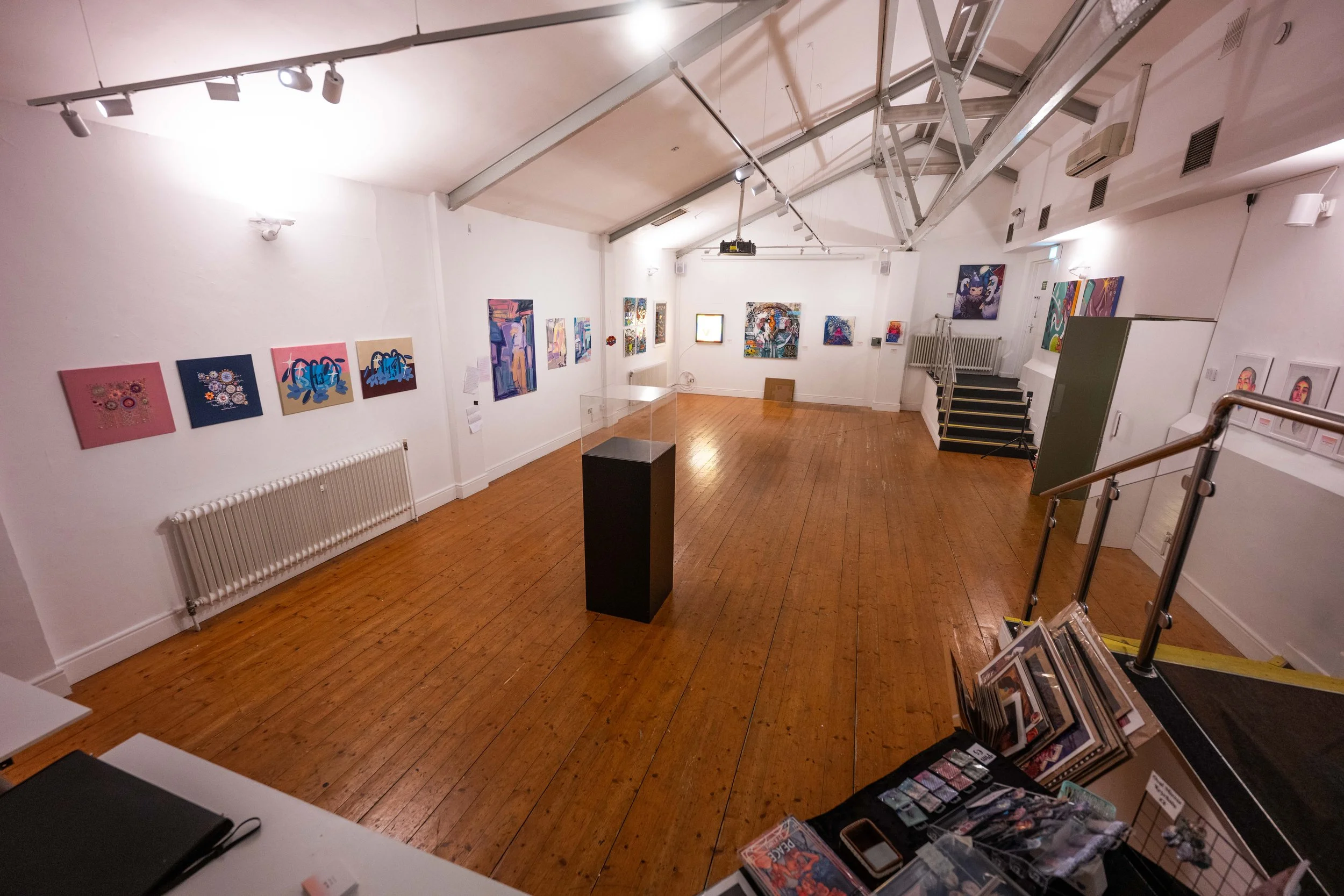
The exhibition brought together thirteen members of Minaw and explored the relationship between our public mural practices and the work we make more privately in our studios, moving from large-scale walls into painting, drawing, textiles, glass, sculpture and mixed media within the gallery.
For me, though, it didn’t feel so much like moving from one world into another.
It felt like bringing several parts of my practice together.
Nazar
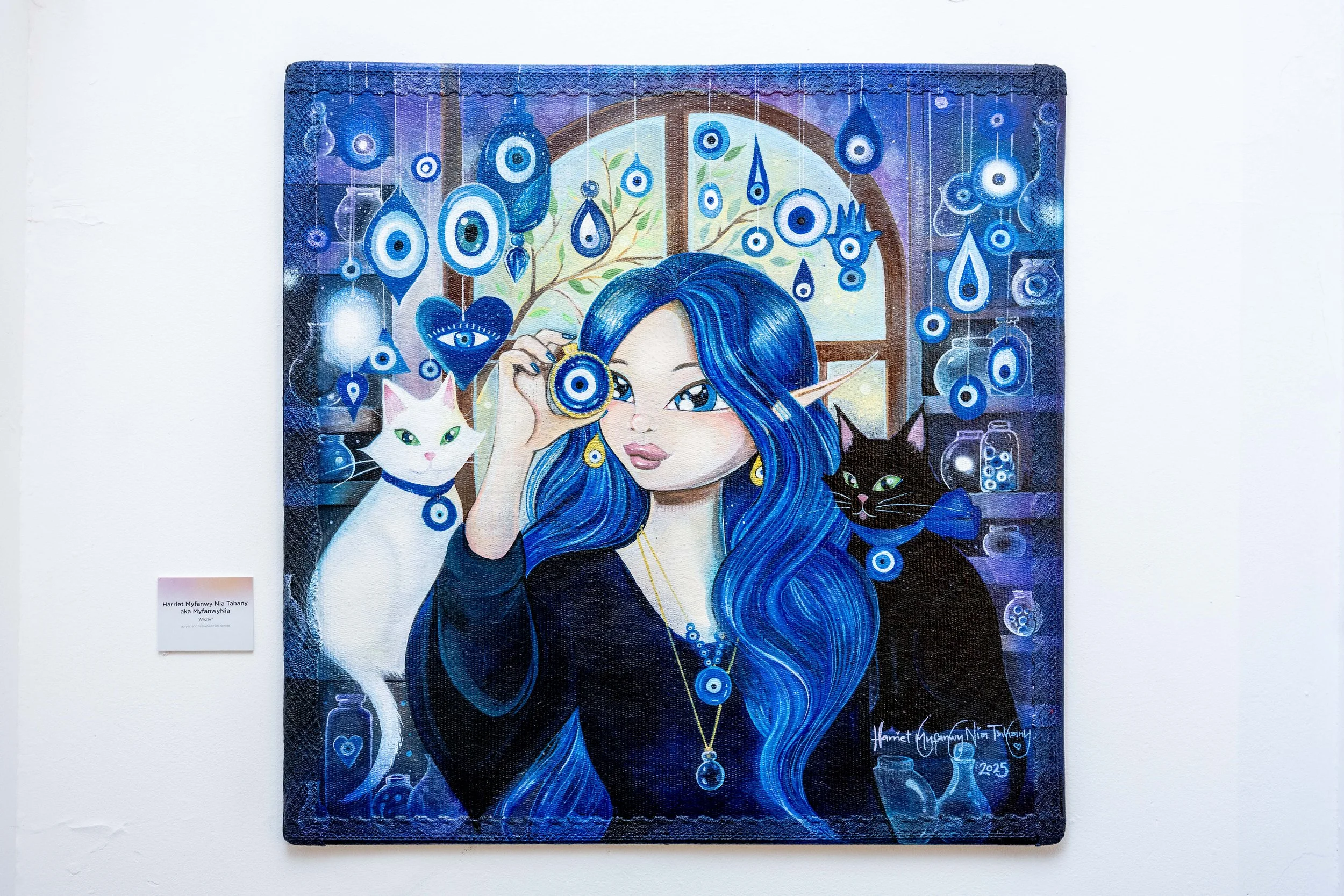
Nazar is acrylic and spray paint on canvas and cotton lace, measuring 130 × 130 cm.
The canvas is stretched over board, which has become a surface I really love working on. It has the texture and tooth of canvas but the solidity of a panel, so I can lean into strong illustrative graphics at a much larger scale. The cotton lace created a tactile border which I sealed onto the canvas with the primer.
This kind of painting allows me to channel the Pop Surrealist side of my practice while still enjoying the physicality of painting.
I worked with acrylic alongside spray paint, bringing a material I use regularly in mural painting back into the studio. Spray paint gives me textures, softness, gradients and effects that I simply can’t achieve in quite the same way with a brush, while acrylic lets me come back in slowly, building detail and sharpening the image.
That meeting point between the two processes feels very natural to me.
Nazar grew from ideas around protection, the gaze and the ancient language of talismans.
The Nazar, or evil eye, is a protective motif found across cultures and carried for generations in the form of charms and amulets. I was particularly interested in the watchful eye not as a symbol of fear, but of awareness and care, something that watches over, guards quietly and keeps what is precious safe.
The repeated eyes, cats, lace and talismanic objects gather around the central figure almost like a protective little universe of their own, a safe space, with the figure both collector and keeper of these protective treasures.
Night Circus
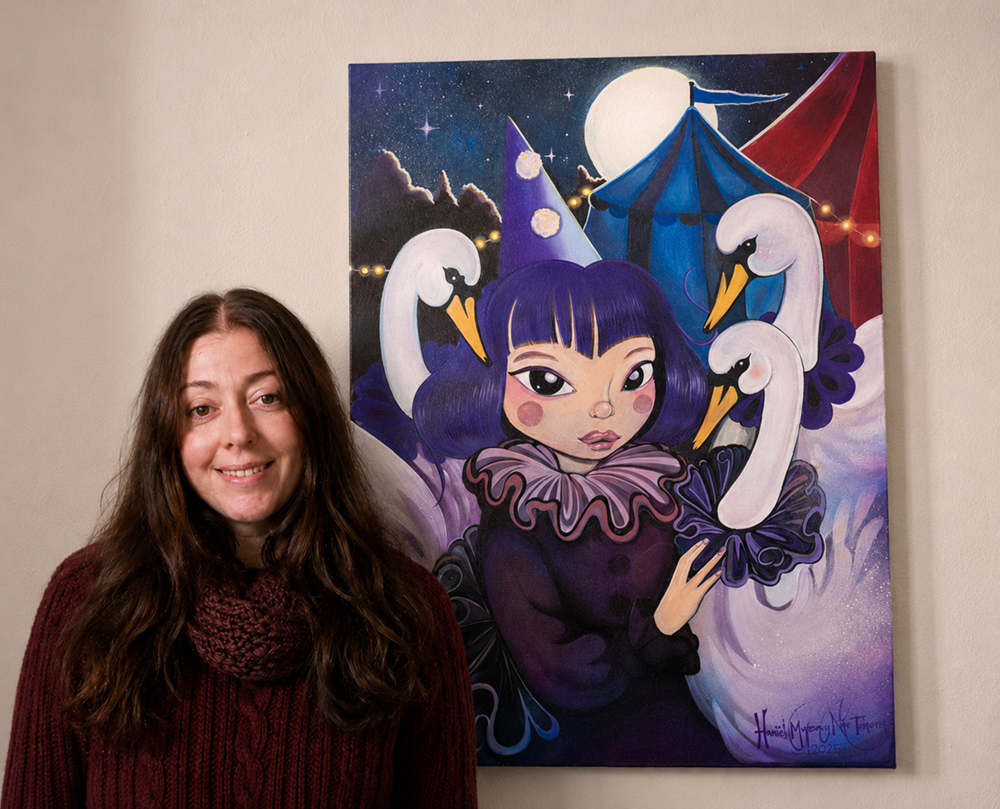
My second painting, Night Circus, took me somewhere quite different.
At 130 × 170 cm, it is larger than Nazar, painted in acrylic and spray paint on stretched canvas.
The surface has a different quality to the canvas-over-board of Nazar. It is softer and more yielding, and I think the painting itself became softer and stranger with it.
I was drawing from circus and festival imagery, with elements of clowncore and that peculiar atmosphere that surrounds spectacle after dark.
The figure sits among three enormous swans, odd, beautiful, slightly uncanny companions whose exaggerated scale moves them away from ordinary birds and into something more dreamlike.
There is performance in the painting, but I was interested in the quieter space around performance too: the moment when the crowds have left, the noise has faded and something more honest and emotional remains.
The circus becomes less a spectacle and more a strange little world inhabited by the figure and her oversized swan companions beneath the moonlight.
Making both paintings reminded me how much I enjoy working at this scale.
There is something very different about standing physically in front of a large canvas, moving around it and gradually watching an image develop. Murals give me that sense of physical scale too, but canvas allows me to stay with the work in another way, returning, adjusting, layering and letting it change slowly.
From the studio to Flux
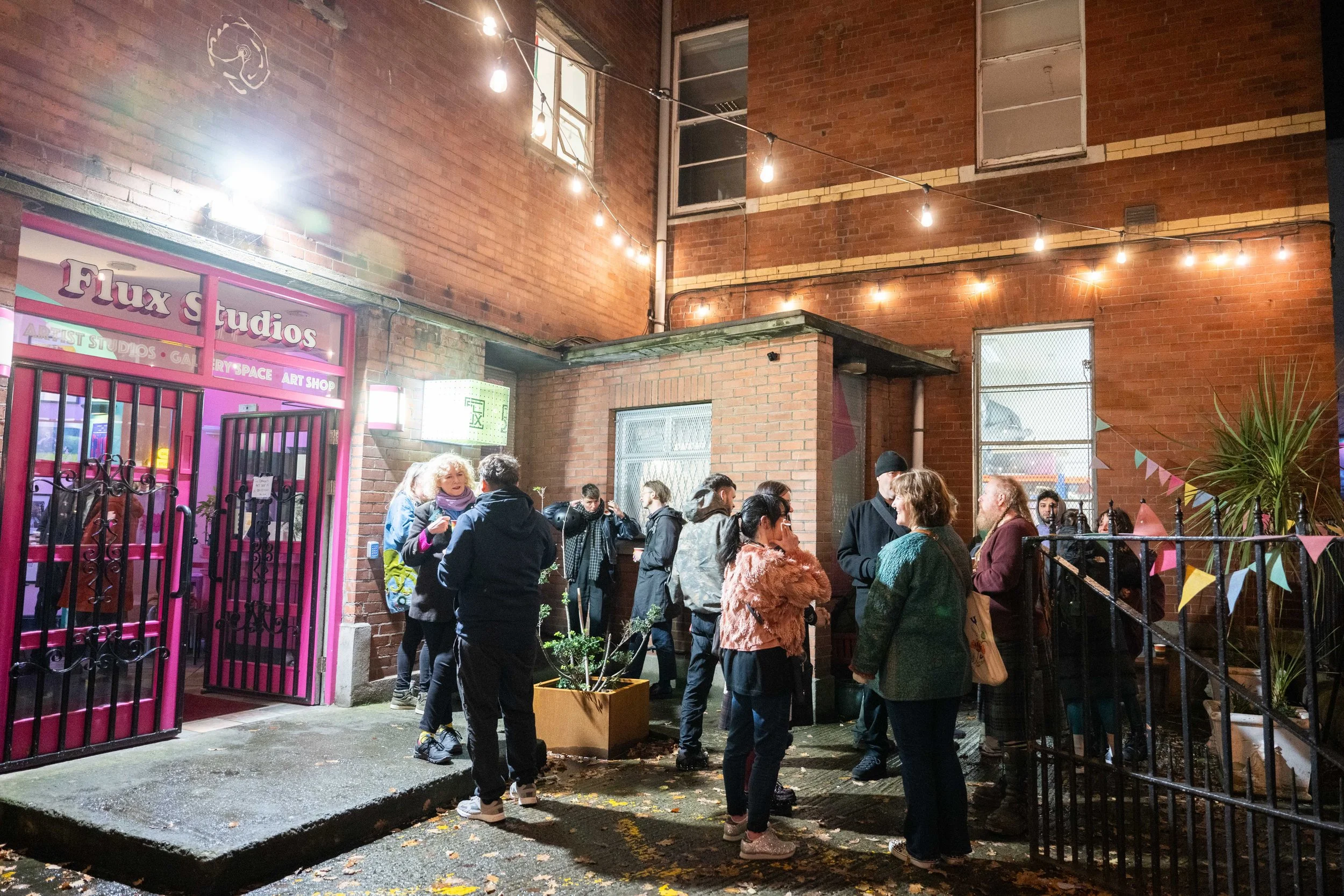
Street to Studio ran from 27–30 November 2025 at Flux Gallery on Chatham Row in Dublin.
The exhibition was collectively planned and organised by Minaw. A lot of the planning happened through our WhatsApp group, and we rented the gallery together rather than coming into an exhibition that had already been put together for us.
That collective element carried through into all the practical parts too.
My husband and I travelled up to Dublin the day before and booked a hotel within walking distance of Flux, which made the whole thing feel like a little occasion in itself.
After the work of getting everything ready, we went out for sushi that evening, a small Dublin treat.
At the gallery, everyone was pitching in.
Paintings arrived, boxes were opened, measurements were taken and decisions had to be made about where everything would hang. Chloe and Kathrina took the lead on much of the installation, and Kat’s boyfriend Joey gave us a very welcome extra pair of hands, arriving with a satisfying collection of power tools and laser-guided measuring devices.
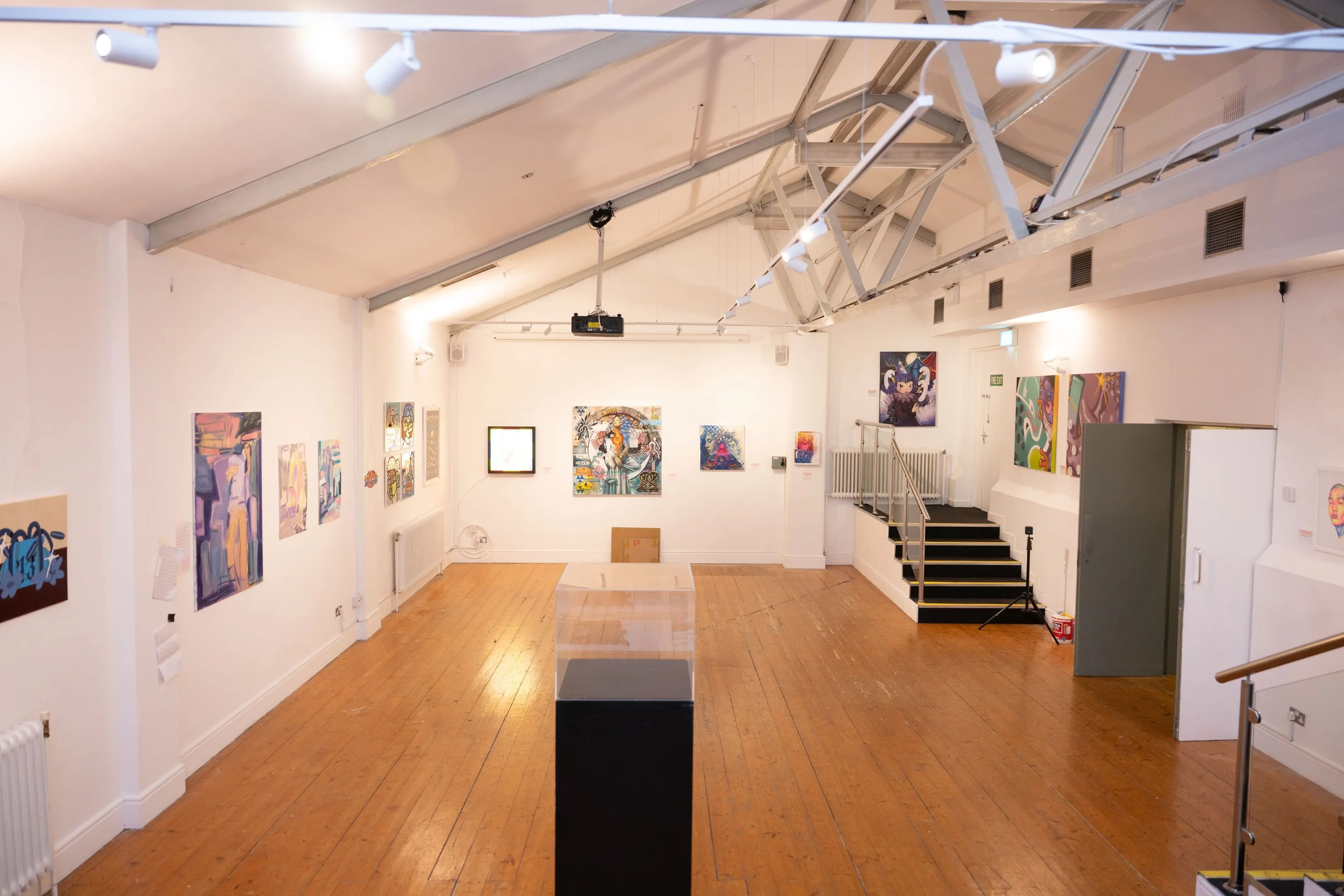
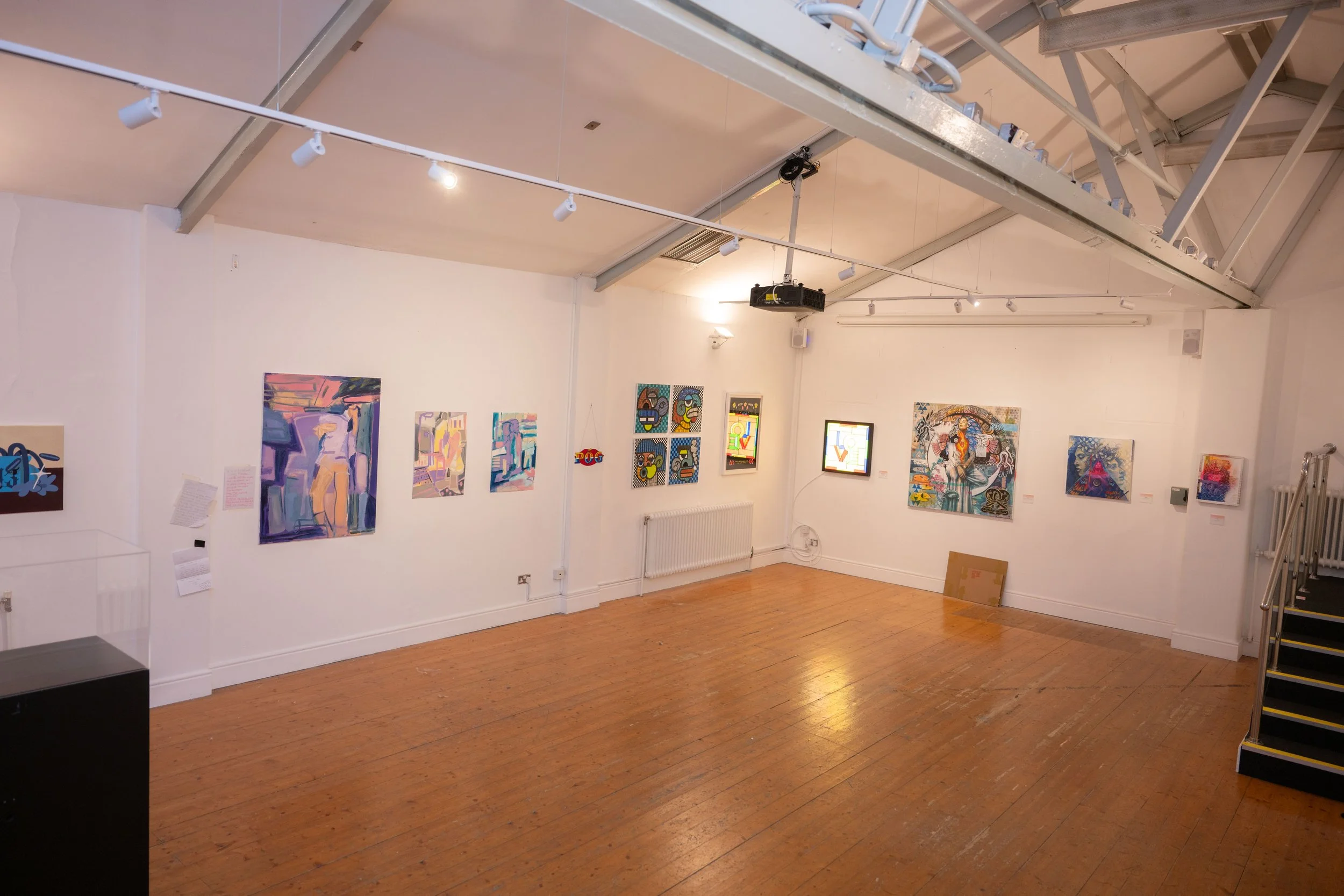
Gradually, the empty white gallery began filling with the very different visual worlds of the Minaw artists.
By the time everything was on the walls, the space had been completely transformed. We even had a small merch table with prints and pieces from some of the artists.
Around the gallery
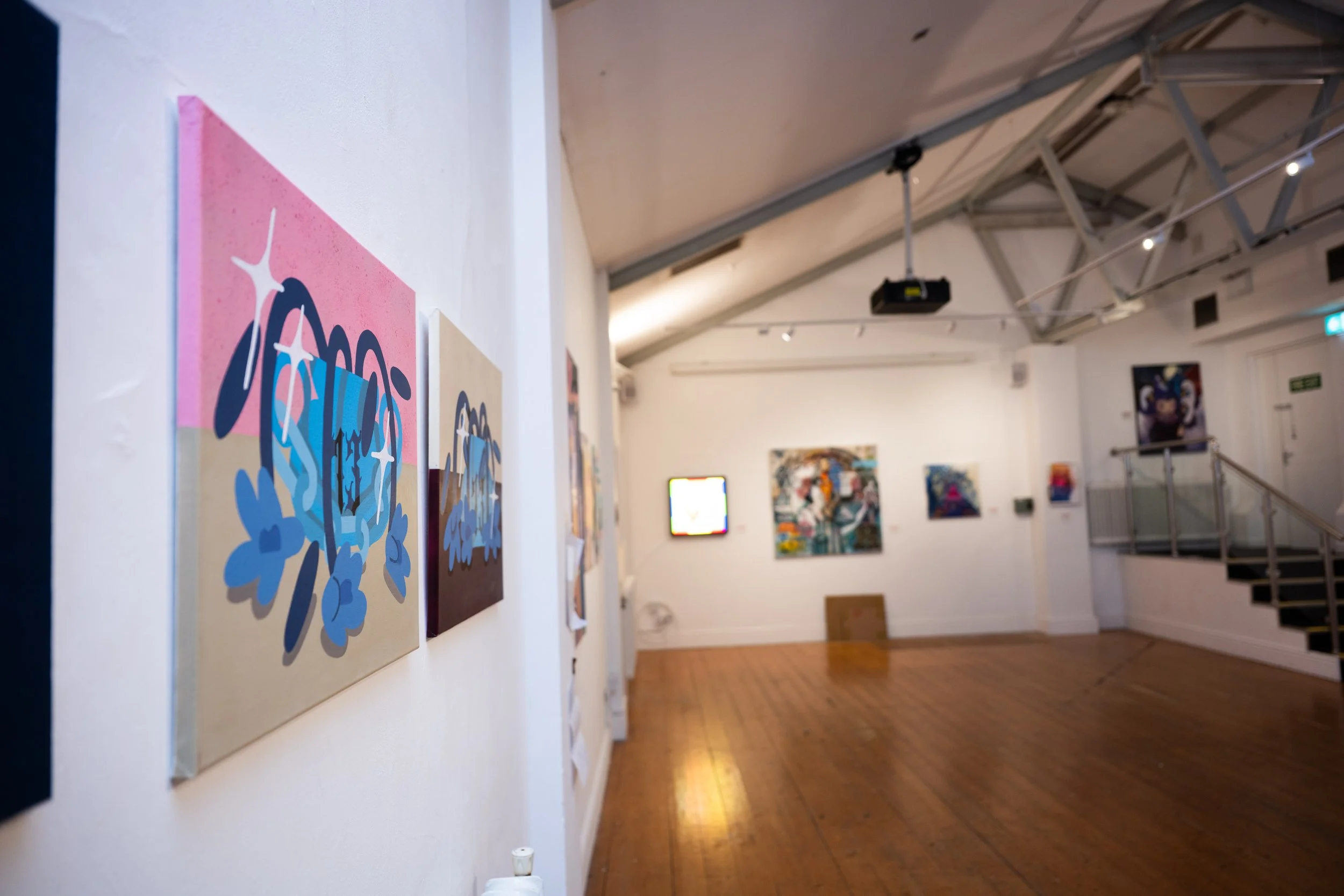
One of my favourite things about exhibiting with Minaw is seeing what everyone else has been making.
We know one another’s mural work so well, but studio practice can reveal an entirely different side of an artist. People always manage to surprise me.
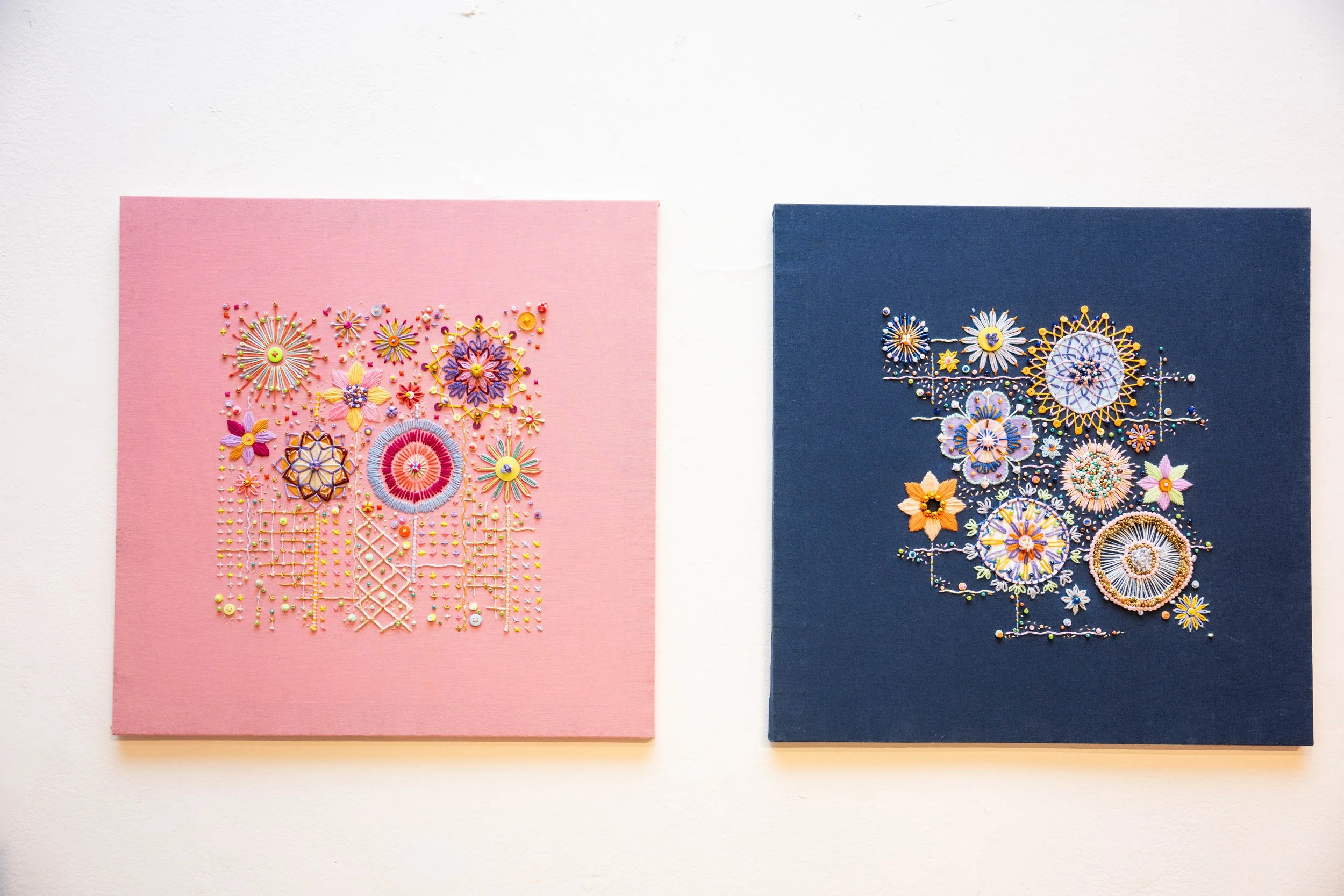
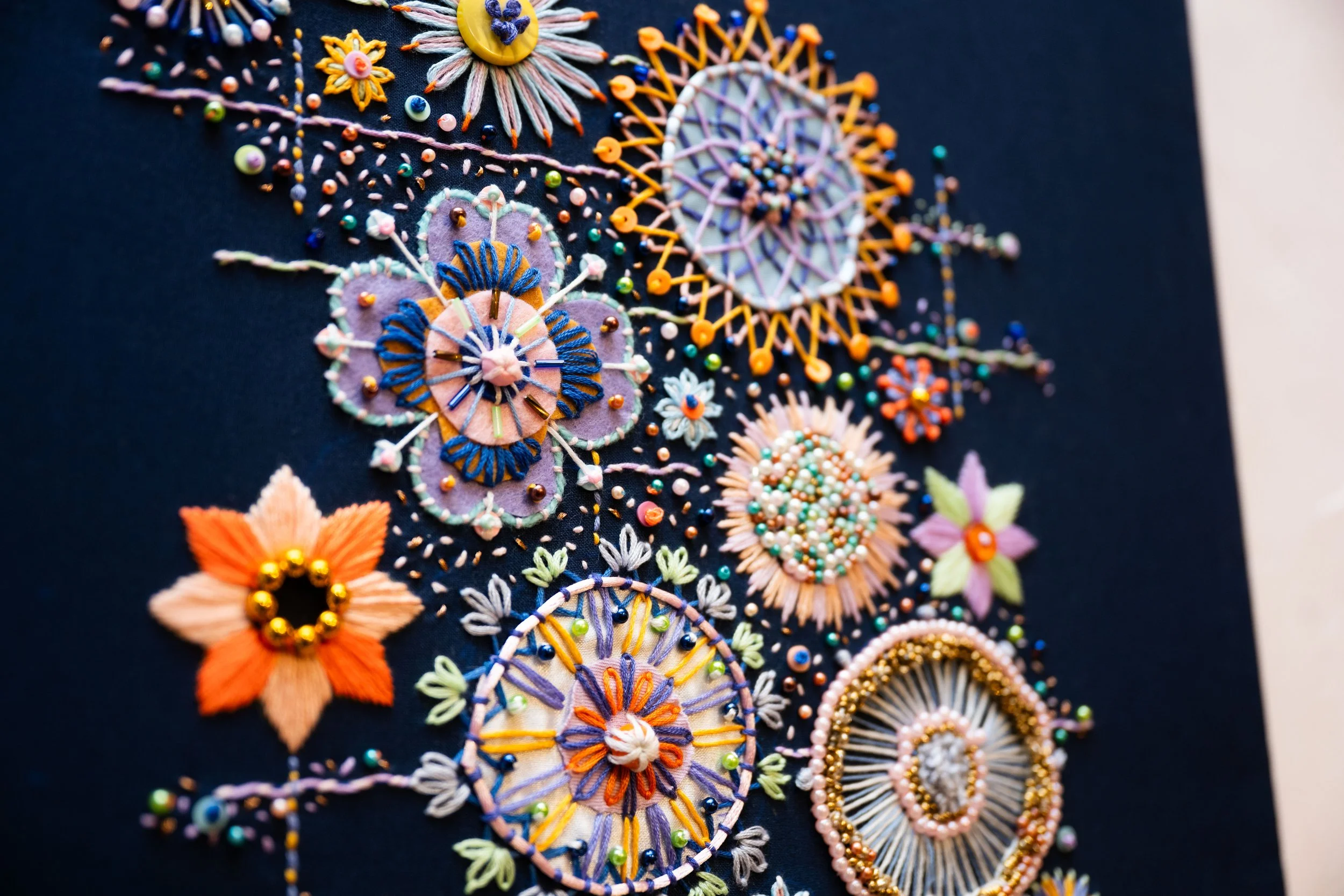
Anna Doran translated the intricate, mandala-like visual language I associate with her stencil work into textile pieces built up through stitching and beadwork. I loved how the change of medium altered the pace of the work. Shapes that might otherwise be quickly sprayed or repeated through a stencil became slow, tactile and intensely detailed, with beads catching the light and giving the surfaces an almost jewel-like quality.
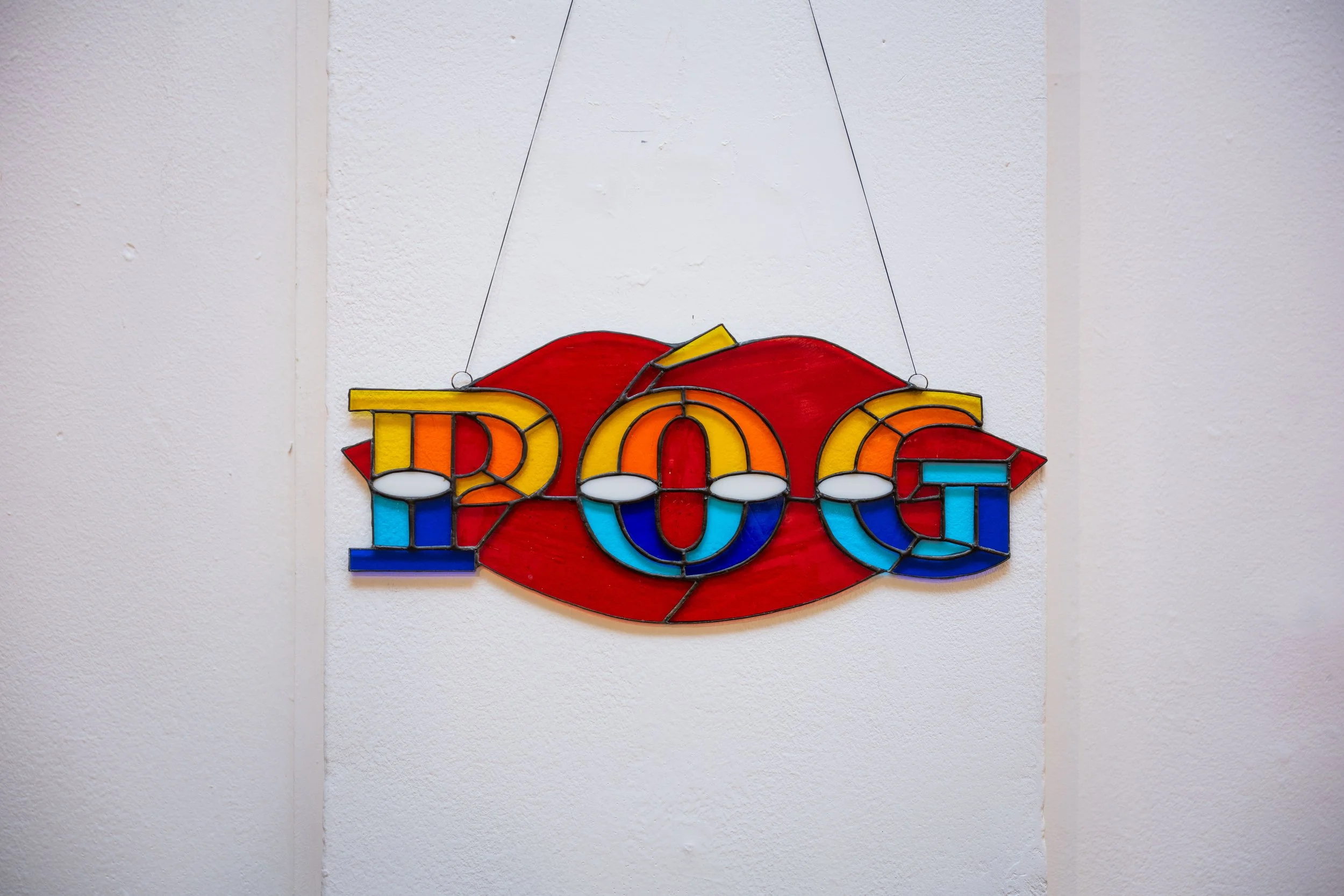
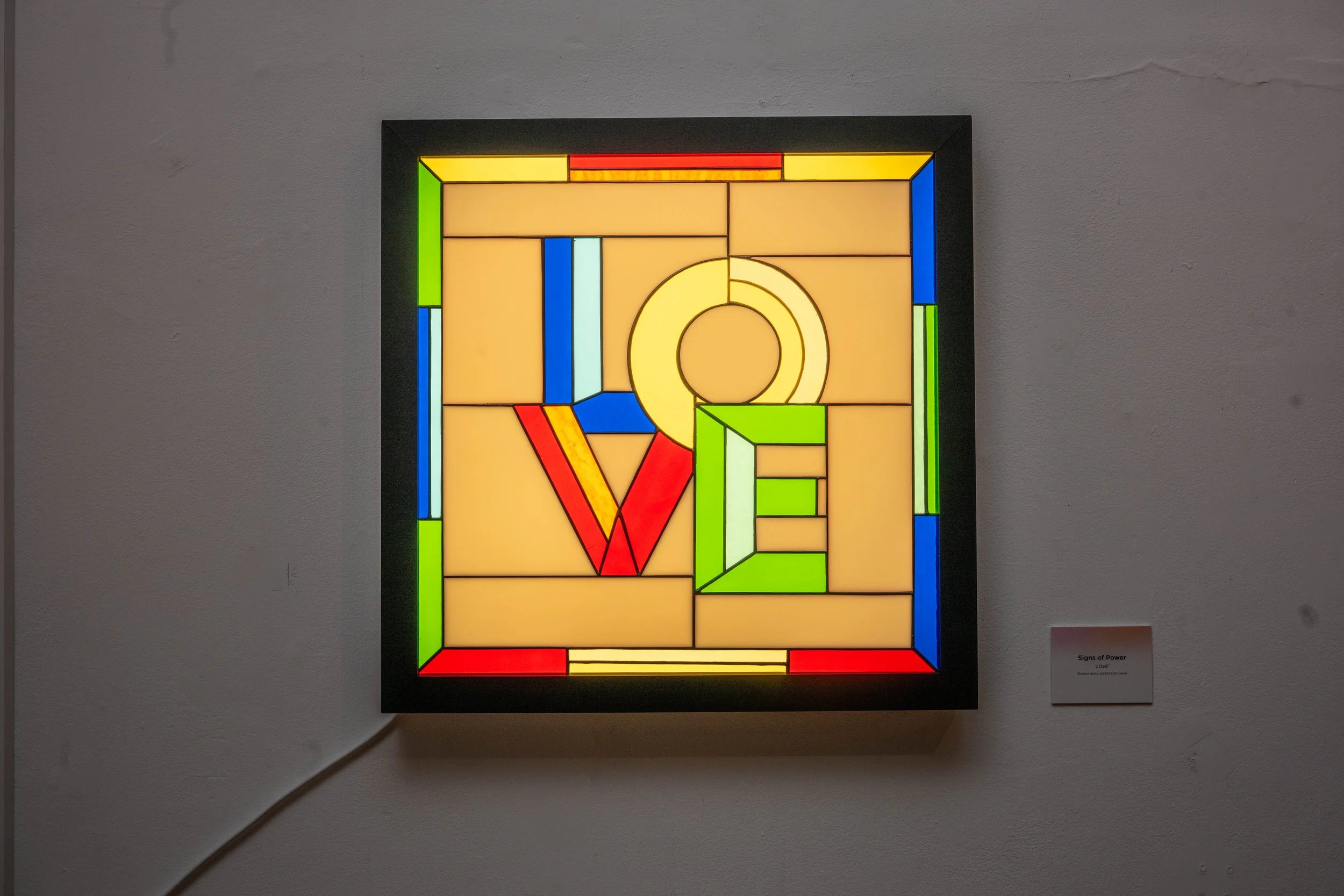
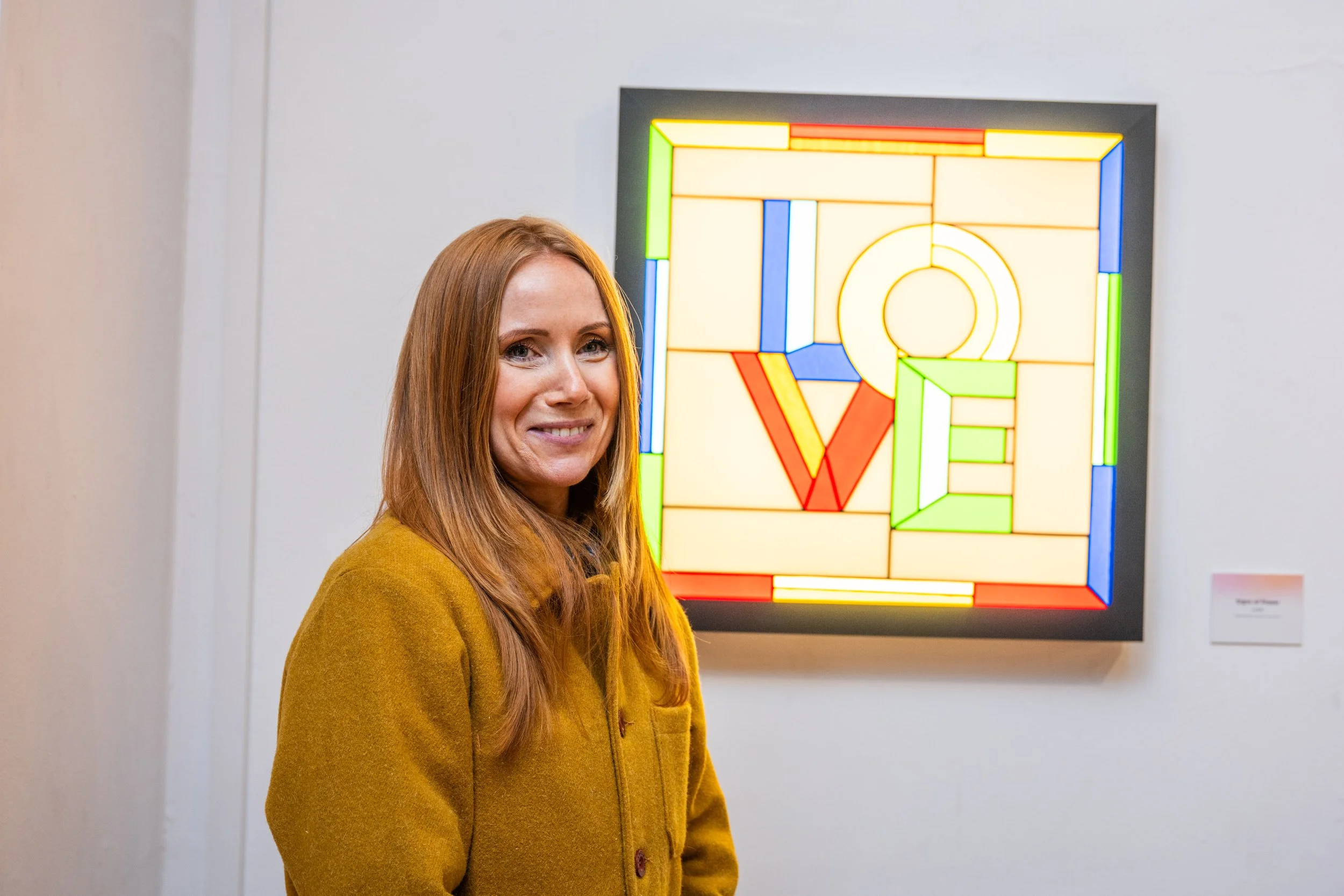
Vanessa, Signs of Power, moved into stained glass. Her hanging POG lips piece was wonderfully cheeky, while her illuminated LOVE work transformed traditional leaded glass into something closer to contemporary typography, signage and light installation. It still felt unmistakably connected to her lettering practice, but the material changed the way the work occupied the room.
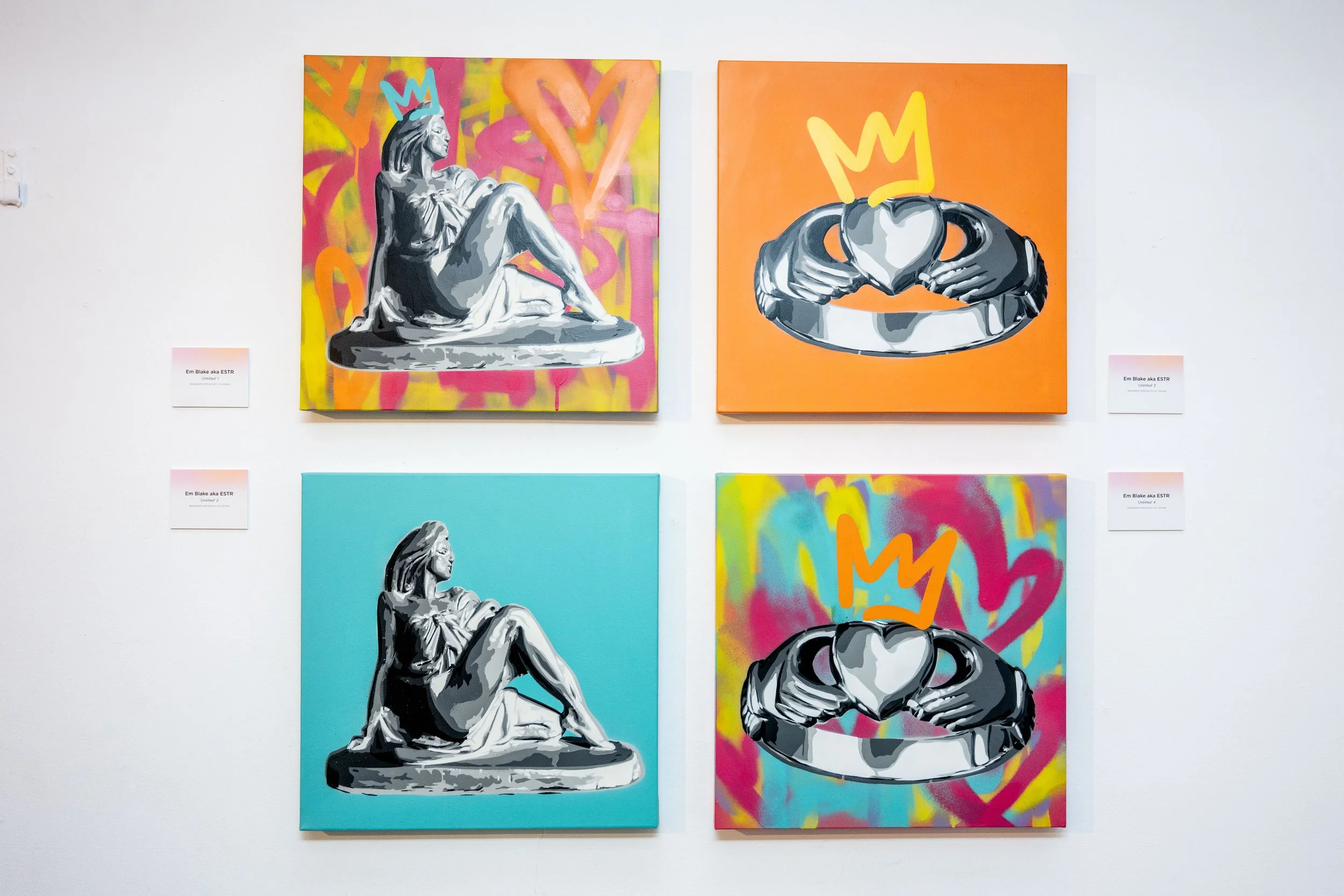
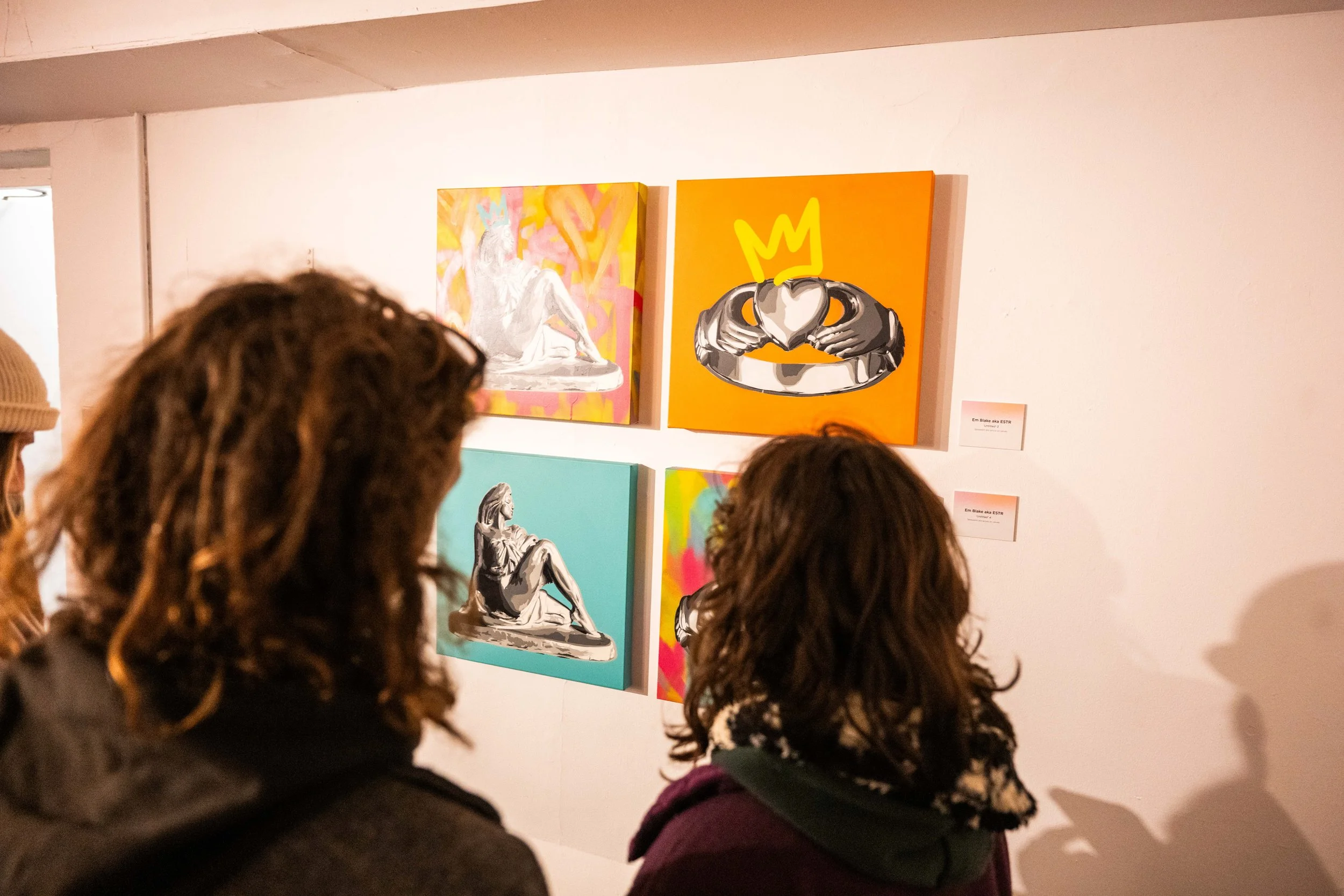
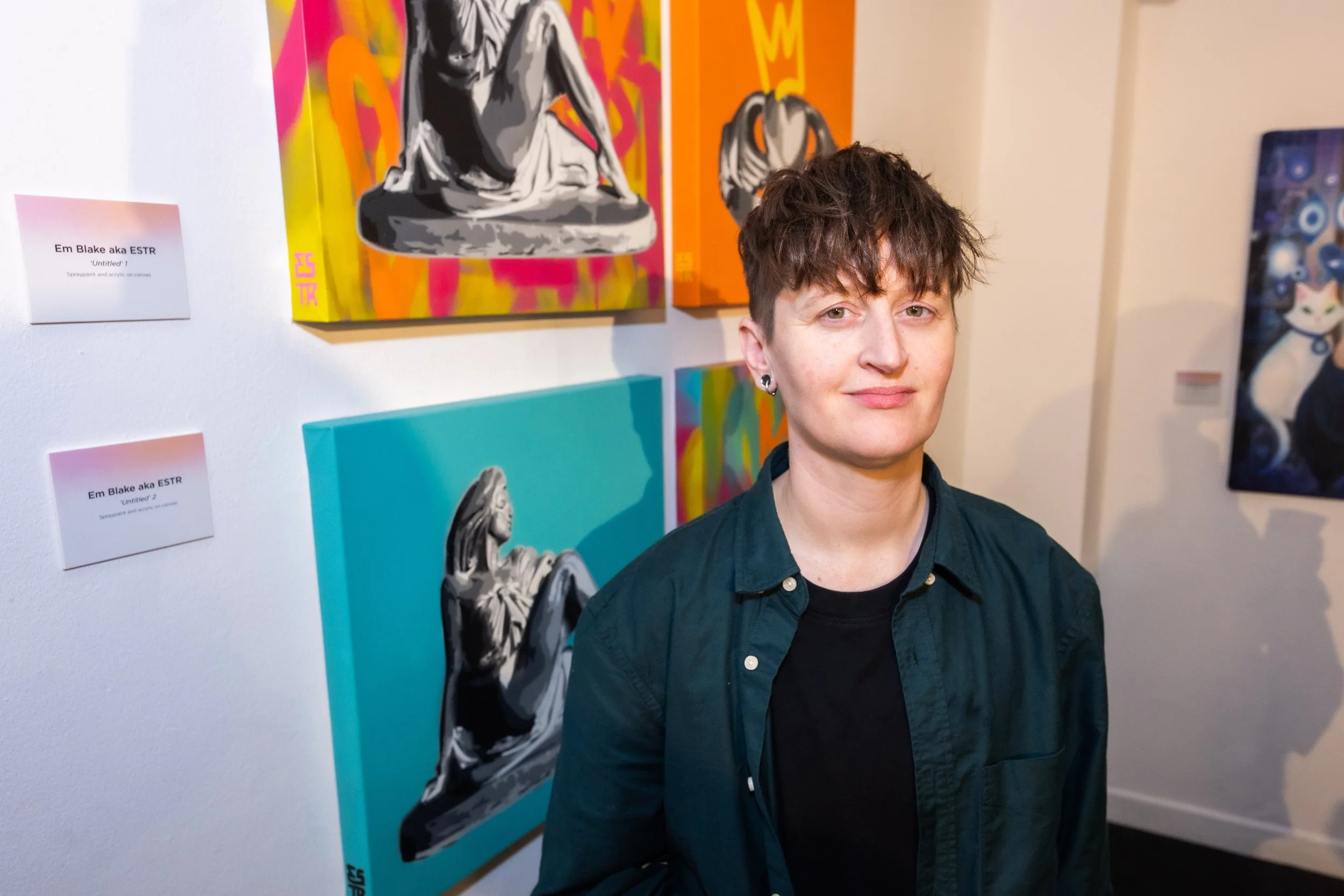
Em Blake, aka ESTR, showed a series of bold canvases using the Claddagh ring and ‘Dublins White Lady’ or ‘Lady on the Rock’ a seated female figure as contemporary icons. Greyscale, stencil-like imagery pop against saturated orange, turquoise, pink and yellow, with crowns and graffiti-like marks pushing the works towards Pop and street-art territory. One of the pieces, White Lady, also carried a lovely thread back to the White Lady Art Gallery, where Minaw first emerged.
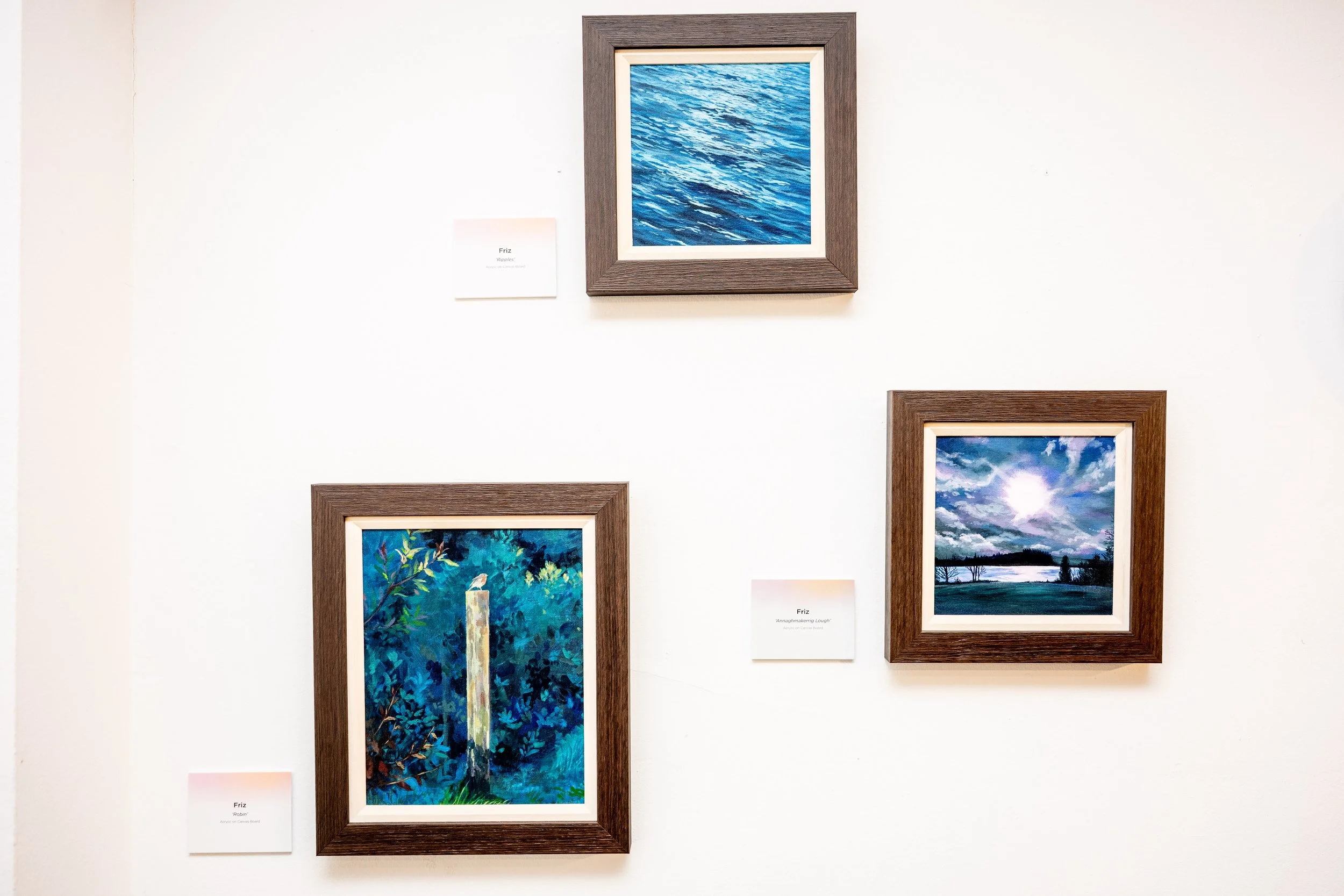
Friz, aka Marian Noone, went in almost the opposite direction to the monumental scale of her mural practice. Her small acrylic paintings Robin, Annaghmakerrig Lough and Ripples were quiet, concentrated studies of landscape, water and atmosphere. Ripples became almost abstract through the movement of blue and white marks across the surface, while Robin drew you into a dense little world of turquoise foliage around a tiny bird. Their small scale made you physically move closer to them.
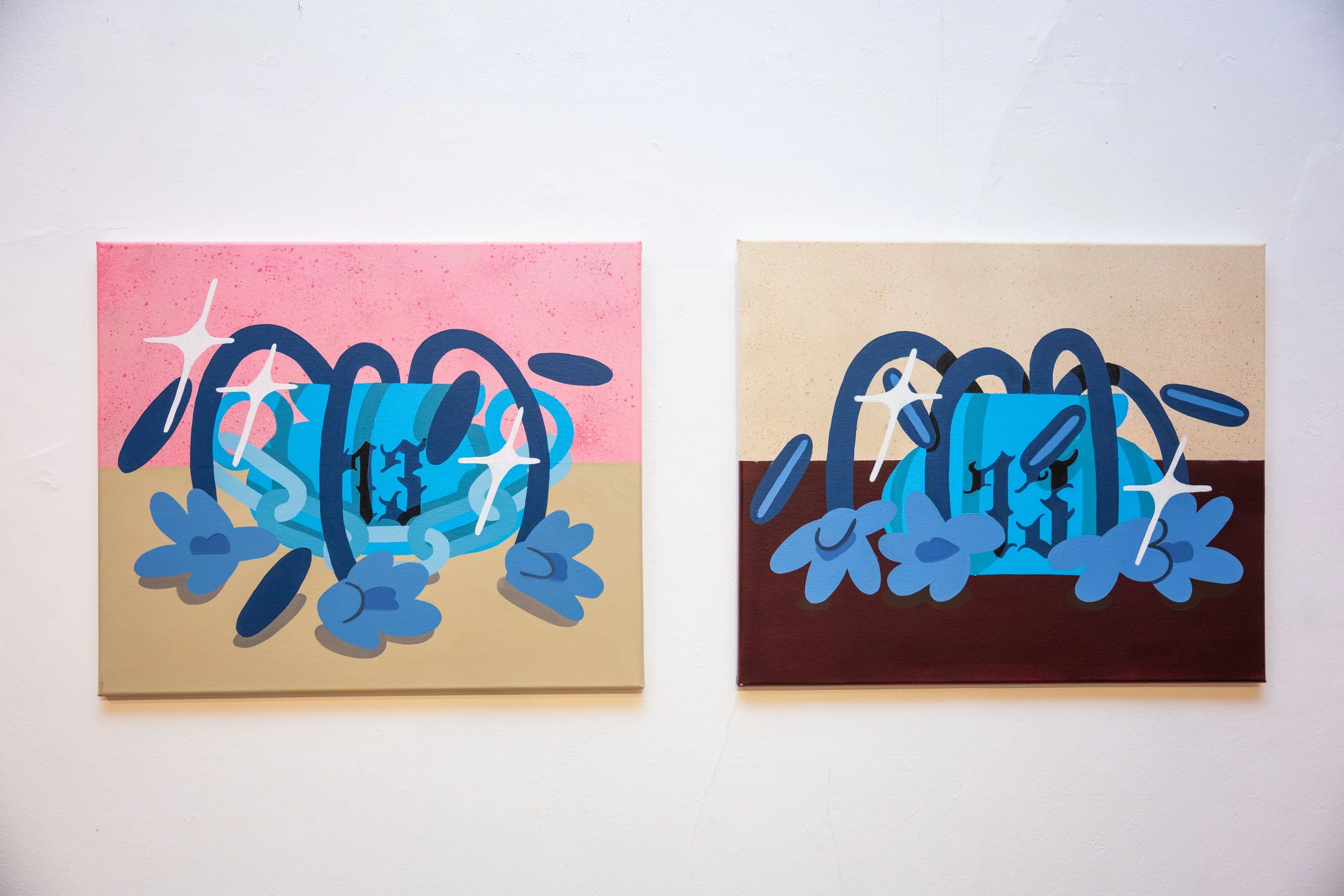
Zippy’s canvases were playful and beautifully graphic, built from looping lines, simplified floral forms, sparkles and strong blocks of blue. I loved how the same visual language shifted across the pair almost like variations on a motif. She had also worked the number 13 into the paintings, perhaps a little nod to the thirteen Minaw artists exhibiting together.
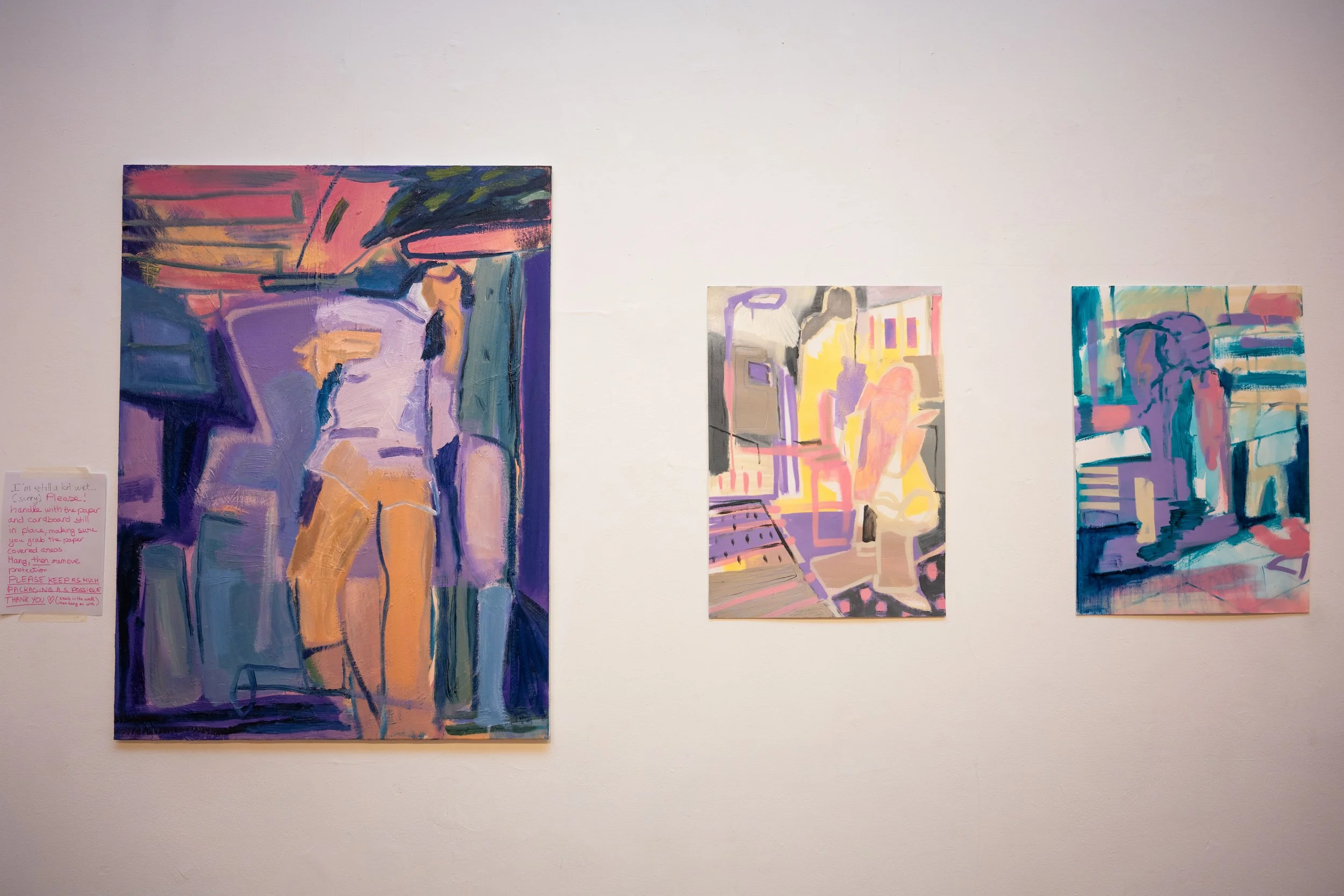
Claire Prouvost’s canvases felt like a real departure from the sharp edges and controlled gradients I often associate with her murals. These works were looser and much more painterly, with figures slipping in and out of blocks of lavender, pink, teal, cream and charcoal. To me they suggested interiors without ever fully describing them, a room, a chair or a body appearing briefly before dissolving back into the paint.
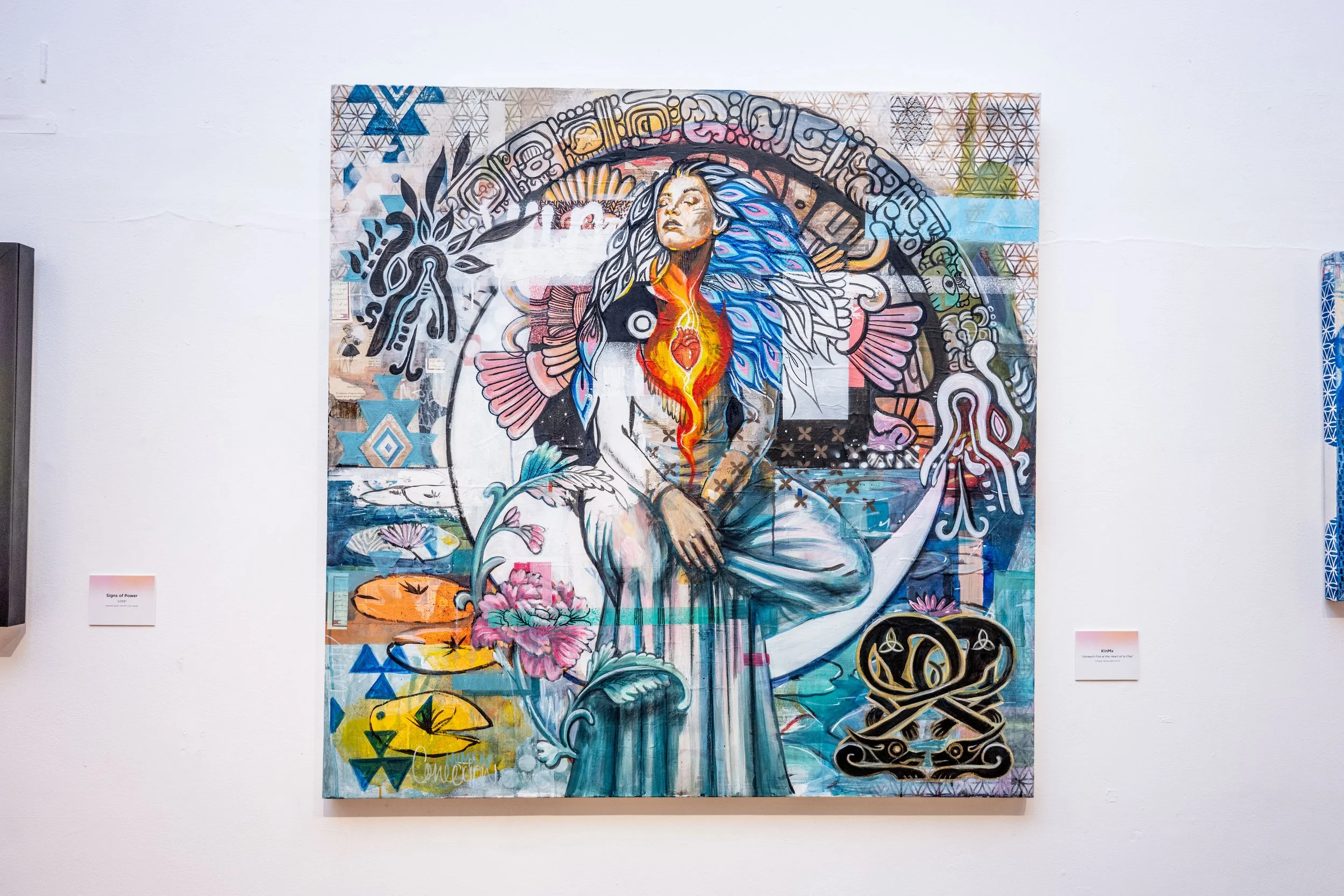
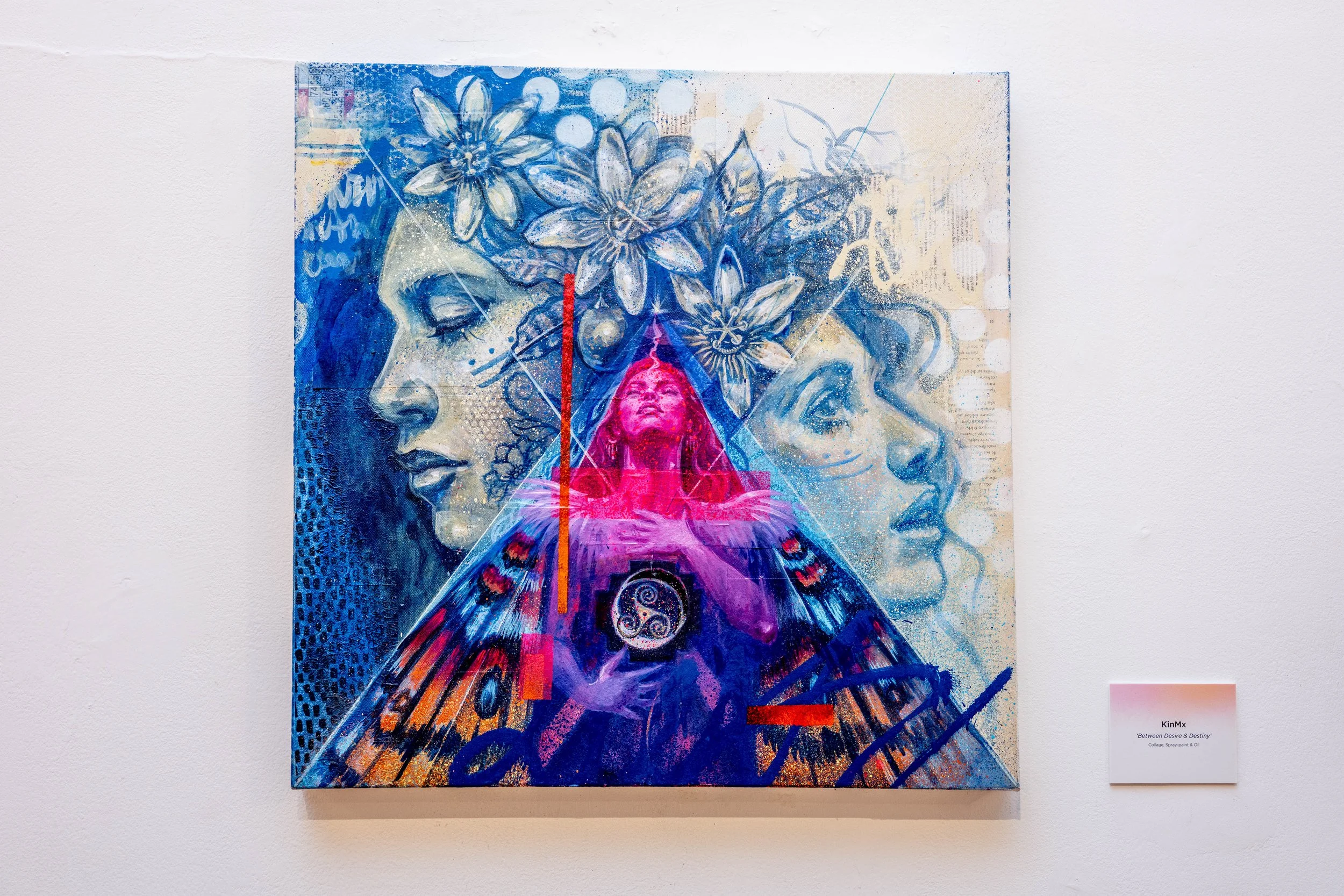
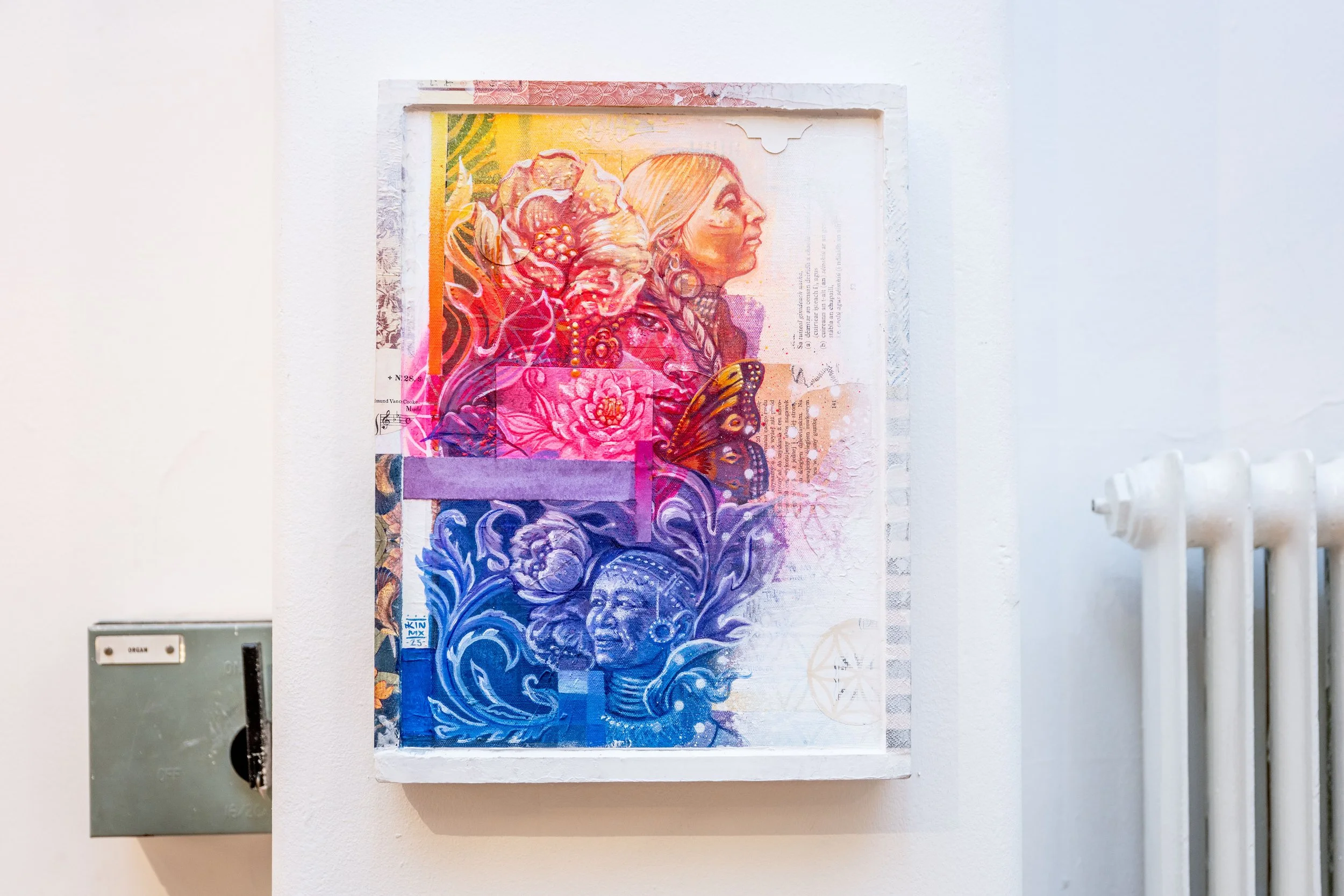
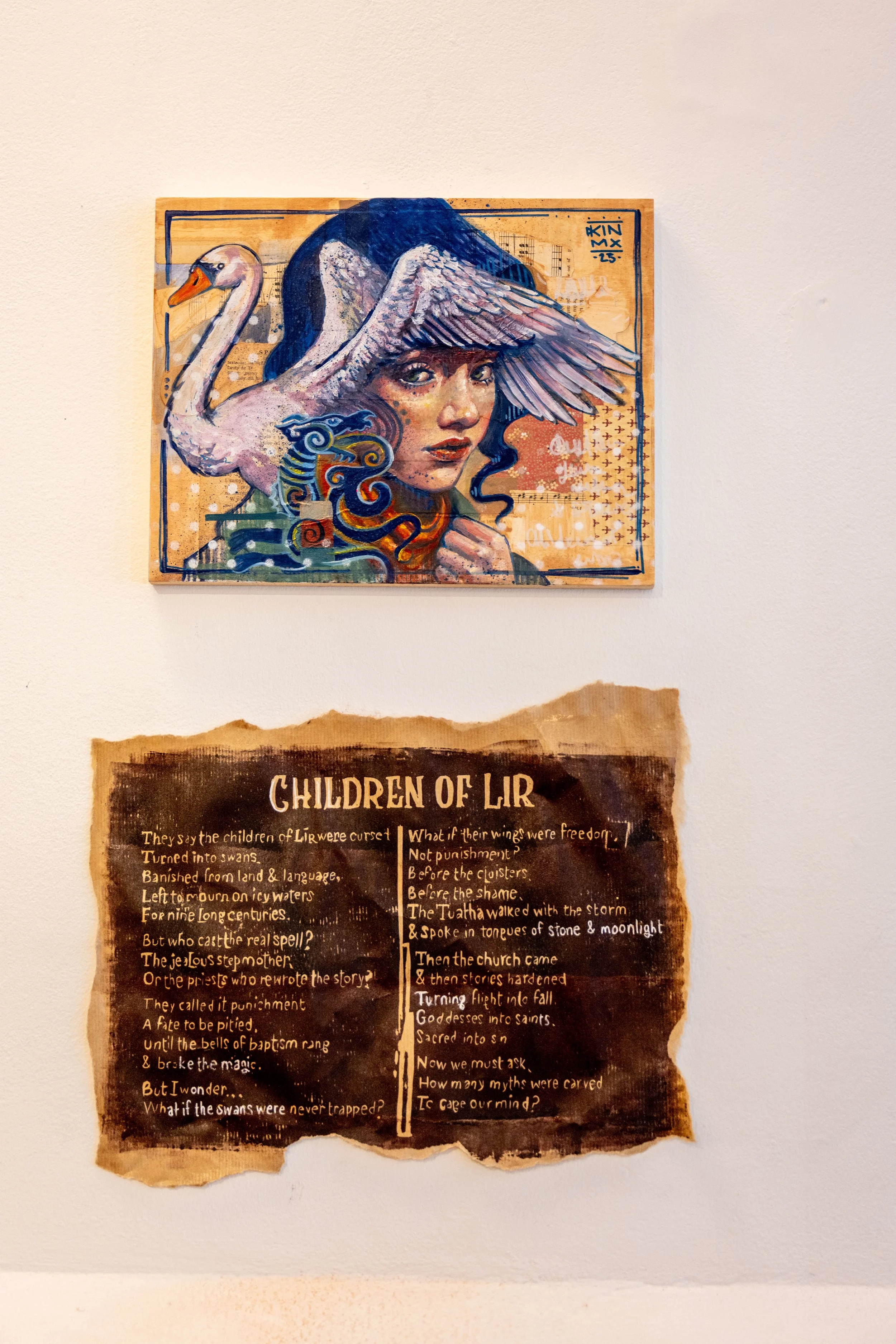
Kathrina, KinMx, brought the layered, symbolic language of her practice into richly worked paintings combining portraiture, birds, pattern, collage, geometry and mythology. I especially loved her Children of Lir piece, accompanied by text beneath it. Her use of collage is something that translates particularly beautifully in the studio: fragments of printed material, pattern and text can become part of the surface in ways that simply aren’t possible on a mural wall. Her work always seems capable of carrying many visual languages at once without losing its own identity.
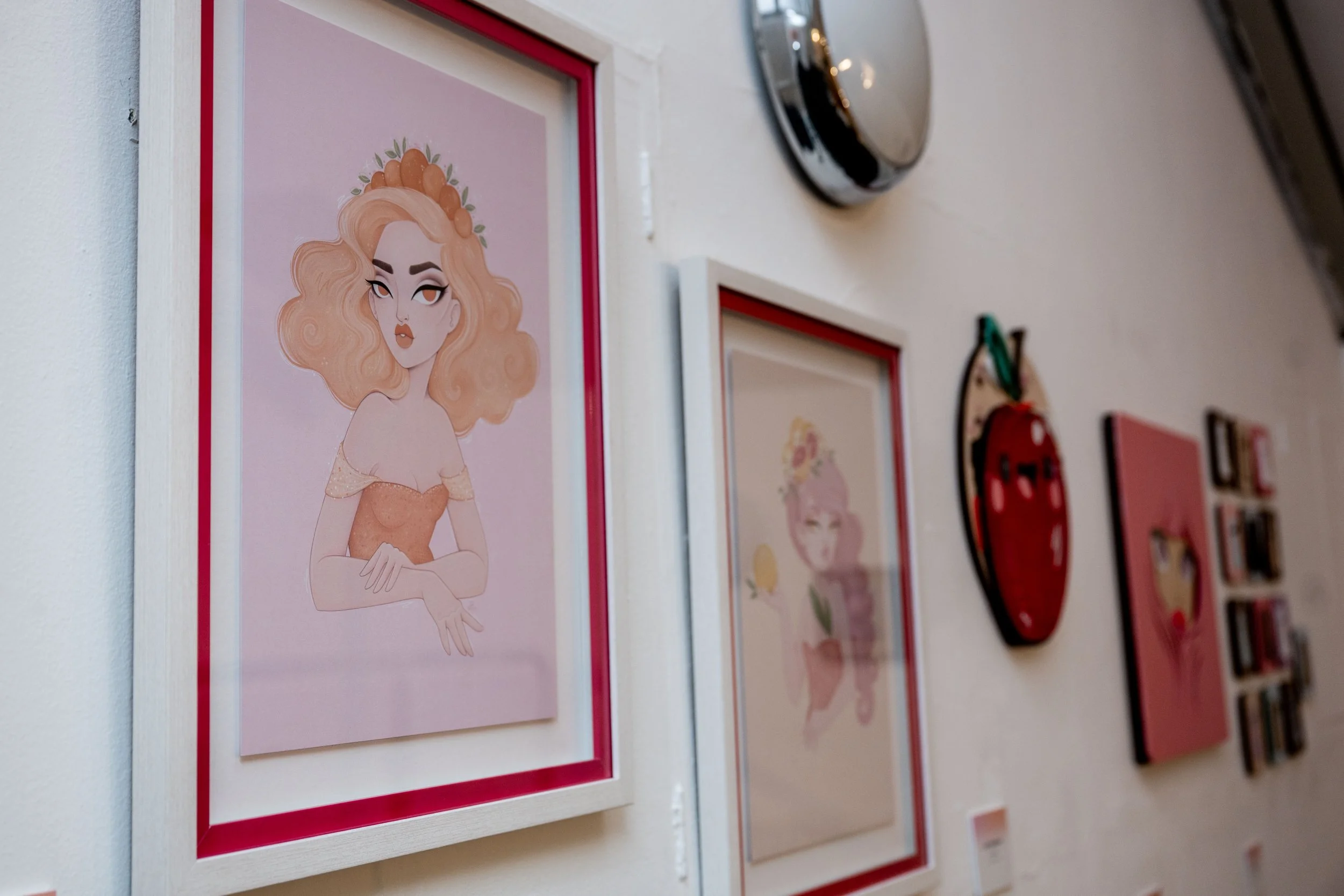
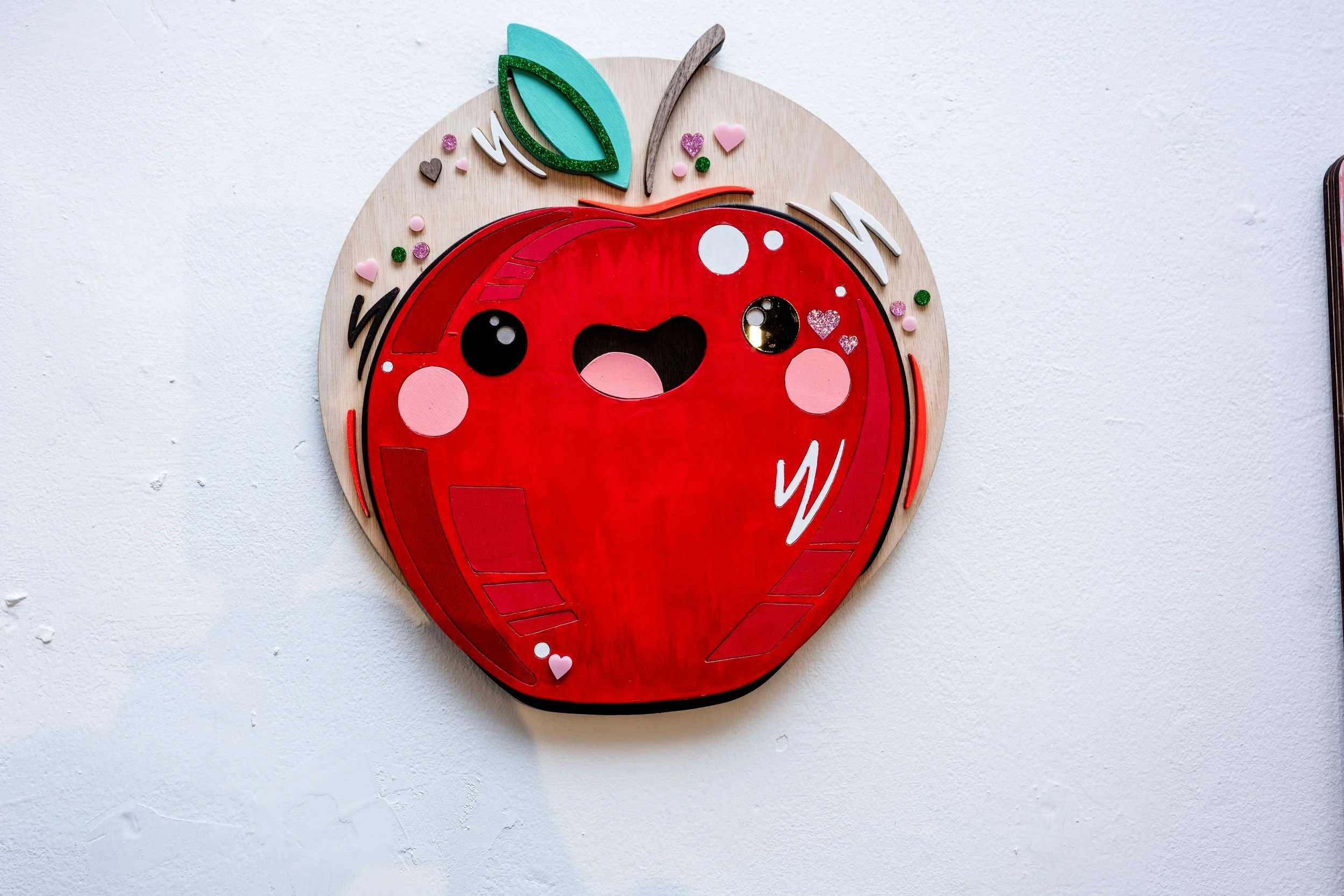
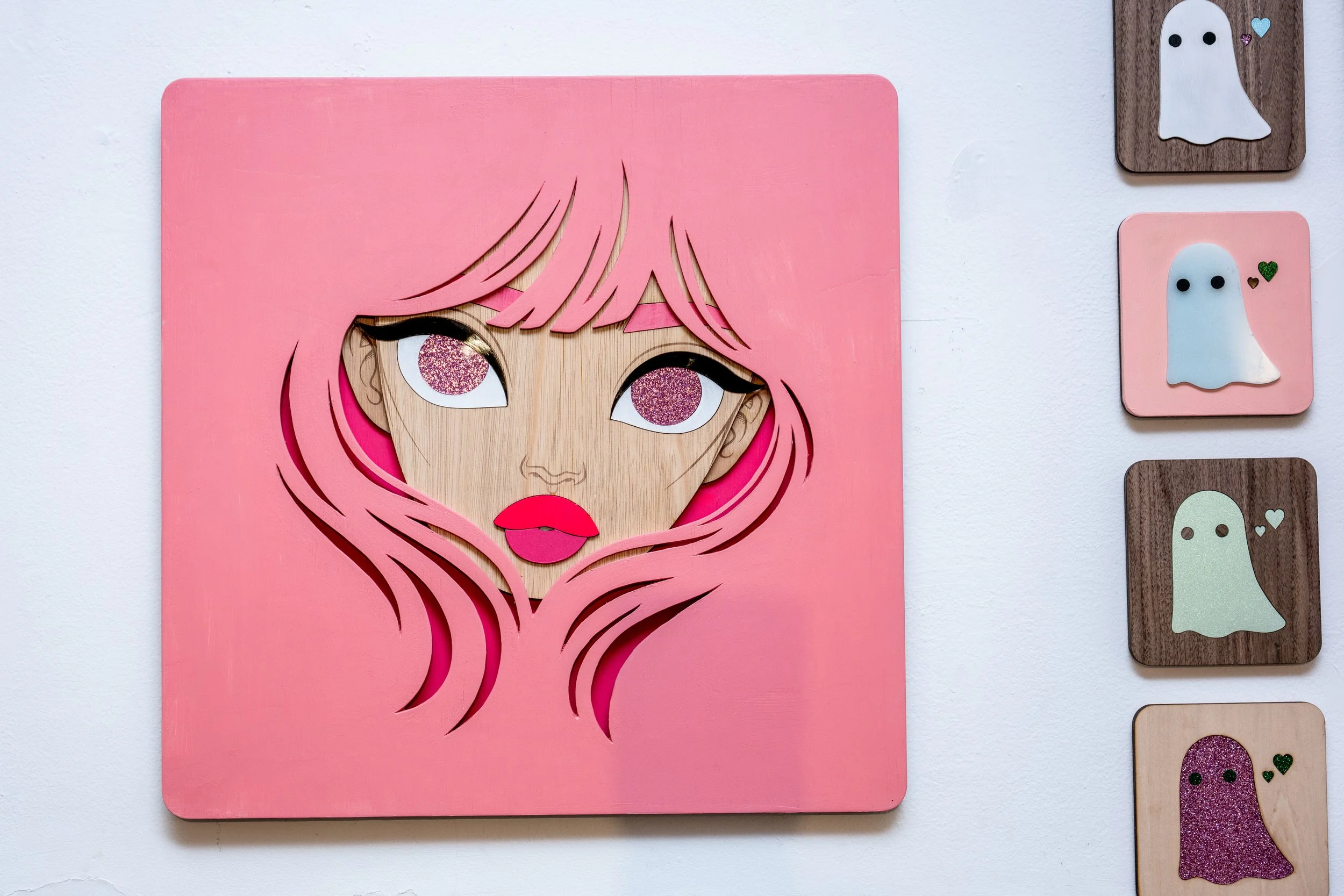
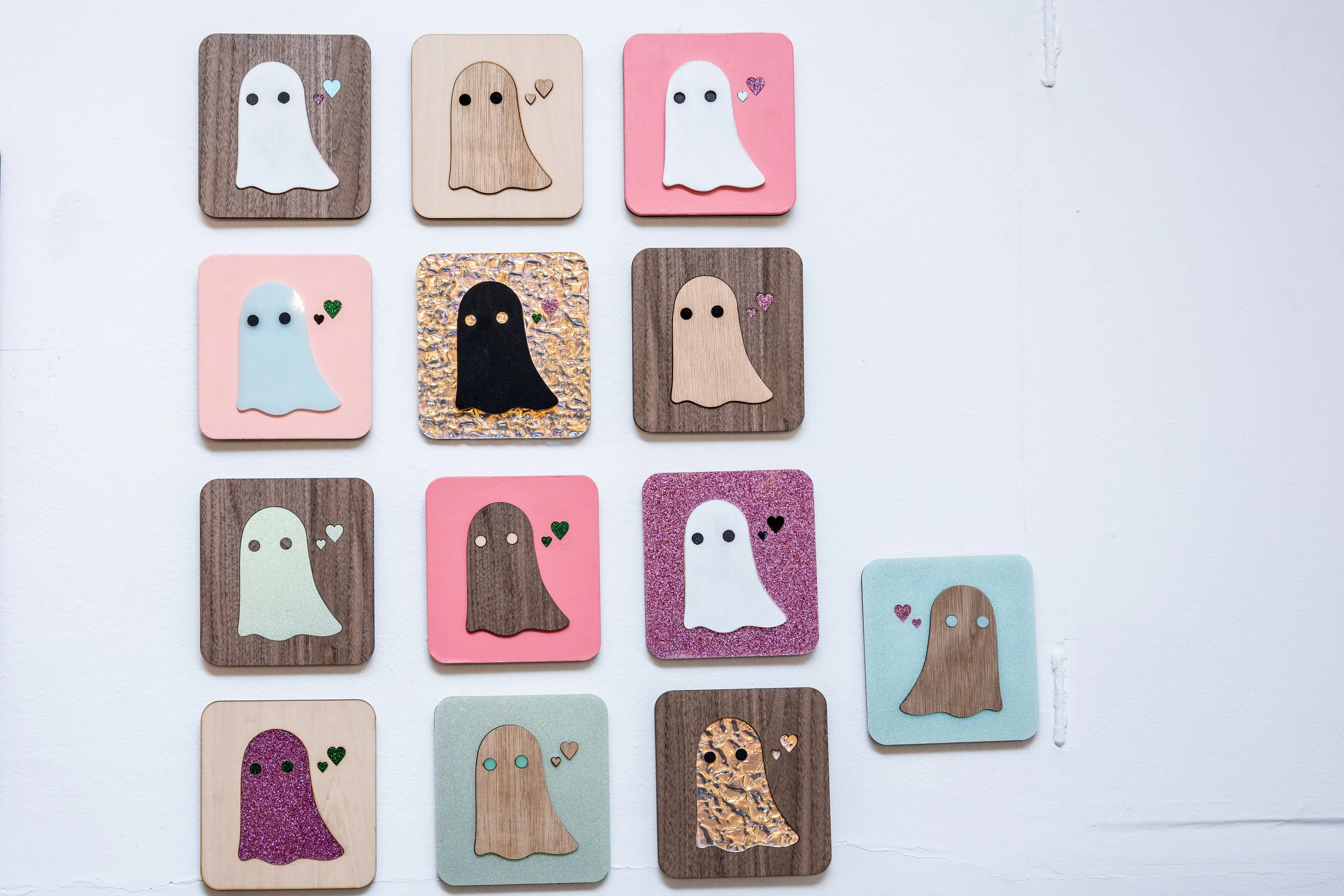
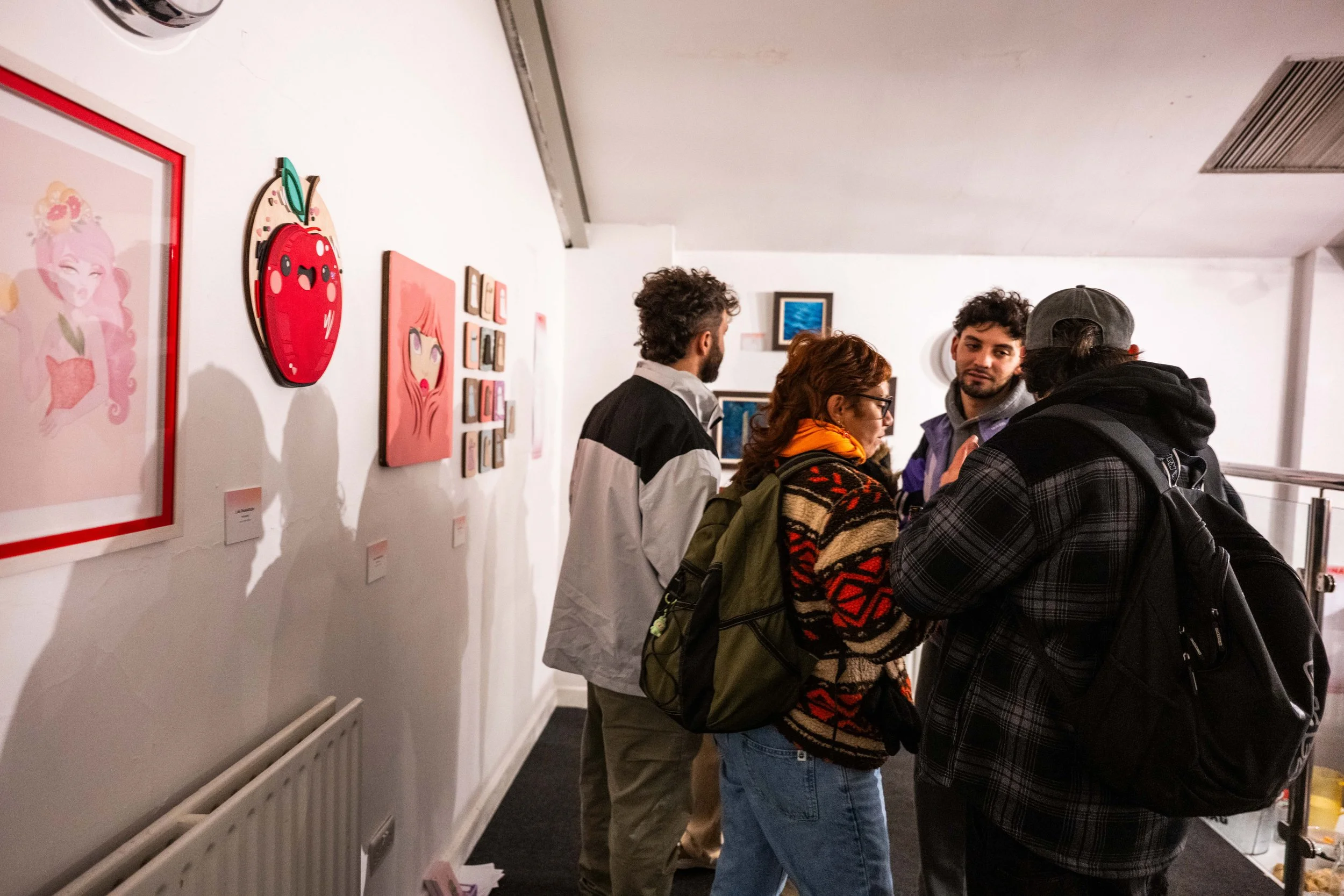
Loki PookaDubh brought together illustration and a series of layered laser-cut pieces that I found myself particularly drawn to. Painted wood, exposed grain, glitter acrylic and raised layers turned her images into little relief objects rather than simply flat illustrations. I particularly loved her bright red apple piece.
There was also a funny bit of synchronicity here because Loki and I had both recently bought very similar laser equipment. I found myself studying how she was using hers, breaking an illustration apart and rebuilding it physically in layers. Her grid of little ghosts did this beautifully too, repeating one simple character across different woods, colours, metallic textures and sparkling surfaces.
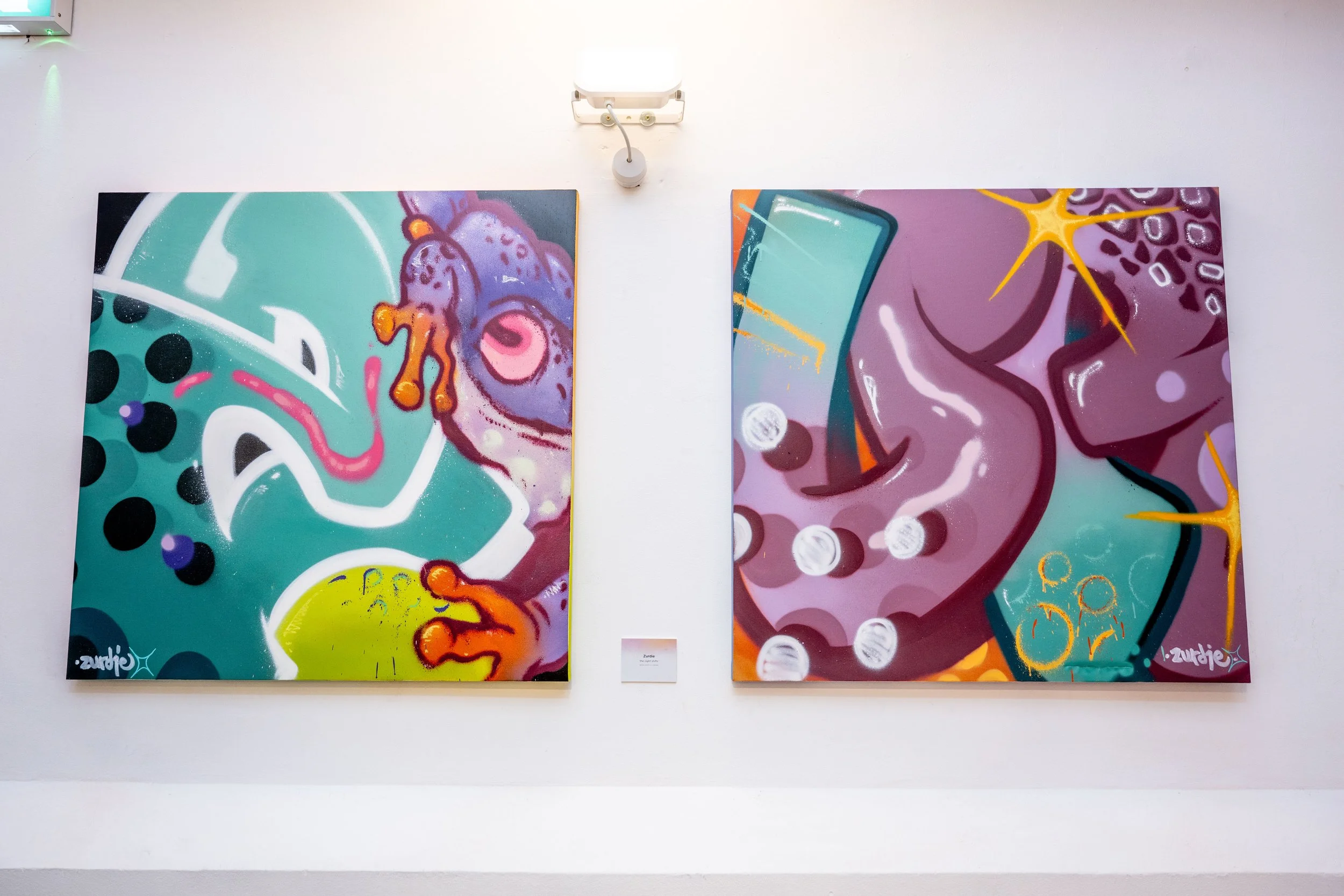
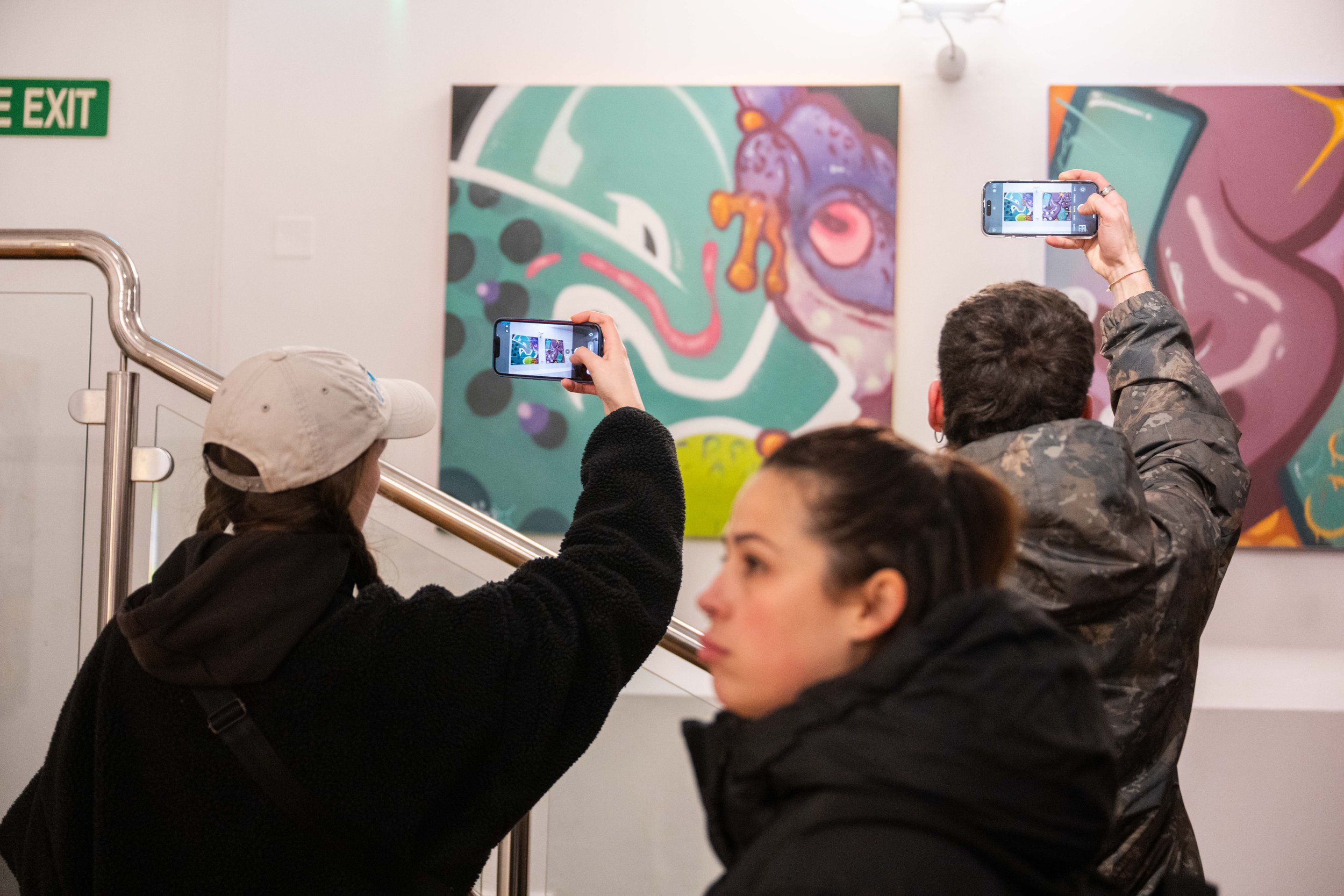
Zurdie’s two large canvases had a completely different energy again. They felt almost like extreme close-ups or fragments of a much larger image, with rounded cartoon-like forms pushed right to the edges of the canvas. Turquoise, purple, pink and flashes of yellow sat alongside spray-painted gradients, looping marks, dots and glossy highlights. I loved how the cropping made you look less for a complete image and more at the movement of shapes, lines and gestures across the surface.
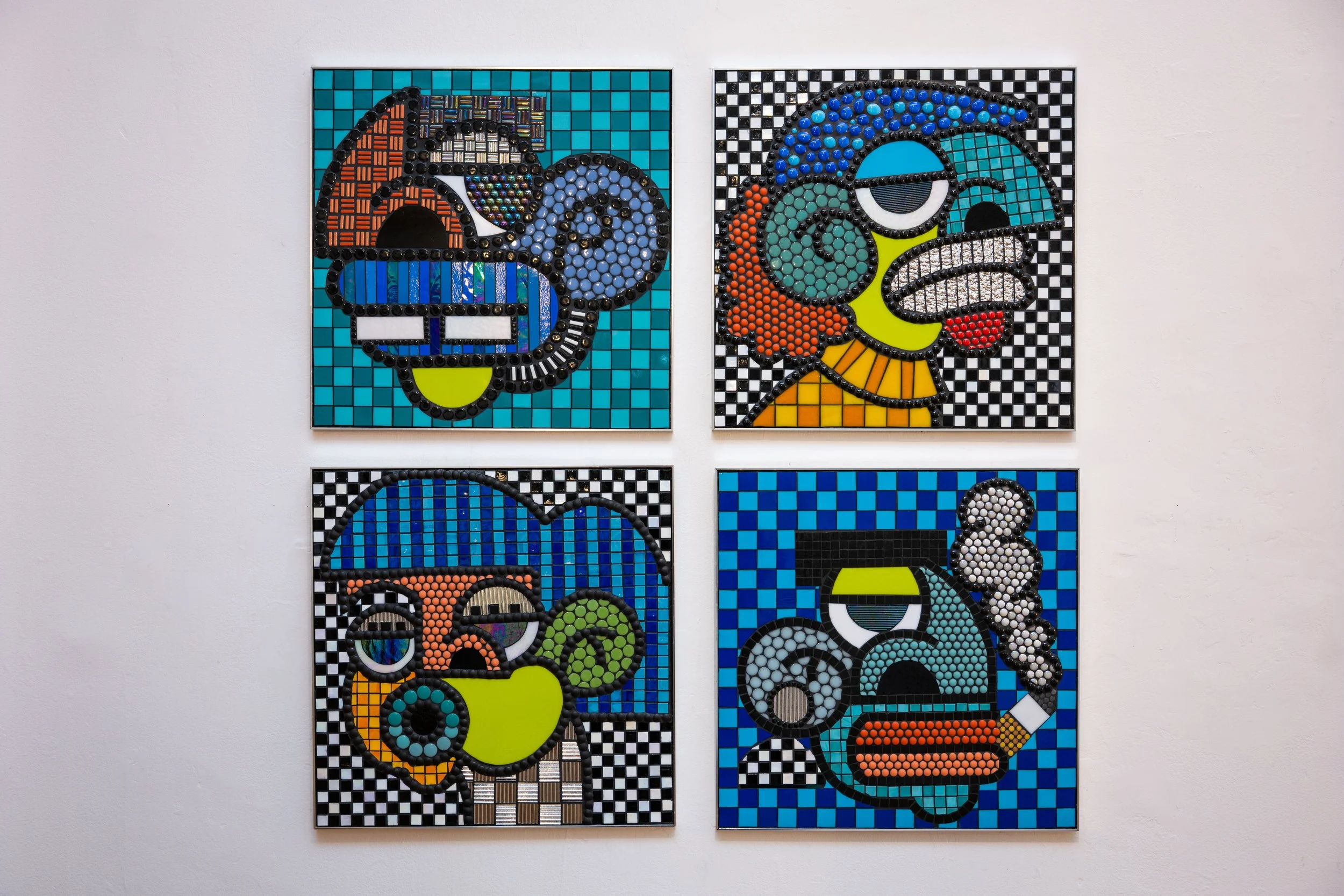
Klo-Wi’s mosaic panels were bold, playful and wonderfully graphic. Faces and abstract forms were constructed from tiny pieces of glass and tile against bright turquoise and checkerboard grounds, held together by strong black outlines. From across the gallery they had the immediacy of illustration or street art, but up close the surfaces broke apart into hundreds of individual pieces. They felt almost like concentrated samples of a much larger mosaic language.
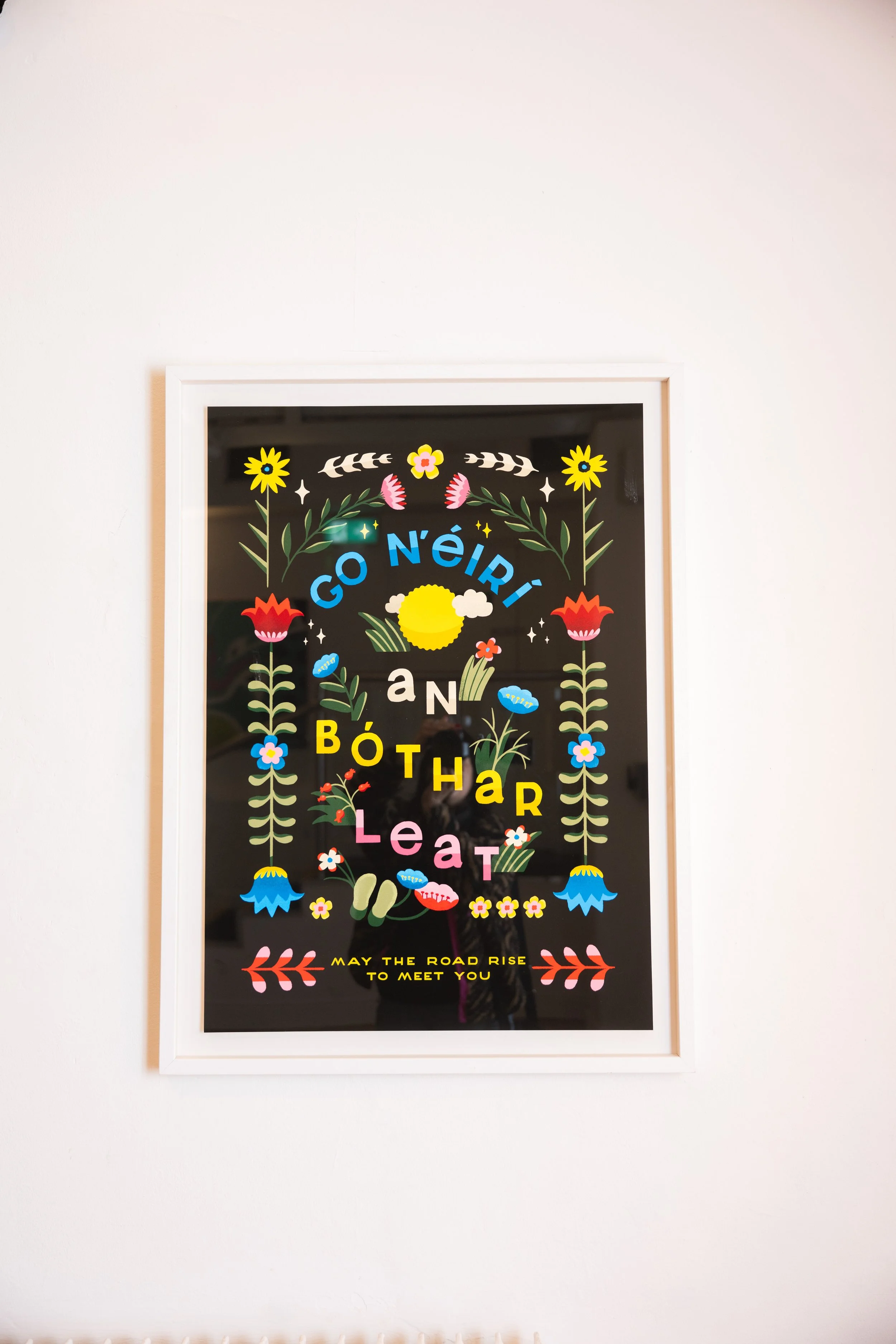
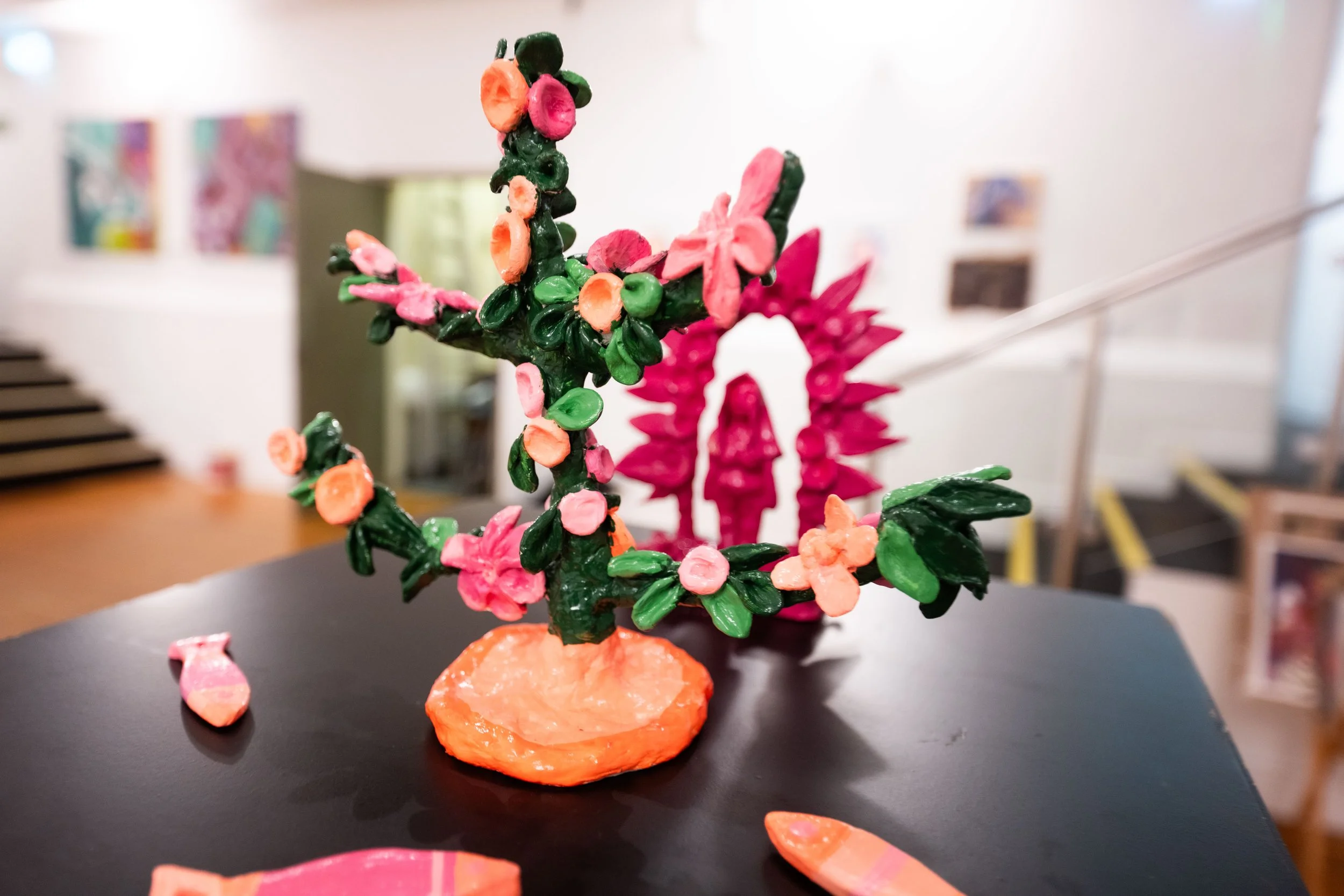
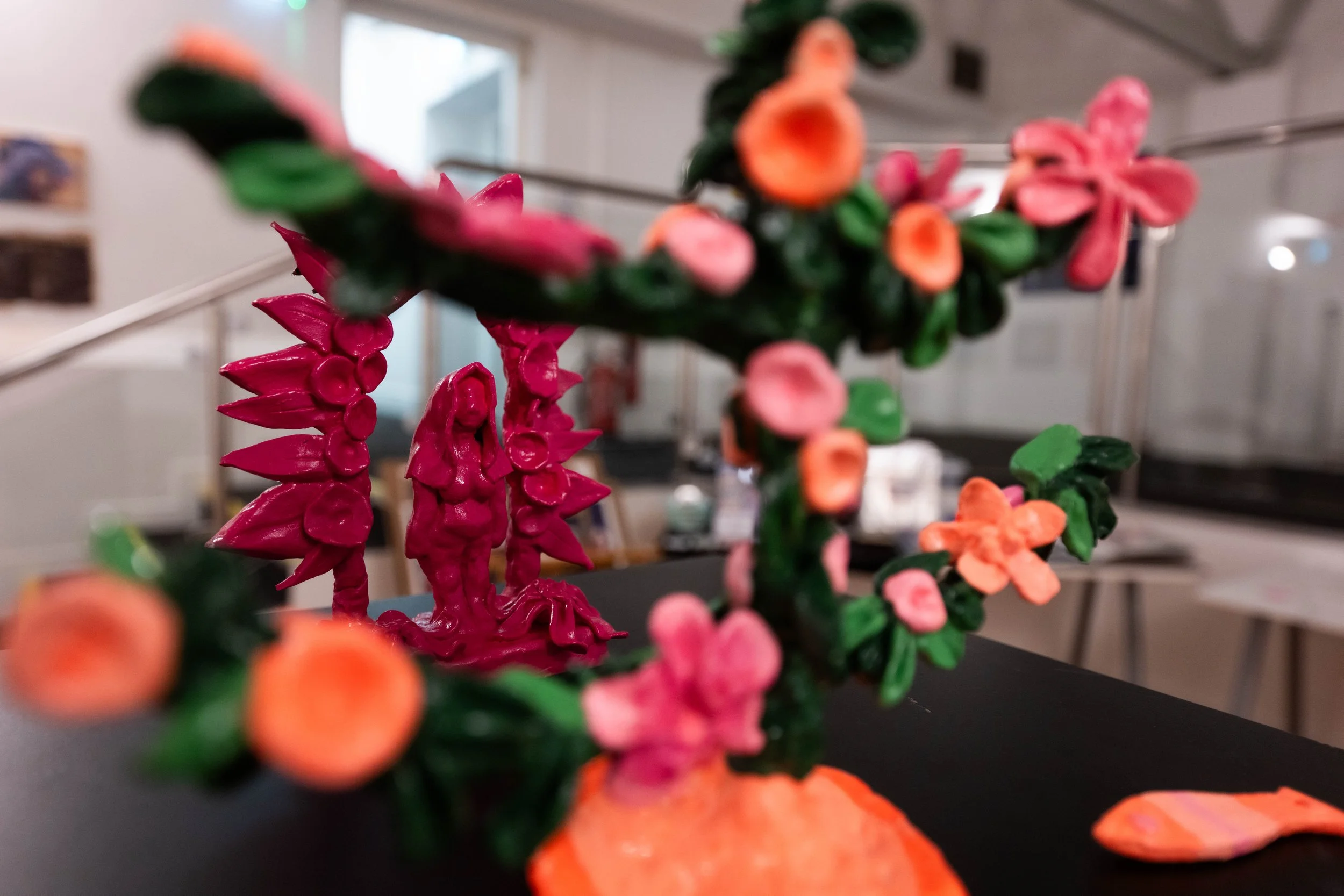
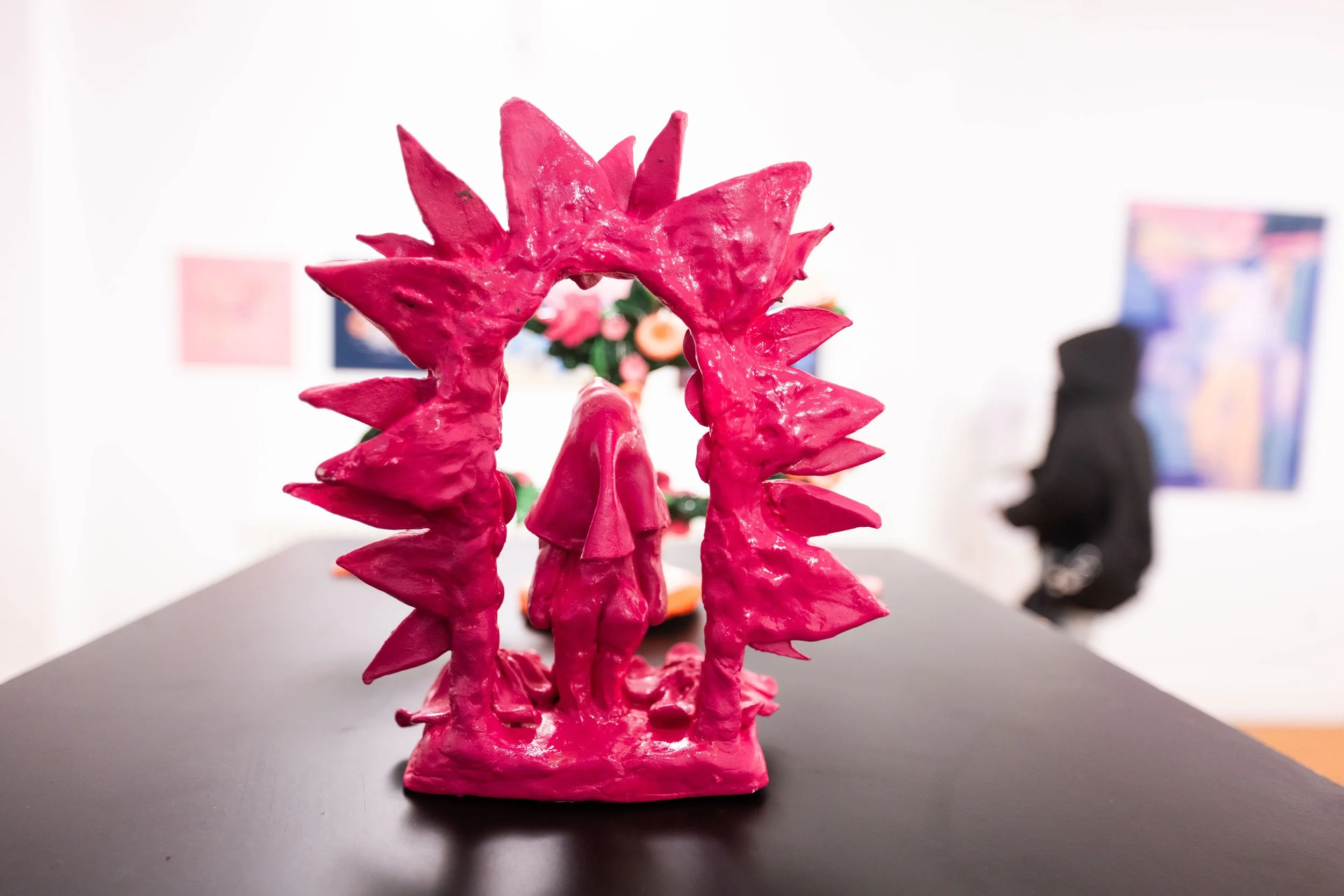
Holly Pereira’s work surprised me by taking her familiar floral and folk-inspired imagery into three dimensions. Her framed Go n-éirí an bóthar leat retained the ordered, graphic quality I associate with her work, with the Irish blessing surrounded by stylised flowers and decorative motifs.
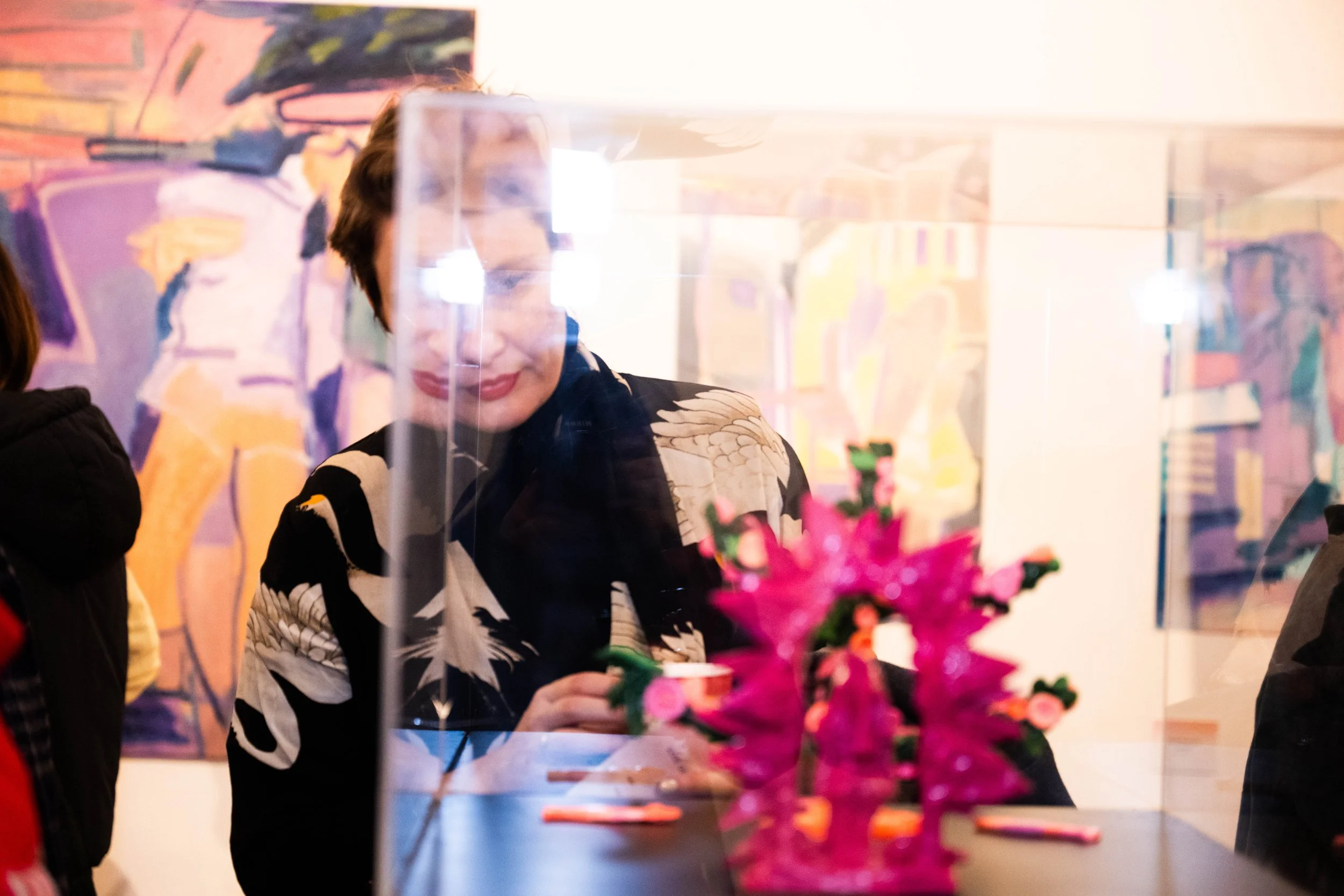
Nearby, those motifs seemed to step off the page altogether in brightly painted sculptural pieces. Flowers, leaves and small objects had been built up by hand, leaving the modelling visible beneath glossy pinks, oranges and greens. One hot-pink piece, with a small veiled figure beneath an arch of flowers, reminded me of a miniature devotional grotto transformed into something much stranger and more playful.
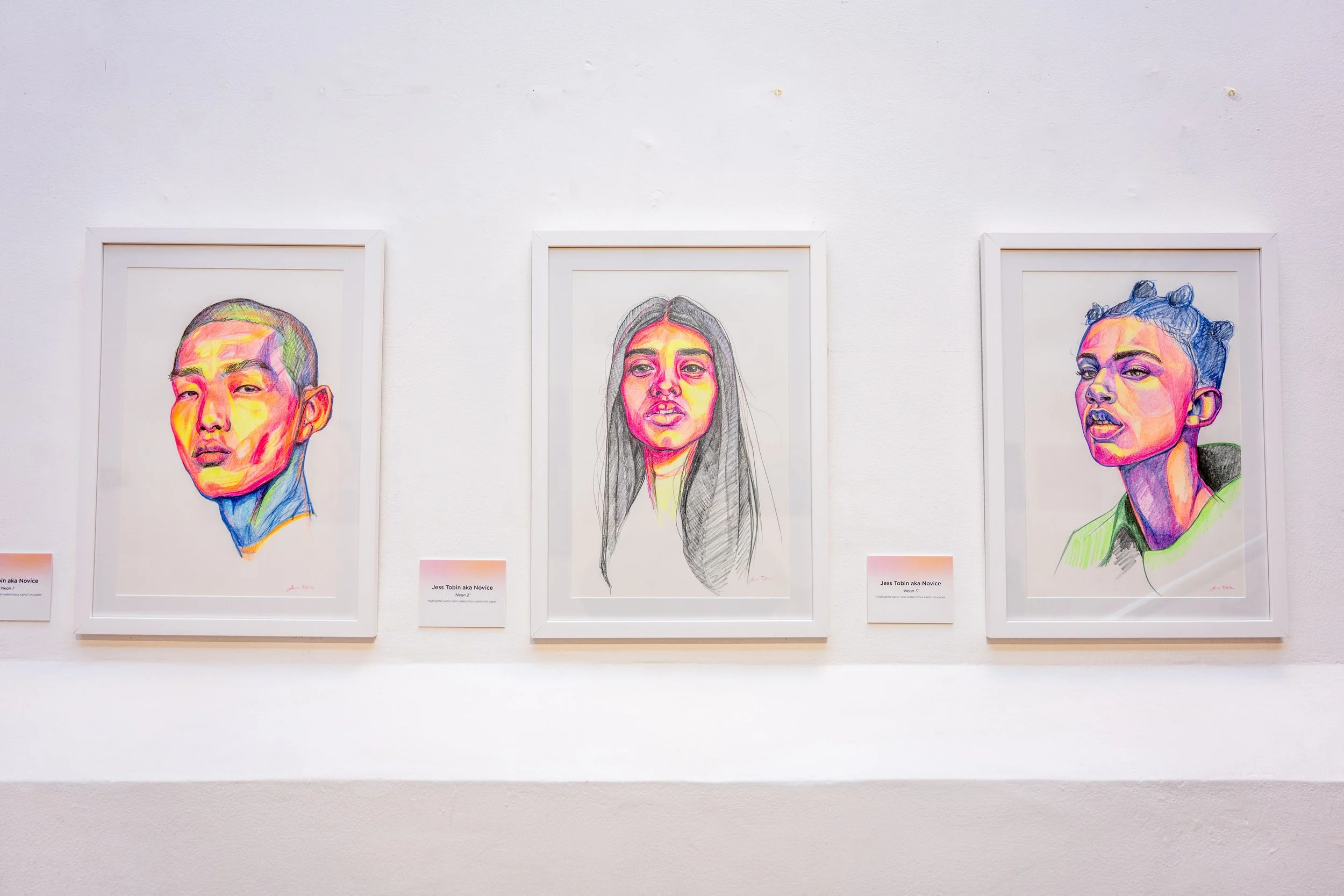
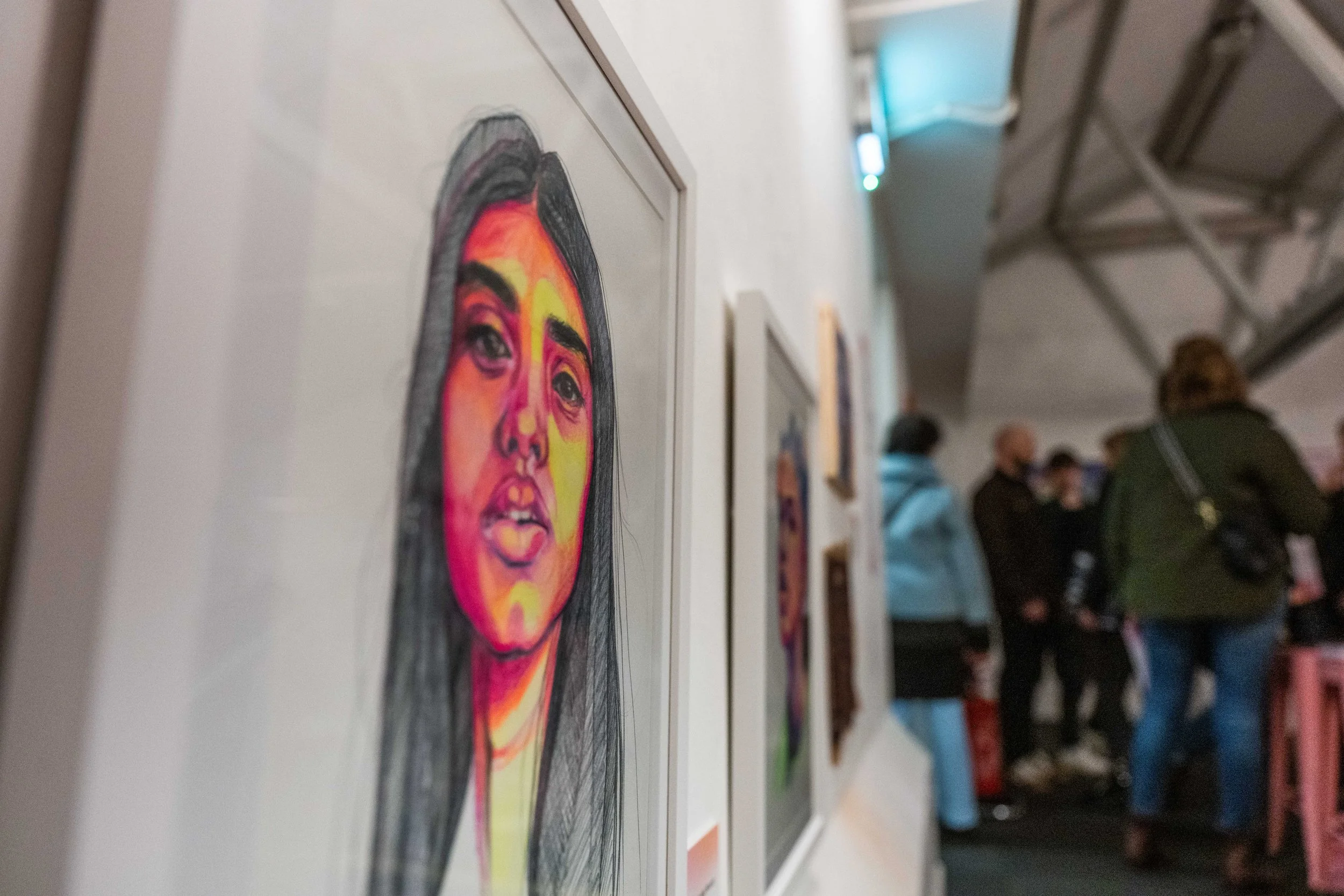
And Jess Tobin, aka Novice, showed a series of neon portrait studies that really stood out against the white gallery walls. The drawings combined careful observational portraiture with flashes of fluorescent pink, yellow, orange, blue and violet, using colour to describe the planes of the face rather than following natural skin tones. I loved that you could still see the drawing underneath, graphite lines and quieter passages sitting beside sudden bursts of electric colour.
What struck me seeing everything together was that Street to Studio wasn’t really about thirteen muralists making smaller versions of their murals.
Everyone answered the idea differently.
Pattern became stitch and beadwork. Lettering became glass and light. Illustration became laser-cut relief. Mosaics condensed larger public work into intimate panels. Monumental mural painting became tiny landscape studies. Clean graphic forms loosened into painterly interiors. Folklore moved into sculpture.
And in my own case, street and studio materials met again on two very large canvases.
That diversity felt very Minaw.
The collective has never needed everyone to make the same kind of work. What connects us is something broader: the shared experience of making work publicly, the friendships that have grown around that and the different individual practices we return to when we go back into our own studios. Minaw has been evolving since 2013, with members joining, stepping into other projects and sometimes returning, while that sense of connection remains.
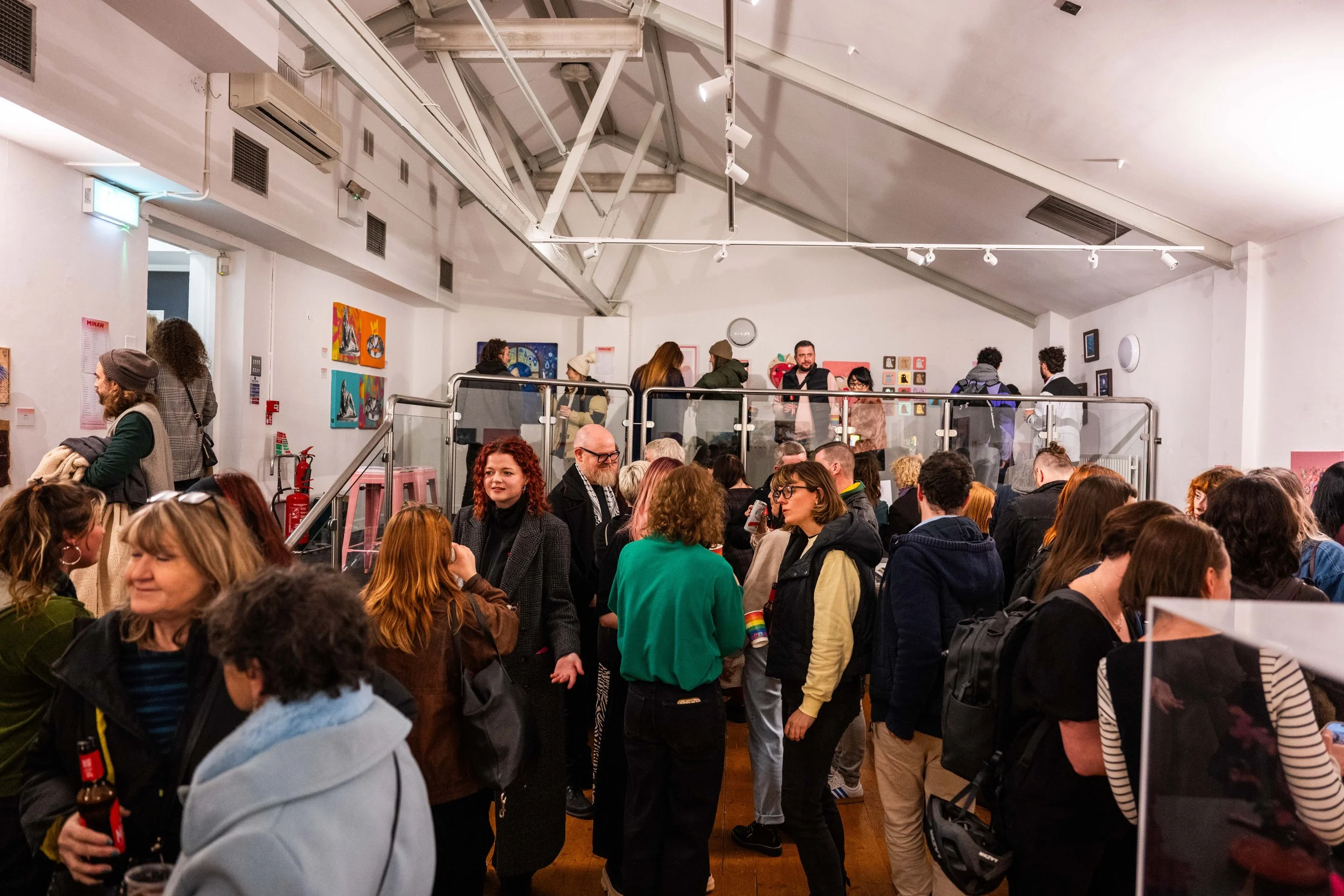
Opening night
Opening day had all the slightly chaotic little jobs that happen behind the scenes of an exhibition.
I made a run to Dunnes Stores for cheese and nibbles for the evening, while Zurdie, Claire and Chloe had been working on drinks sponsorship. Madri, Kopparberg, White Claw and Absolut were among the brands supporting the opening, with Absolut setting up a little bar in the foyer.
Before we opened the doors, a few of us went for dinner together across the street from Flux.
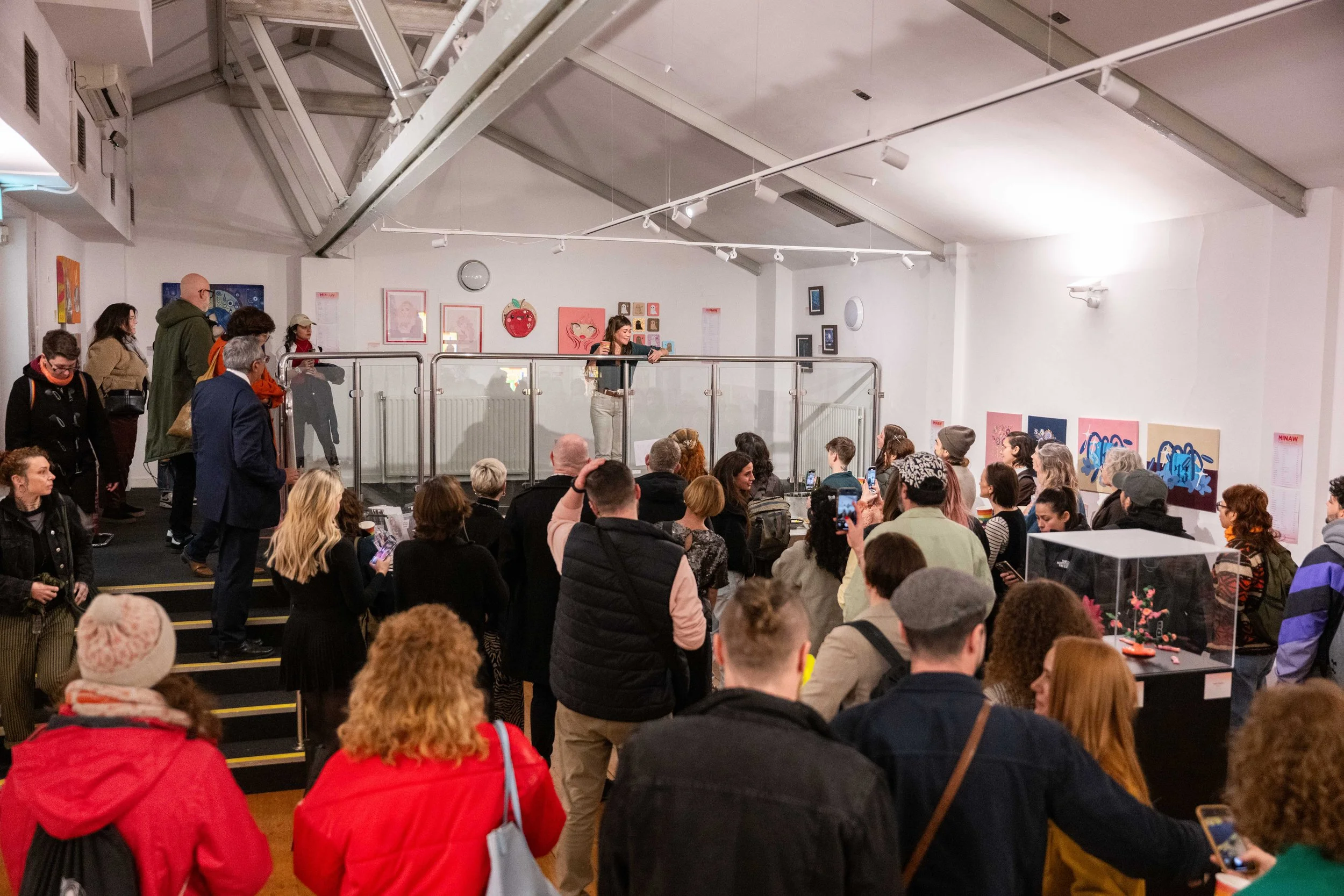
And then suddenly the quiet gallery we had been working in was full.
Ruth Medjber of Ruthless Imagery photographed the night, taking portraits of us beside our work as well as documenting the exhibition as the gallery filled around us.
It was wonderful to see so many people moving through the space and spending time with all of these very different practices.
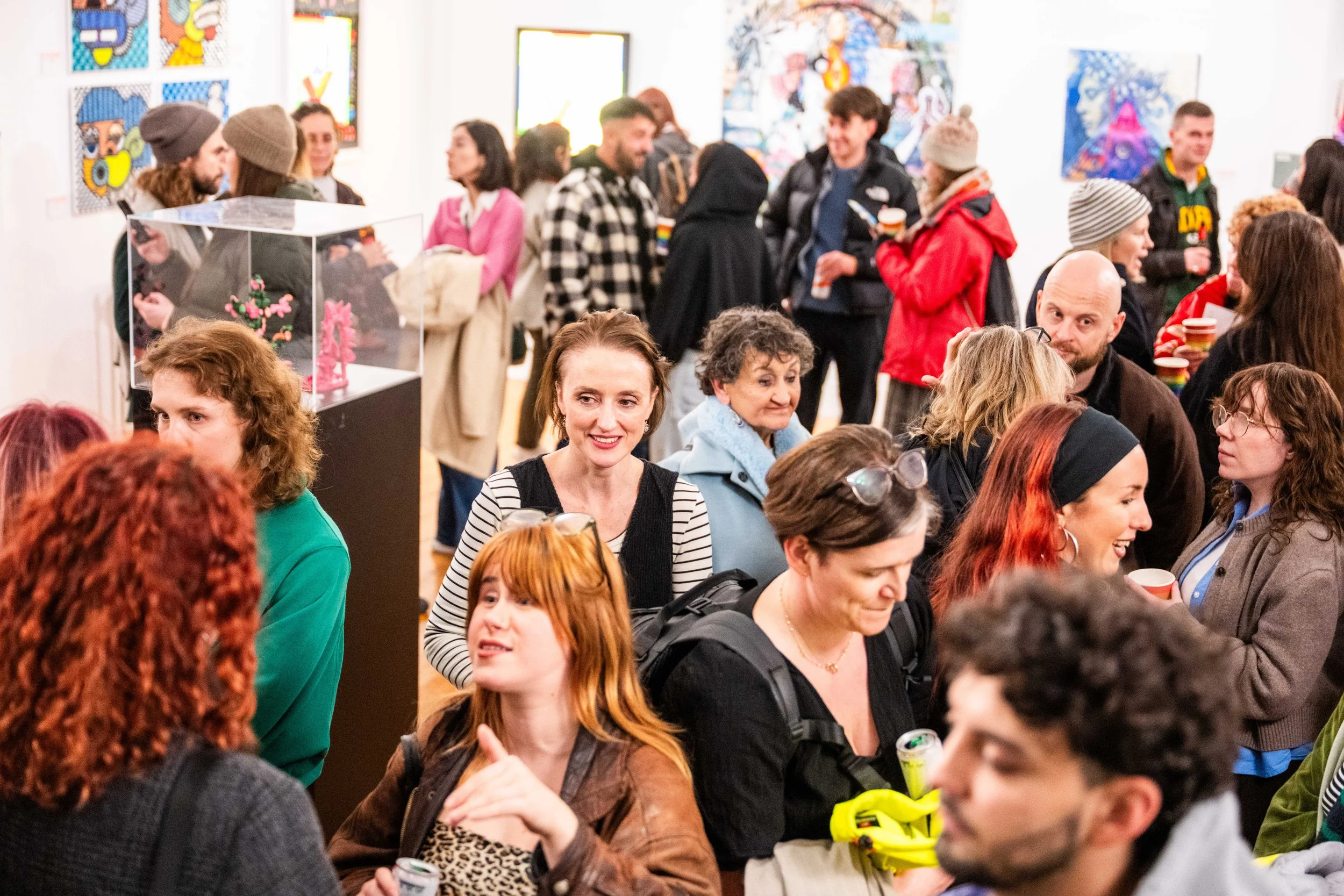
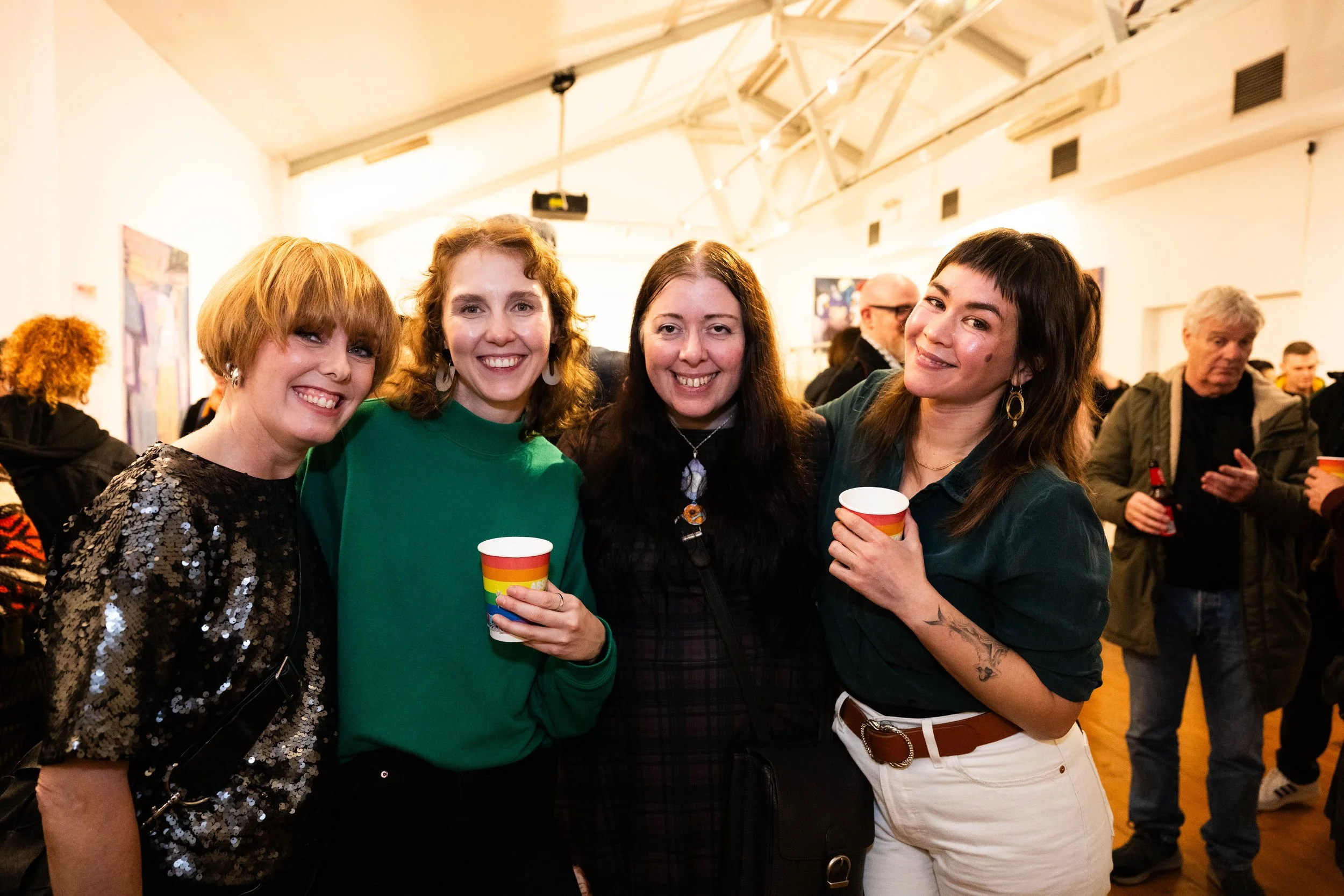
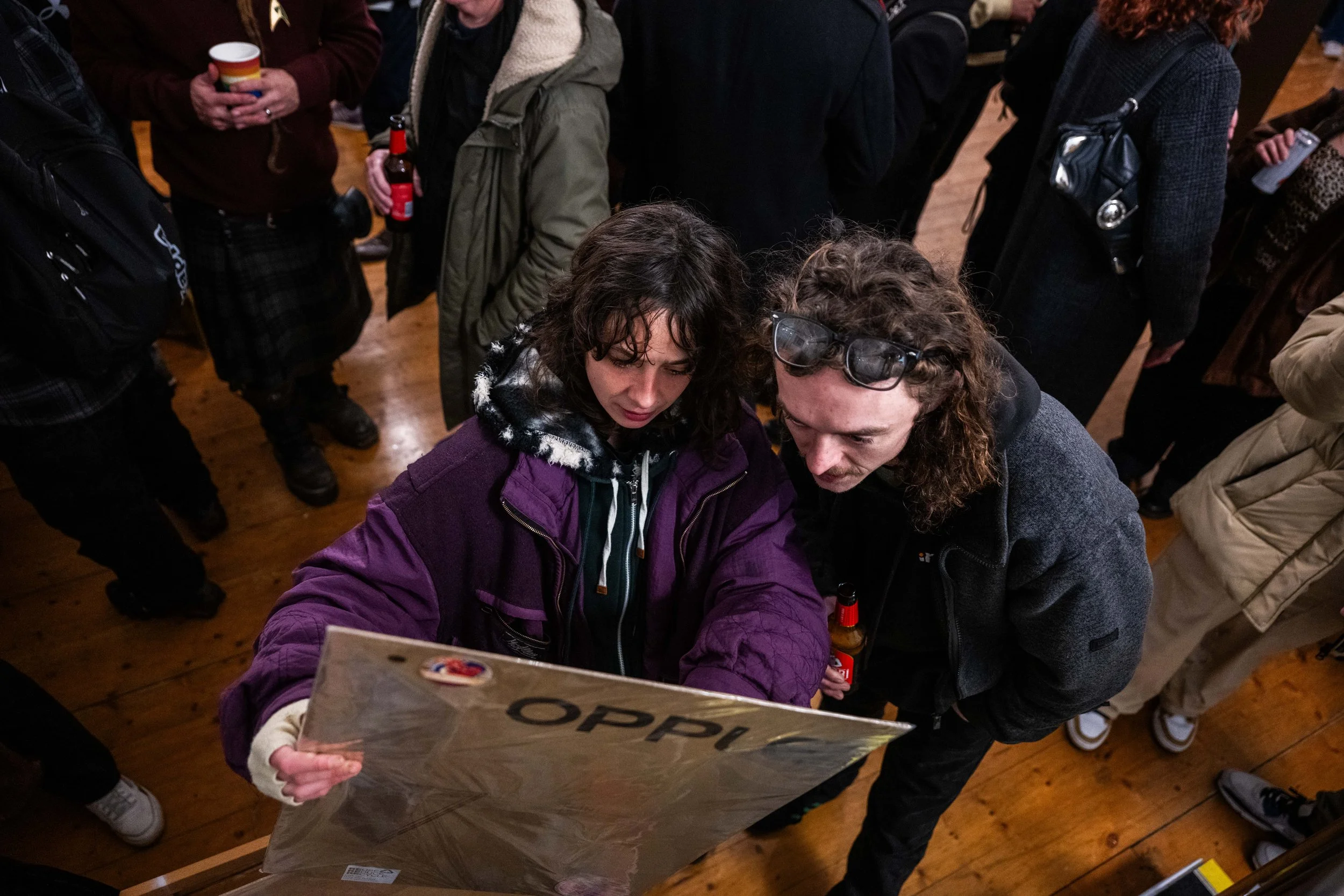
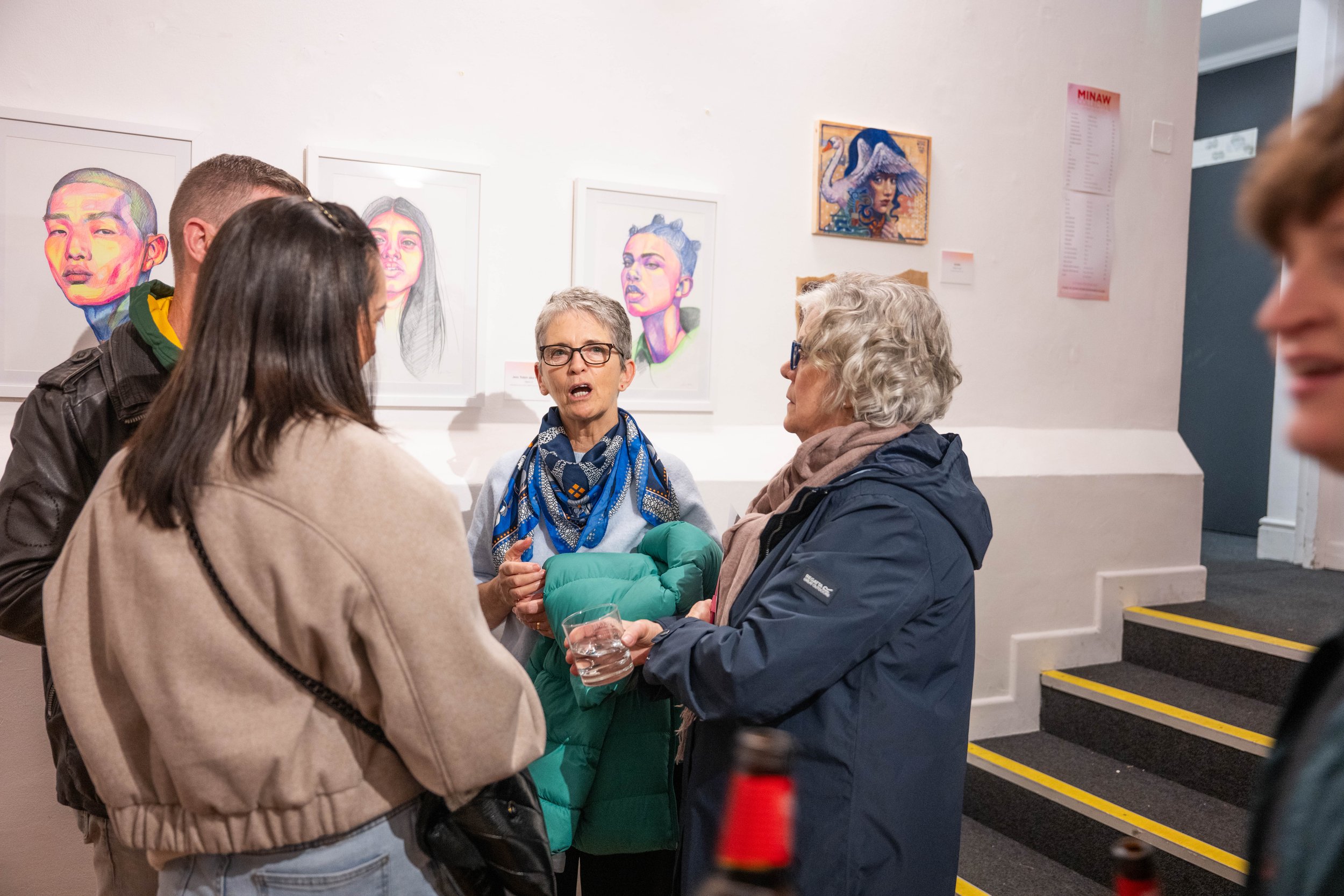
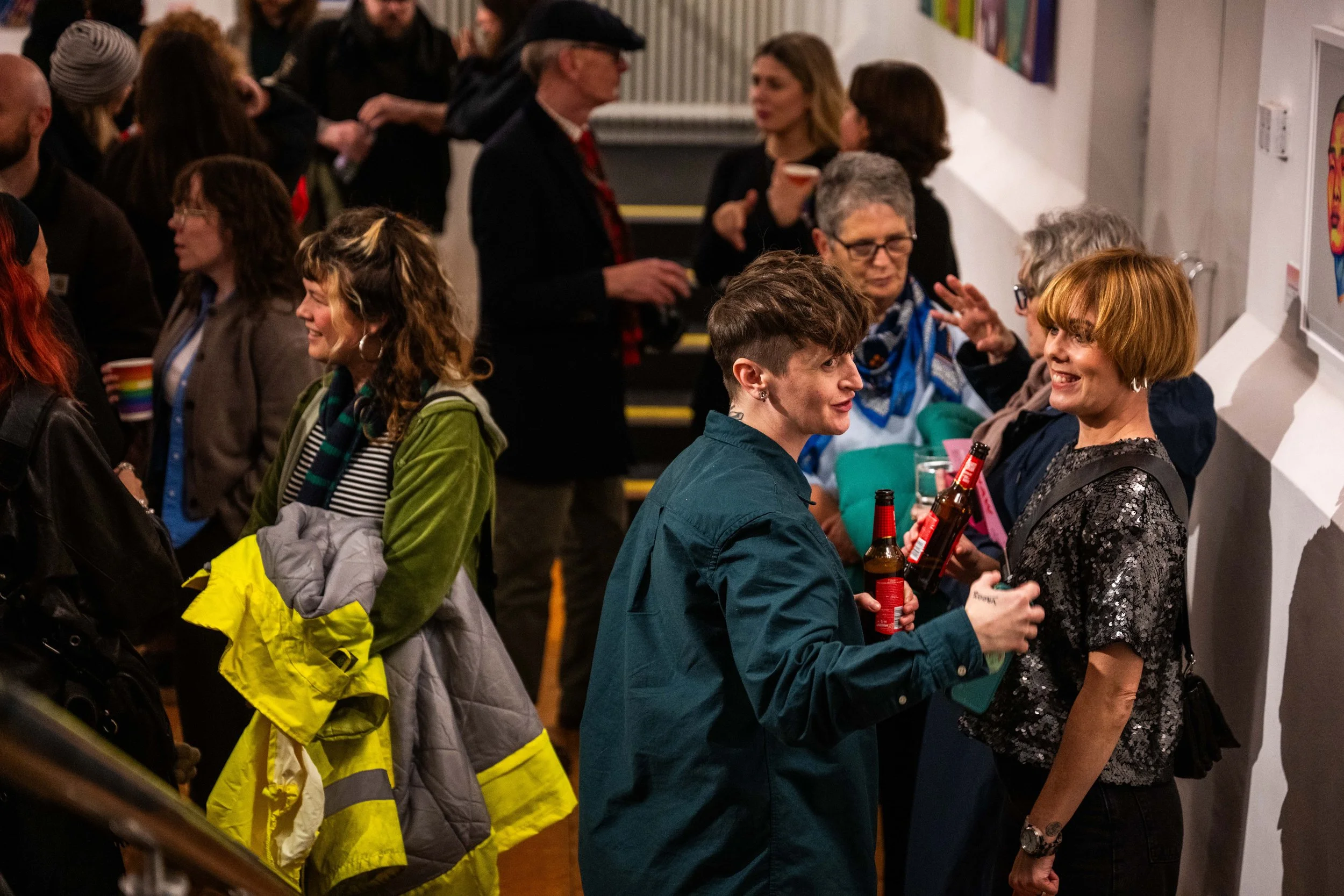
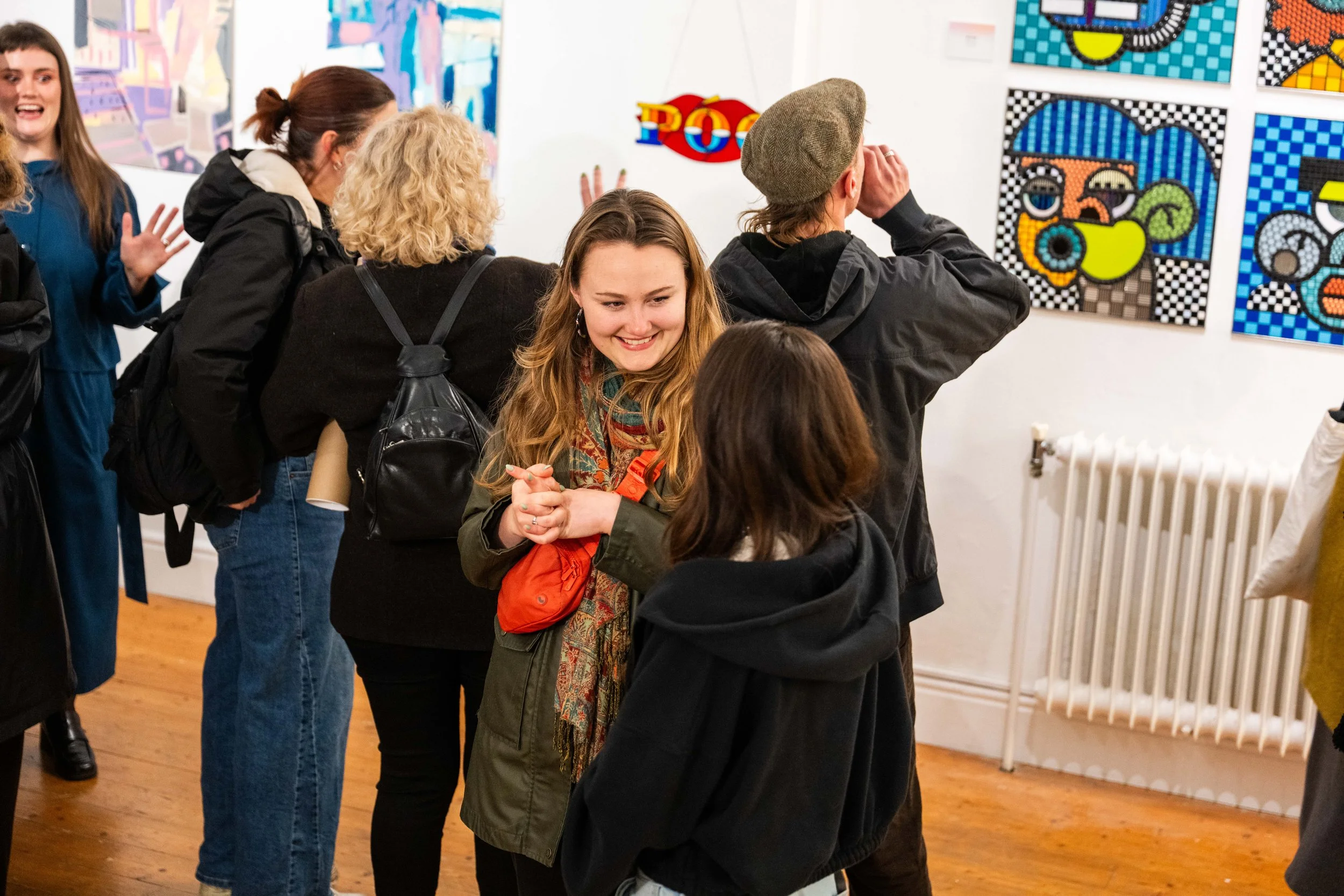
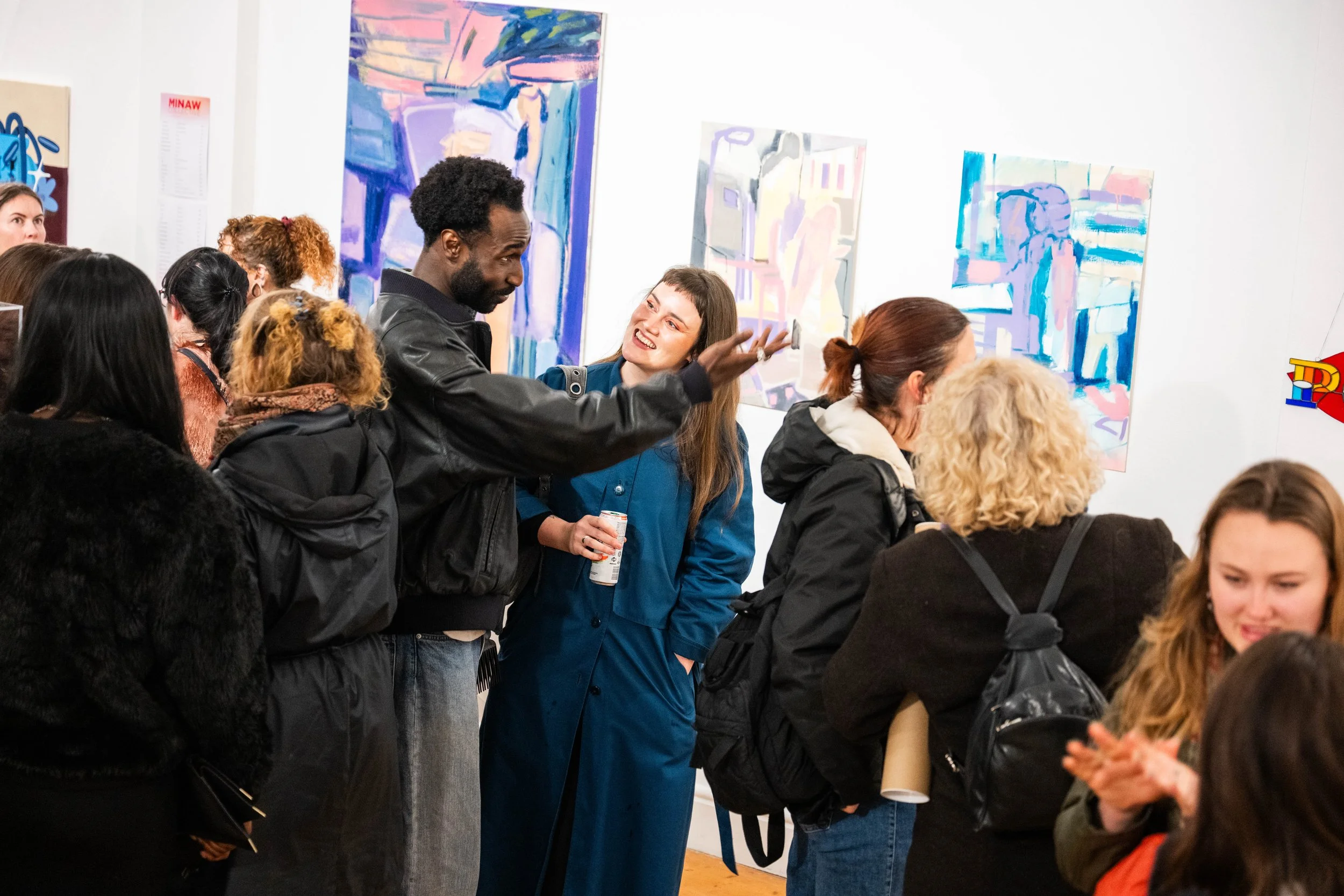
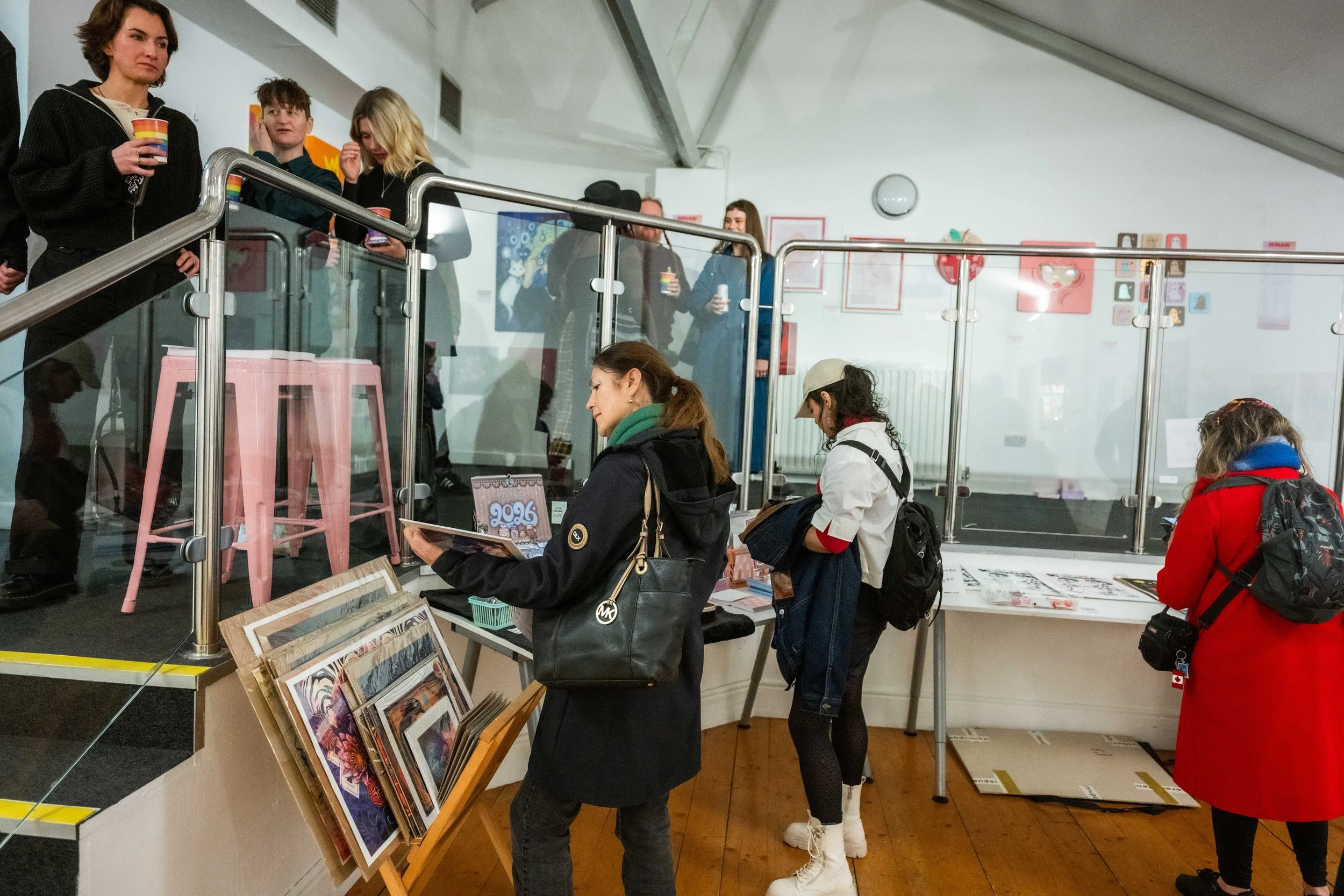
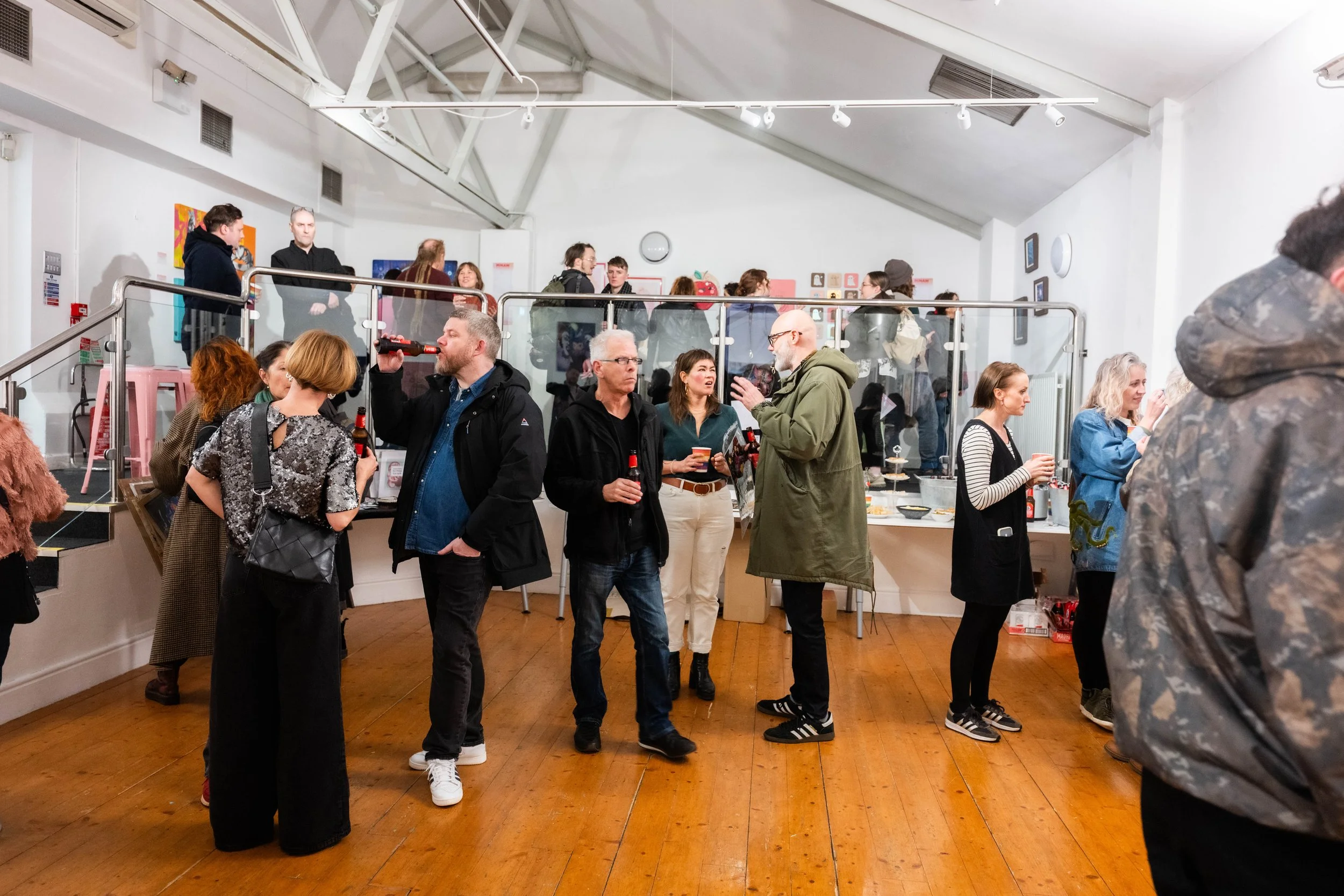
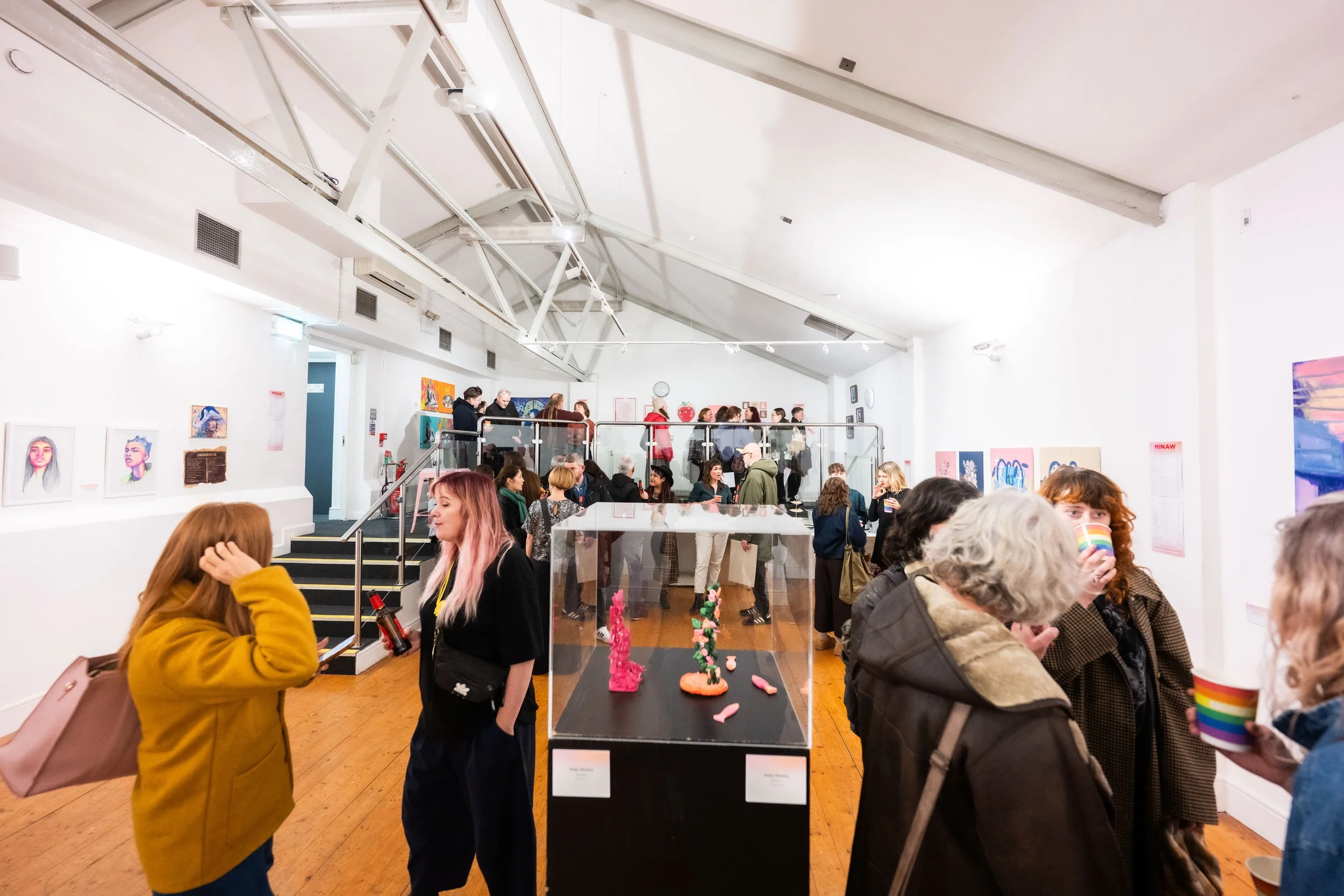
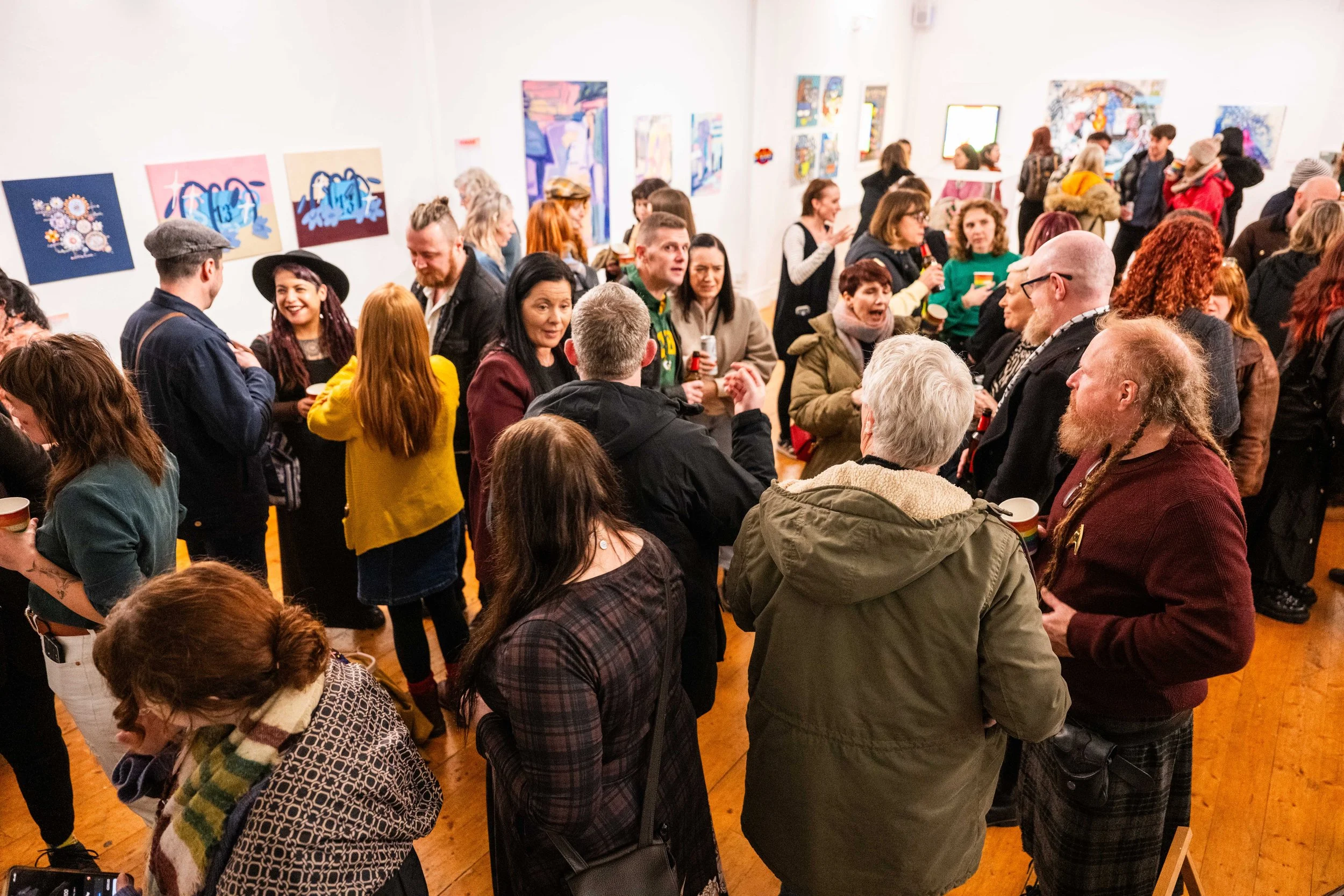
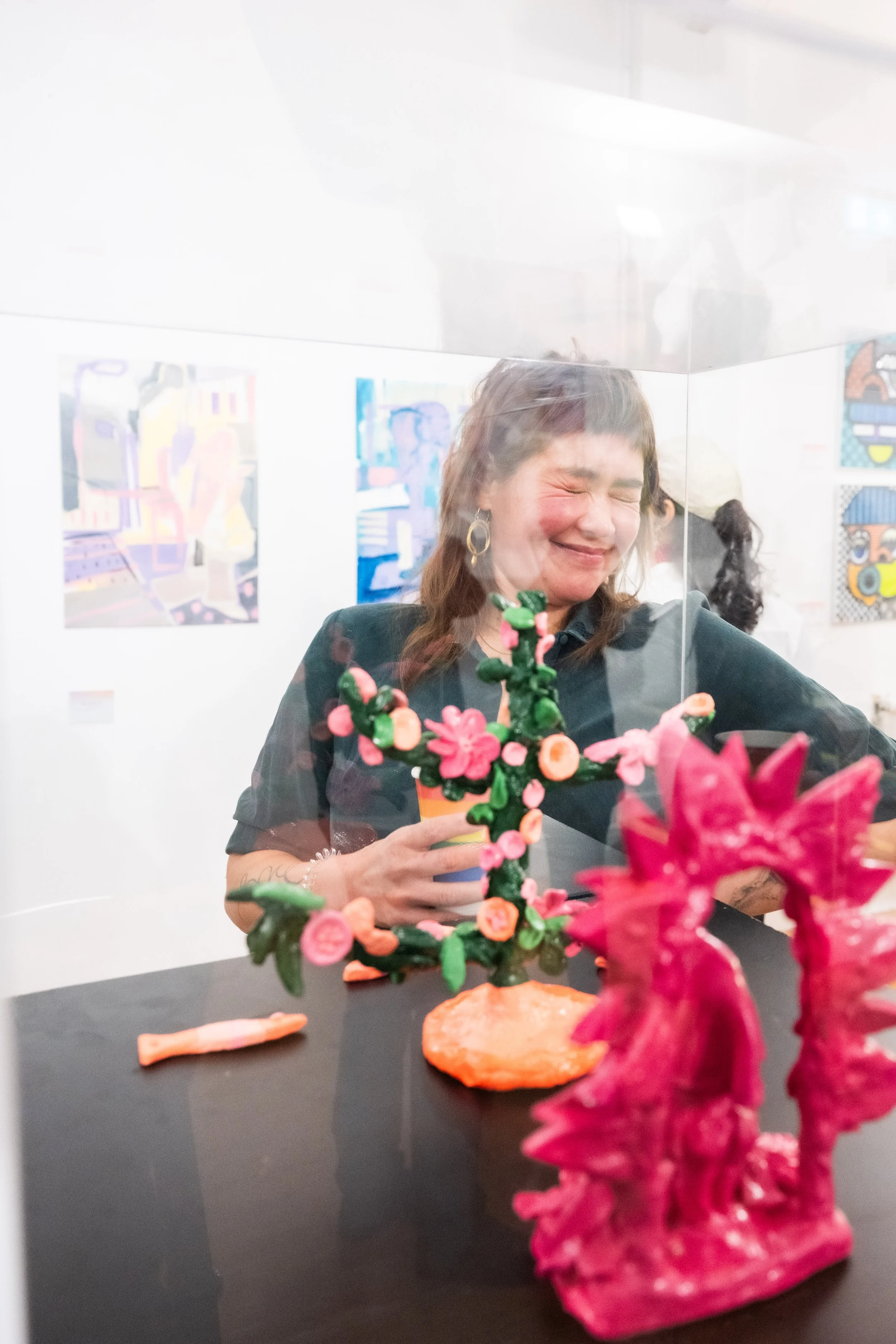
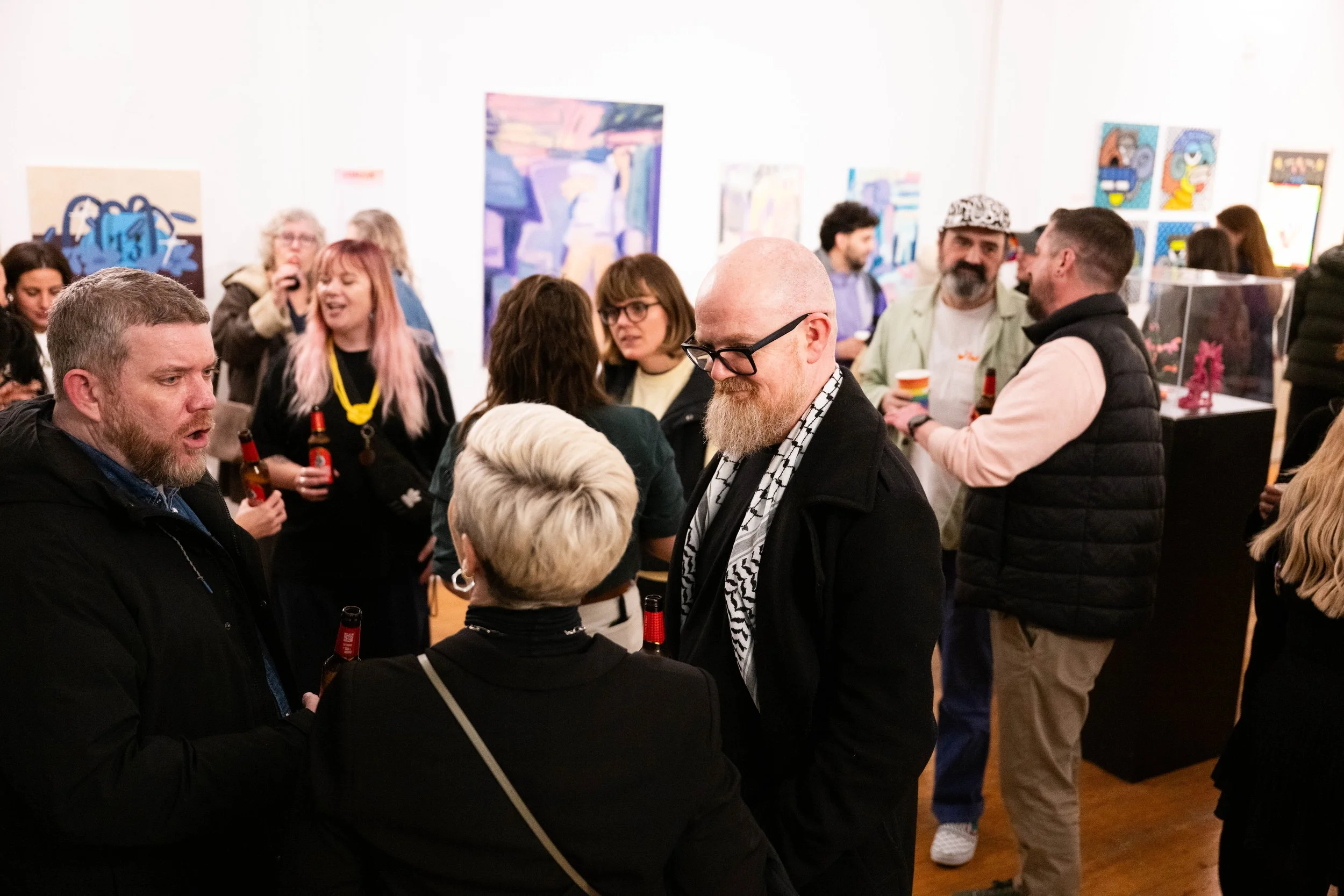
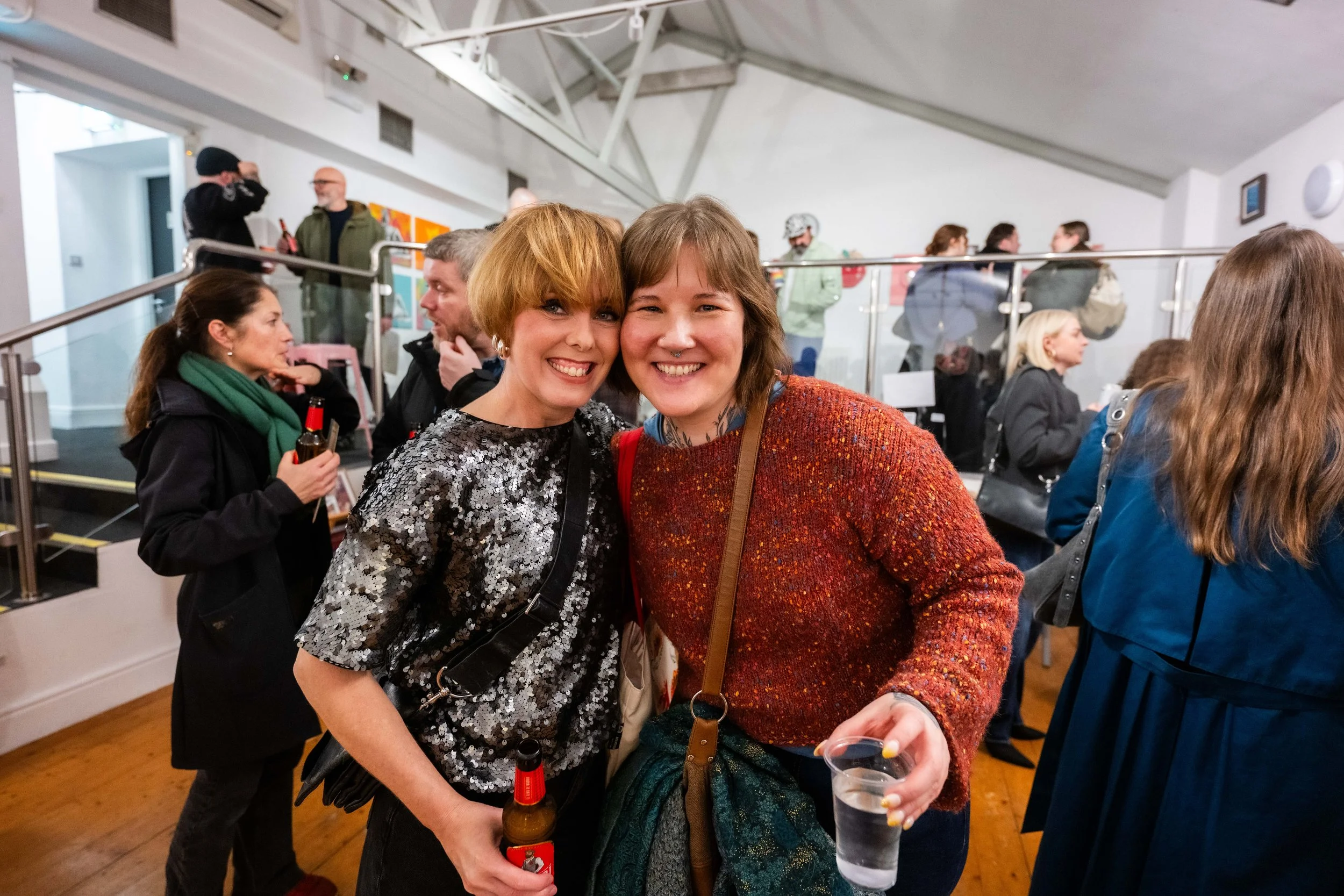
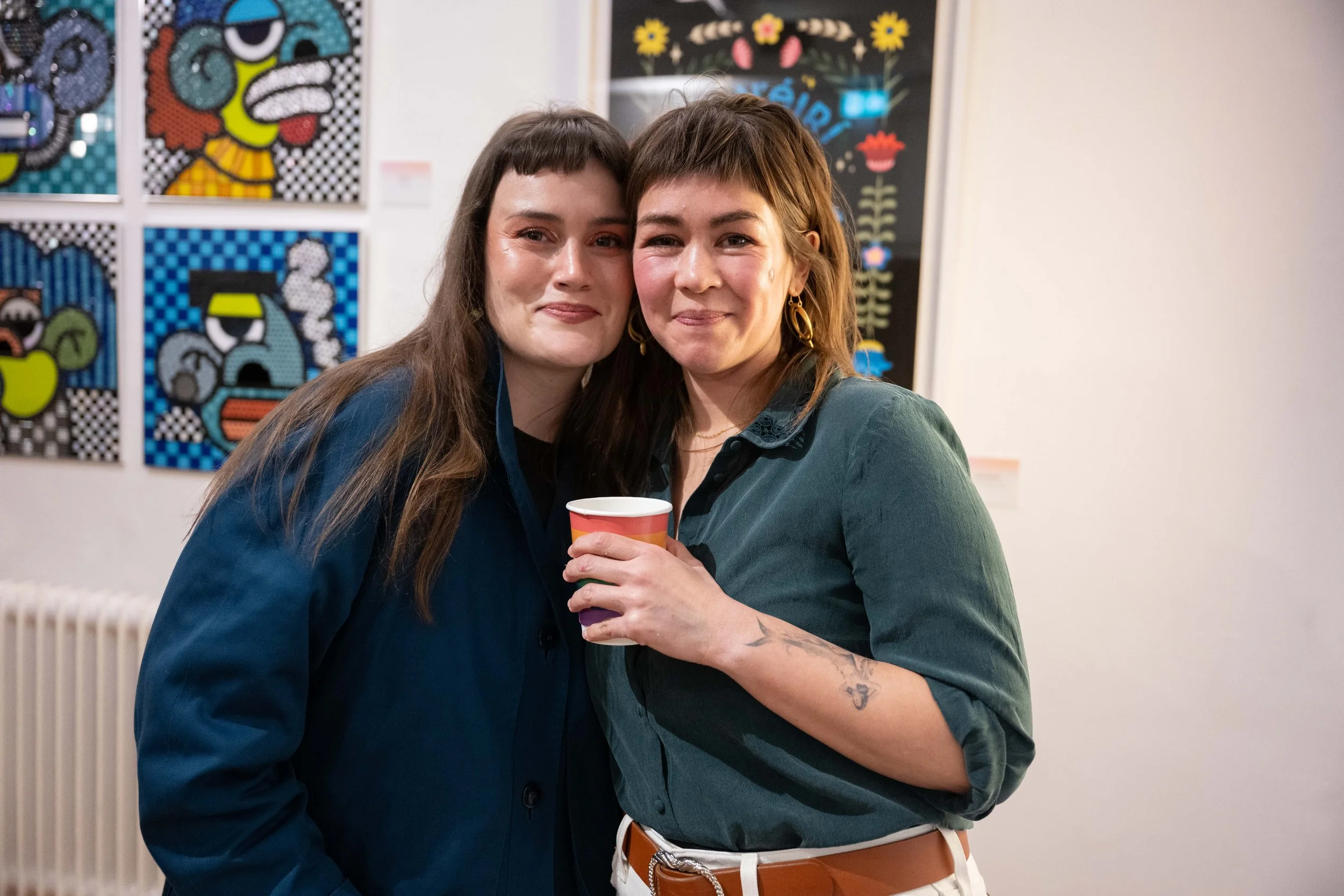
Seeing Nazar and Night Circus hanging there after spending so much time alone with them in the studio felt particularly special.
After the opening finished, a group of us headed out to a bar to keep the celebration going a little longer.
Because we were staying in Dublin that night, there was no long journey back to Leitrim waiting for us. It was lovely simply to stay, spend time together and enjoy the exhibition we had all worked to make happen.
But more than anything, Street to Studio reminded me how much I had missed making large paintings.
Illustration, products, murals and painting all occupy different parts of my practice, but they continually feed into one another. In Nazar and Night Circus, spray paint met acrylic, mural techniques came back into the studio and the bold illustrative language that runs through so much of my work was allowed to expand across a large canvas again.
It felt good to slow down.
And very good to paint.